
Emface is a non-invasive facial treatment that uses electrodes to stimulate facial muscles and is FDA-cleared for the temporary reduction of facial wrinkles. For readers weighing Emface reviews in Anaheim, patient experiences are only one part of the picture: treatment expectations, downtime and provider ratings matter too.
It makes sense to look for real-world feedback before choosing a treatment. Reviews can offer useful context, especially when they name the treatment, describe the area addressed, and explain when the reviewer assessed the change.
This article explains how Emface works, what patients report about results and downtime, and how it differs from injectables. It also looks at Anaheim provider ratings and Google review counts, helping you interpret the feedback with a clear, evidence-minded perspective.
Key Takeaways
- Emface combines radiofrequency with muscle stimulation; understanding both helps set realistic expectations for what the treatment targets.
- Patient experiences vary, and changes may develop over the weeks and months after a treatment course rather than appearing all at once.
- Compare Emface with Botox and filler by the concern each approach addresses and the kind of treatment experience you prefer.
- Downtime is generally minimal, but knowing the potential side effects and aftercare considerations can help you plan.
- When reviewing Anaheim providers, consider both Google ratings and review counts, then read the comments for details about the patient experience.
Patient experiences and expected results
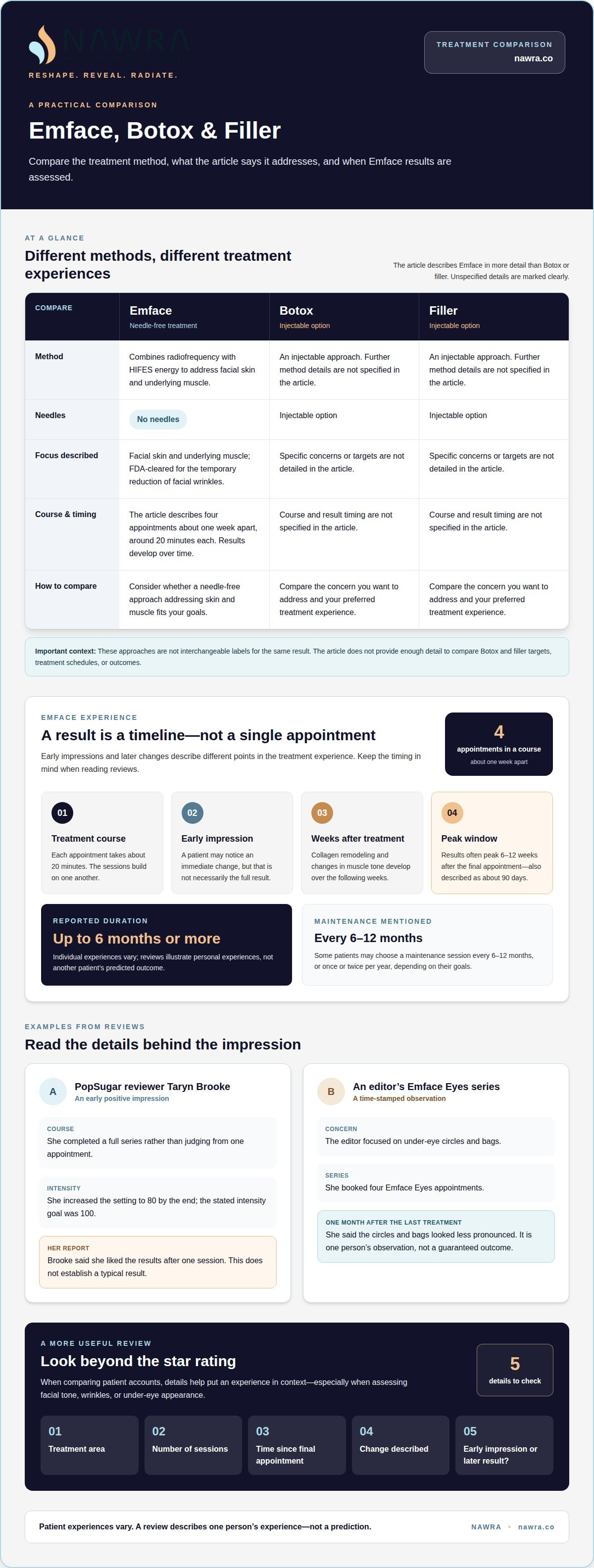
Emface patients report changes such as improved facial tone and less pronounced wrinkles, but individual experiences vary. Results develop over the weeks and months after treatment, and can last up to six months or more. Reviews from Anaheim can illustrate personal experiences, not predict another patient’s outcome.
A typical course involves four appointments spaced about one week apart, with each treatment taking about 20 minutes. The sessions build on one another: facial muscles receive stimulation while radiofrequency energy heats tissue. The treatment uses no needles, so it differs from injectable approaches in both technique and sensation. Patients may notice an immediate change, but that early impression isn’t the full result.
Longer-term changes take time. Collagen remodeling and changes in muscle tone develop over the weeks following treatment. Results often peak 6 to 12 weeks after the final appointment, with the peak also described as about 90 days after the last session. That timing matters when reading reviews: someone writing shortly after the final visit may be reporting an early response, not the eventual outcome.
Example: PopSugar reviewer Taryn Brooke
Situation: Taryn Brooke wanted to assess the treatment through a full series, rather than judge it from a single appointment. Action: She completed a course and increased the intensity setting to 80 by the end; the stated intensity goal was 100. Result: Brooke said she liked the results after one session. Her experience offers a useful example of an early positive impression, but it doesn’t establish a typical result for Anaheim patients.
Example: An editor’s Emface Eyes series
Situation: An editor focused on under-eye circles and bags. Action: She booked four Emface Eyes appointments as a treatment series. Result: One month after her last treatment, she said the circles and bags looked less pronounced. This is a specific, time-stamped observation, not proof that every patient will see the same change.
Maintenance is part of the longer-term picture. Patients may choose a session every 6 to 12 months; maintenance may also be needed once or twice per year, depending on the patient and their goals. When assessing reviews, note the treatment area, number of sessions, time since the final appointment, and the change described. Those details make accounts more useful than a star rating alone, especially when comparing facial tone, wrinkles, and under-eye appearance.
How Emface combines radiofrequency and muscle stimulation
Emface combines radiofrequency with HIFES energy in a needle-free treatment. The paired technologies address facial skin and underlying muscle, which distinguishes Emface from approaches focused on only one aspect of facial appearance. Consider whether this method aligns with your specific goal.
When comparing facial treatments, look for a clear description of the device and how it is used, rather than relying on a broad technology label. Ask which areas the treatment addresses and how the plan relates to your concern. Those details are more useful for evaluating fit than a list of technical terms.
Radiofrequency and HIFES energy are used together in Emface to address facial skin and underlying muscle. The treatment is needle-free. When reading about results, note whether a reviewer describes an immediate impression or a change noticed later, since these are different points in the treatment experience.
Electrical and electromagnetic stimulation are not interchangeable terms
Descriptions of facial treatments may use terms such as electrical muscle stimulation or electromagnetic stimulation. Don’t treat those phrases as interchangeable without checking the specific device and method. For Emface, the key detail is that it combines radiofrequency with HIFES energy for facial skin and underlying muscle.
HIFES is another term readers may encounter when comparing descriptions of facial stimulation. The label alone doesn’t explain which facial areas are targeted or how a treatment combines stimulation with radiofrequency. In Emface’s case, applicators and electrode placement help explain how the treatment addresses facial areas. Those details are more informative than a technology acronym by itself.
For example, a person focused on forehead lines and cheek definition may want to understand how those areas are treated together. The forehead electrode and cheek electrodes provide a concrete picture of the stimulation layout; the applicators provide the targeting framework. This doesn’t mean every concern receives the same emphasis. Placement and treatment planning shape how the facial areas are addressed.
That distinction also helps frame the beauty-treatment comparison. Emface does not use needles, and its approach combines energy with muscle stimulation rather than relying on an injectable. It is also not surgery. Those differences describe the method, not a guarantee that one option produces a better result for every concern. For a broader look at facial treatment approaches, explore facial treatment options and consider which mechanism aligns with your goals.
Comparison with Botox and filler
Botox, filler, and Emface are distinct treatment approaches, not interchangeable labels for the same result. Emface combines radiofrequency and HIFES energy for facial skin and underlying muscle, without needles. Botox and filler are injectable options. Start by identifying the concern you want to address, then compare the method and the outcome you want to evaluate.
For forehead lines, clarify what matters most: wrinkle appearance, a needle-free approach, or another treatment preference. Emface uses radiofrequency and HIFES energy, while Botox and filler are injectable options. That distinction explains how the approaches differ, not which will produce a better result for you. A review is more useful when it names the treatment and says when the reviewer assessed the outcome.
Facial volume is a separate consideration from wrinkle appearance. Filler is commonly discussed in relation to volume, while Emface combines radiofrequency and HIFES energy for facial skin and underlying muscle. Don’t take a review about cheek appearance as proof that every treatment addresses the same concern. Note the area, the reviewer’s goal, and the change they describe.
Consider two illustrative decision scenarios. Situation: A person is focused on forehead wrinkles and wants a non-invasive option. Action: They compare Emface’s combined radiofrequency and HIFES approach with injectable choices. Result: They can assess each option against their preferred method and treatment goal without assuming identical outcomes.
Situation: Another person is focused on facial volume rather than forehead lines. Action: They distinguish that goal from Emface’s approach to facial skin and underlying muscle. Result: The comparison becomes more precise because it does not treat every facial concern as equivalent.
Review language can blur important distinctions. “Natural,” “lifted,” and “refreshed” describe impressions, not treatment mechanisms. For a useful comparison, look for the named treatment, target concern, and timing of the review. An immediate impression and a later assessment are different points in the experience. Keep the goal consistent, too: comments about facial volume may not help you assess a treatment for forehead lines.
Emface reviews in Anaheim are most useful when readers separate treatment type from treatment target. Botox, filler, and Emface differ in method; the right comparison depends on whether the priority is wrinkle appearance, facial volume, or muscle tone, and on whether an injectable or non-invasive approach fits that priority.
Downtime and safety considerations
Emface combines radiofrequency with HIFES energy in a non-invasive, needle-free treatment. At NAWRA, Emface is part of a measurement-first approach: every protocol starts with a clinical scan before treatment, followed by a rescan to measure changes. Results vary and are not guaranteed.
Some patients describe an immediate lifted appearance, while collagen remodeling and changes in wrinkles develop over the following weeks. These are different stages, not the same outcome. A person planning an appointment around an event should distinguish a short-term impression from later changes. The treatment’s effects build over time, so a same-day appearance doesn’t represent the full course.
Safety considerations include the area being treated and the patient’s circumstances. Emface should not be applied over hair or scar tissue, or when a patient has electronic or metal implants. These restrictions matter when applicator placement is planned. A treatment area that includes scar tissue, for example, changes where the applicator can be placed.
- Skin response: Potential side effects include temporary skin damage, such as crusting, blistering, or burns.
- Aftercare: Wait at least 24 hours after a session before intense facial massage or heavy slugging.
- Activity: Normal activity can resume right away, but intense facial massage has a separate 24-hour wait.
That distinction helps with practical planning. Someone returning to work after an appointment may resume normal activities, while postponing intense facial massage until the next day. A patient with an electronic implant or scar tissue in the planned area faces a different consideration: treatment should not be applied in those circumstances. Safety depends on the treatment area and relevant patient factors, not simply on downtime.
Example: A patient schedules treatment before a social event and expects a visibly lifted result that day. The useful step is to plan around minimal downtime, while remembering that collagen-related changes unfold later. If the patient also uses intense facial massage, they leave at least 24 hours between the session and that activity. This separates immediate scheduling from later result expectations.
Reviews can help clarify what patients experienced, but details matter. Look for comments describing the applicator area, the timing of any skin reaction, and whether the reviewer mentions crusting, blistering, or burns. A rating alone won’t show whether the account concerns temporary downtime, a safety issue, or a later change in wrinkles. Specific descriptions provide a more useful account of treatment experience.
Anaheim Emface provider ratings and Google review counts
Google ratings and review counts offer different signals for assessing an Anaheim provider. A rating summarizes reviewers’ scores, while the count shows how many people contributed. Neither measures treatment quality on its own. Read both alongside Emface-specific comments about the appointment, sensation, communication, and follow-up.
Don’t infer an Anaheim rating or review count from general Emface feedback. Google profiles change as people post reviews, so use the current profile when comparing providers. Confirm that each profile identifies the location you are considering, then consider its rating and total review count together.
Review detail adds the next layer. Look for accounts that name Emface rather than describing beauty treatments generally. A helpful comment might explain whether the cheeks or forehead were treated, how the sensation felt, and whether appointments were spaced across a series. Claims about collagen or elastin are less useful without a clear treatment timeline and a specific result described.
Example: A reader finds one Anaheim profile with a high rating and another with detailed Emface comments. Action: They compare the current Google rating and count, then read comments for treatment-specific details. Result: They can distinguish broad customer feedback from accounts about the treatment itself, without treating either profile as proof of a particular outcome.
To verify credentials and device availability, match the treating professional’s name and stated title against an official licensing-board lookup. Then use the clinic’s own service information to confirm it identifies Emface and the device, since a Google rating alone can’t establish either detail.
Consultations, payment arrangements, and promotions are clinic-specific. A Google rating or review count does not establish that any of these options is available, and promotional mentions in reviews may not reflect current terms. Treat them separately from patient feedback and provider ratings.
- Compare profiles: Keep the Anaheim location, visible rating, and review count together.
- Read treatment-specific comments: Note the area treated, sensation, series, and follow-up described.
- Assess recency and detail: Give more context to a review that explains its experience than a score alone.
- Separate claims: Ratings reflect reviewer feedback, not verified credentials, device availability, or a promised result.
Use this method to interpret Emface reviews in Anaheim: note the current Google rating and count, then assess detailed treatment accounts separately. Combine profile-level feedback with specific comments, while considering credentials, device information, and clinic policies as separate questions.
NAWRA: Em face
NAWRA offers Emface for readers considering a non-invasive approach to facial treatment. If your broader goals include body composition, recovery, or muscle stimulation, its other offerings may also be relevant: DEXA Body Composition, ExoPod Full-Body Therapy, BOA Lymphatic Drainage, and EMSCULPT NEO.
Choose your next step based on the outcome you want to assess. DEXA Body Composition measures body composition, while EMSCULPT NEO focuses on body contouring and muscle stimulation. ExoPod Full-Body Therapy and BOA Lymphatic Drainage support different wellness goals. A focused discussion can help connect your priorities with the relevant service.
For guidance on which option aligns with your goals, contact NAWRA.
Choose your next step with clarity
Use Emface reviews in Anaheim as context, not as a substitute for defining what you want to address. Before deciding, identify your priority: a specific facial concern, a preferred treatment approach, or a clear idea of what outcome you want to assess. That focus makes a conversation more useful and keeps your decision anchored to your goals.
It also helps to be direct about what matters most to you, including the outcome you’re seeking and the questions you still have. A thoughtful discussion can connect those priorities to a suitable treatment plan without treating online ratings as a personal forecast. The next step is simple: contact NAWRA to discuss Emface and consider how the treatment fits your goals.
Move forward with a clear objective and the information you need to make an informed choice. Your decision should reflect your priorities, not pressure to follow another person’s path.
Frequently Asked Questions
What is Emface?
Emface is a non-invasive facial aesthetic treatment that combines radiofrequency with muscle stimulation, without needles. It is intended to address facial wrinkles temporarily, not to diagnose or treat a medical condition. For a practical example, someone considering it for forehead lines can weigh its needle-free method against their preferred treatment approach. These services have not been evaluated by the FDA and are not intended to diagnose, treat, cure, or prevent any disease.
How much does Emface cost in Orange County?
The price depends on the case and is given after a quote request. Cost factors include the treatment area, the proposed plan, the number of sessions, and whether the quote covers a single appointment or a series. For example, a plan focused on one facial area may differ from a multi-area course. No industry price range is a substitute for a provider’s quote for the specific plan.
The bottom line: Is Emface worth it?
Emface may be worth considering if your priority is a needle-free facial treatment and you’re comfortable with changes that develop over time. It’s a less suitable match if your main goal is added facial volume, since the treatment is not a filler. Define the concern you want to address first, then decide whether its method, treatment course, and expected type of change match that goal.
What is EMFACE and why is it the gold standard for needle-free lifting?
Emface is a needle-free treatment, but “gold standard” is a promotional label, not an established ranking of facial treatments. Its approach combines radiofrequency and HIFES energy for facial skin and underlying muscle. That describes its method, not proof that it is superior to other options. Compare treatments by the concern addressed, the method used, and the type of outcome you want to evaluate.
What do patients say in reviews of EMFACE treatments in Anaheim, CA?
Emface reviews in Anaheim are most useful when comments describe the treatment area, appointment experience, and the change noticed. Read for specifics, such as whether a reviewer discusses forehead lines or cheek appearance, and when they assessed the result. A general five-star comment tells you less about Emface than a detailed account. Treat personal reviews as individual experiences, not forecasts for your own results.
Which Anaheim clinics offer EMFACE and what are their ratings?
NAWRA offers EMFACE in Los Alamitos and serves Anaheim, Cypress, Cerritos, Long Beach, Seal Beach, La Palma, Buena Park, Lakewood, Norwalk, Irvine, Laguna Niguel, Newport Beach, Huntington Beach, Bellflower, Tustin, Fullerton, and Yorba Linda. Google ratings and review counts change over time, so read current profile figures alongside EMFACE-specific comments.
How much does EMFACE cost in Anaheim, including package prices?
The price depends on the case and is given after a quote request. Package pricing can reflect the treatment area, planned session count, and what the course includes. Those details matter because a single appointment and a multi-session plan aren’t equivalent quotes. For an Anaheim-area treatment plan, focus on the scope of the proposed course and what the quoted amount covers, rather than comparing headline figures alone.
How many EMFACE sessions are recommended, and how long is each session?
A typical course consists of four sessions, scheduled about one week apart, and each appointment takes about 20 minutes. When organizing the series, note each appointment date and the areas treated. That record helps you compare experiences consistently and track how changes develop after treatment. If a review describes only one session, remember that it reflects an early experience rather than a completed course.