

Gross mass is vanity; regional tissue distribution dictates athletic velocity, force, and durability. Standard scale weight and generic BMI charts tell you nothing about functional muscle or metabolic readiness. Even consumer impedance monitors fluctuate wildly based on daily hydration shifts, obscuring dangerous left-to-right muscular imbalances that invite soft-tissue injuries. When performance hinges on micro-adaptations, rigorous body composition testing for athletes replaces blind guesswork with clinical clarity.
You already recognize that unmonitored cutting phases often sacrifice explosive lean tissue rather than pure adipose fat. In this guide, you’ll discover how elite competitors evaluate body composition modalities to optimize power-to-weight ratios, correct bilateral asymmetries, and safeguard structural durability across every training block. We compare the clinical accuracy, error margins, and physiological metrics of today’s leading assessment methods so you can establish a verified baseline and select the definitive gold-standard protocol for your sport.
Key Takeaways
- Master the diagnostic hierarchy of body composition testing for athletes, contrasting inaccurate two-compartment estimates against clinical three-compartment DEXA technology.
- Identify invisible bilateral limb asymmetries and visceral fat shifts to prevent soft-tissue strain, correct compensatory mechanics, and accelerate physical durability.
- Align regional lean mass targets with sport-specific power-to-weight demands to eliminate unmonitored muscle wasting during intensive cutting phases.
- Establish a structured, periodized scanning schedule synchronized with RMR metabolic testing to calibrate macronutrient targets with absolute precision.
Why Standard Body Composition Metrics Fail Elite Athletes
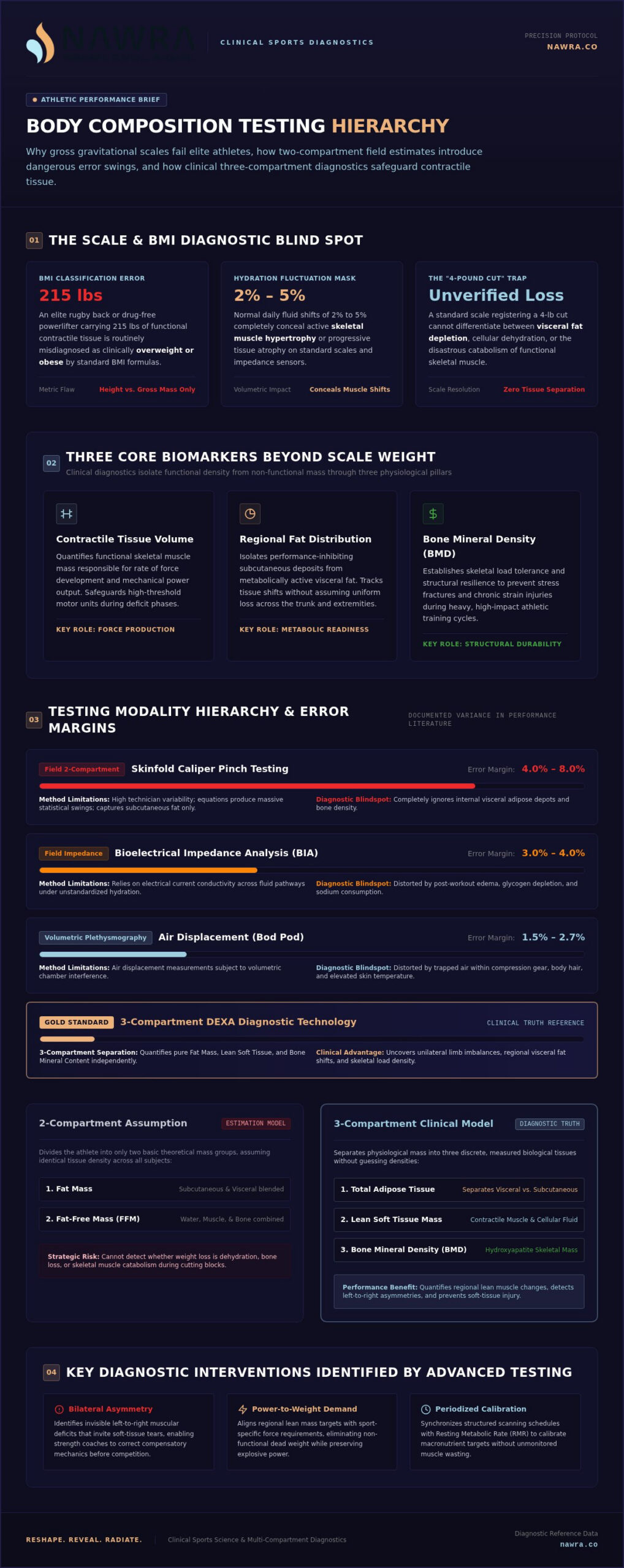
Athletic body composition isn’t a single gross number. It represents the physiological distribution of lean muscle mass, adipose tissue, and bone mineral content. Standard metrics reduce this complex framework to total weight divided by height squared. Under basic Body Mass Index (BMI) formulas, an elite rugby back or drug-free powerlifter carrying 215 pounds of functional contractile tissue is routinely misdiagnosed as clinically overweight or obese. The math simply breaks down when applied to trained physiques.
Total scale weight creates a dangerous blind spot. A standard scale registers a 4-pound loss during an intensive cutting phase, but it cannot differentiate between visceral fat depletion, cellular dehydration, or the catabolism of functional skeletal muscle. When assessing competitive readiness, sports scientists rely on multi-compartment body composition models to evaluate tissue quality independently of total mass. Effective body composition testing for athletes requires true three-compartment diagnostics, splitting the body into fat mass, lean soft tissue, and bone mineral density rather than relying on flawed two-compartment assumptions.
The Gravitational Scale Fallacy in Performance Sports
Relying on gravitational weight induces strategic failure. Daily fluid shifts of two to five percent completely conceal skeletal muscle hypertrophy or ongoing atrophy. When athletes slash calories to hit an arbitrary weigh-in target, unmonitored mass loss frequently strips high-threshold motor units while preserving stubborn adipose stores. Standard scales also offer zero data regarding bilateral balance, concealing unilateral structural deficits until an athlete tears a hamstring or blows an anterior cruciate ligament during full deceleration.
Tissue Quality Versus Gross Volume
Performance output demands maximizing high-density contractile structures while systematically minimizing non-functional mass. Contractile lean tissue directly dictates mechanical power output, whereas unmonitored mass expansion impairs acceleration. You cannot optimize this ratio without clinical precision. High-performance competitors study how to measure body fat accurately to eliminate equation-based guesswork and safeguard structural tissue.
Elite body composition testing for athletes separates structural density from dead weight through three core markers:
- Contractile tissue volume: Quantifies functional skeletal muscle responsible for rate of force development.
- Regional fat distribution: Isolates performance-inhibiting subcutaneous deposits from metabolically active visceral fat.
- Bone mineral density (BMD): Establishes skeletal load tolerance to prevent stress fractures during heavy training cycles.
Comparing Athlete Body Composition Testing Methods: The Modality Hierarchy
Every assessment modality sits somewhere on a spectrum between convenient approximation and clinical diagnostic truth. As outlined in the NSCA analysis of sport performance and body composition, selecting an imprecise method compromises training periodization and skews lean mass targets. Executing rigorous body composition testing for athletes requires understanding where each diagnostic tool fails, where it succeeds, and how much error your protocol can tolerate.
Two-Compartment Field Methods: Calipers and Air Displacement
Caliper pinch testing isolates subcutaneous fat but completely ignores visceral adipose depots. Technician variability creates massive discrepancies, often generating error swings between four and eight percent across standard equations. Hydrostatic underwater weighing delivers higher density precision, yet forcing an athlete into complete lung exhalation underwater limits testing compliance. Air displacement plethysmography, commonly known as the Bod Pod, carries an error margin between 1.5% and 2.7%. Trapped air within compression gear, body hair, and elevated skin temperature frequently distort its volumetric readings.
Bioelectrical Impedance Analysis (BIA): Convenience vs. Precision
Consumer and gym-grade BIA devices send low-voltage electrical currents along fluid pathways, inferring mass through resistance. Under unstandardized hydration conditions, even multi-frequency systems exhibit error margins between 3.0% and 4.0%. Glycogen depletion, post-workout peripheral edema, or a high-sodium meal alters electrical conductivity immediately. Athletes tracking weekly numbers on impedance scales frequently slash calories or overhaul training splits based on phantom body fat shifts that reflect nothing more than fluid retention.
Dual-Energy X-Ray Absorptiometry: The Three-Compartment Gold Standard
Dual-Energy X-ray Absorptiometry (DEXA) provides the benchmark for athletic assessment, holding a tight standard error margin of 1.0% to 2.0%. By transmitting low-dose, multi-energy x-ray beams through tissue, DEXA directly calculates bone mineral content, non-bone lean mass, and adipose tissue across distinct anatomical segments. It eliminates the theoretical assumptions of two-compartment testing. Athletes can track regional left-versus-right discrepancies, monitor visceral fat changes, and protect bone density through high-impact phases. For Southern California competitors seeking uncompromised diagnostic clarity, scheduling a DEXA scan Los Alamitos delivers verified physiological metrics. Partnering with the clinical team at NAWRA gives you the diagnostic roadmap needed to build, refine, and sustain peak competitive form.
Sport-Specific Diagnostic Profiles: Real-World Athletic Examples
Every athletic discipline imposes distinct mechanical constraints and bioenergetic stresses. Applying a generic body composition target across different sports compromises athlete health and subverts physical output. A marathoner requires a vastly different tissue profile than an offensive lineman or a featherweight combatant. Precision body composition testing for athletes contextualizes regional tissue data against specific performance demands, converting raw numbers into competitive advantage.
Endurance Disciplines: Optimizing Power-to-Mass Ratios
Distance runners, triathletes, and road cyclists prioritize power-to-mass efficiency above all else. Excess non-contractile mass acts as an energetic penalty across long mileage. Indiscriminate calorie deficits carry catastrophic consequences. In competitive endurance cohorts, problematic low energy availability (LEA) affects between 23% and 79.5% of female athletes and up to 70% of male athletes, according to the International Olympic Committee’s REDs consensus data. Serial three-compartment imaging tracks regional bone mineral density alongside lean soft tissue, flagging pre-clinical osteopenia and compromised bone health before stress fractures halt a competitive season.
Collision and Strength Sports: Tracking Contractile Symmetry
Rugby competitors, powerlifters, and throwers rely on structural mass to absorb collisions, create ground leverage, and produce high peak force. In these disciplines, total weight increases often mask excessive adipose accumulation rather than functional myofibrillar hypertrophy. Diagnostic segment breakdown provides concrete validation:
- Bilateral limb loading: Identifies uncompensated discrepancies between left and right legs, preventing rotational shear across the sacroiliac joint and patellar tendons under maximum loading.
- Appendicular mass tracking: Verifies that off-season hypercaloric protocols deposit contractile tissue across the extremities rather than inflating visceral compartments.
- Structural joint preservation: Ensures skeletal bone density keeps pace with rapid increases in external force generation.
Combat and Weight-Class Sports: Strategic Weight Modulation
Collegiate wrestlers, mixed martial artists, and lightweight rowers navigate strict weight classifications under tight operational windows. NCAA weight certification rules mandate strict physiological guardrails, setting minimum body fat floors at 5.0% for male wrestlers and 12.0% for female wrestlers, alongside a hard cap on weight reduction at 1.5% of total body mass per week. Athletes using advanced body composition testing for athletes establish verified baselines early in training camps. This diagnostic monitoring separates true adipose reduction from extreme cellular dehydration, ensuring competitors maintain glycogen storage capacity, preserve cognitive processing speed, and execute structured rehydration protocols post-weigh-in.
Critical Biomarkers Athletes Must Track Beyond Body Fat
Fixating on an isolated body fat percentage blinds coaches and athletes to internal physiological status. Two sprinters can share an identical 9.5% body fat reading while possessing vastly different structural durability, injury susceptibility, and recovery kinetics. Advanced body composition testing for athletes uncovers internal bio-indicators that determine athletic longevity. True high-performance diagnostics track three non-negotiable variables: regional tissue symmetry, pathogenic visceral fat volume, and skeletal mineral density.
Segmental Lean Mass and Bilateral Asymmetry Detection
Gross muscular measurements mask compensatory load patterns. Medical-grade scans map appendicular lean mass down to individual arms, legs, and the trunk. A five percent bilateral asymmetry in hamstring lean mass significantly elevates hamstring strain probability. When an athlete favors an uninjured side following an anterior cruciate ligament reconstruction or an ankle sprain, visual inspection fails to spot micro-atrophy. Segmental lean metrics confirm true physiological return-to-play readiness, ensuring the kinetic chain can tolerate maximal eccentric deceleration before competition resume.
Visceral Adipose Tissue (VAT): The Hidden Recovery Inhibitor
Subcutaneous fat sits directly below the skin, serving primarily as an energy reserve or thermal barrier. Visceral adipose tissue (VAT) wraps around vital organs within the peritoneal cavity. It acts as an active endocrine organ, pumping pro-inflammatory cytokines into the portal system. Elevated VAT directly impairs muscular protein synthesis and delays post-training micro-trauma repair. High-calorie surplus phases must be monitored closely to ensure mass accretion occurs within contractile compartments rather than silently expanding inflammatory visceral stores.
Bone Mineral Content (BMC) and Skeletal Durability
Muscular force means nothing if the underlying skeletal architecture fractures under load. Advanced clinical scans assess bone mineral density (BMD), outputting age-matched Z-scores across vulnerable sites like the femoral neck and lumbar spine. Athletes in non-impact disciplines or those navigating aggressive cutting cycles frequently develop sub-clinical bone loss. Structural surveillance detects early warning signs of Relative Energy Deficiency in Sport (REDs), guiding training modifications before a microcrack becomes a complete stress fracture:
- Femoral neck density: Validates hip load tolerance during cutting, sprinting, and landing mechanics.
- Lumbar spine mineralization: Confirms spinal resilience against heavy axial loading and rotational torque.
- Systemic T-scores and Z-scores: Identifies suppressed bone remodeling caused by chronic endocrine disruption or prolonged low energy availability.
Stop running blind with outdated scales. You can schedule your clinical diagnostic assessment to identify hidden structural imbalances, safeguard bone architecture, and build a resilient physical foundation.
Structuring a Periodized Body Composition Protocol for Peak Athletic Form
Isolated data points offer minimal value without a longitudinal roadmap. High-performance body composition testing for athletes must synchronize with macrocycles, aligning physical monitoring with training adaptation. Testing every thirty days creates noise from acute fluid variations, while scanning once a year misses critical windows of tissue catabolism. Structuring scans across defined training phases turns diagnostics into actionable progress.
The Seasonal Testing Cadence: Off-Season, Pre-Season, and In-Season
Diagnostic timing should reflect distinct physical objectives across three primary training blocks:
- Off-season baseline: Establish verified starting points. Track true myofibrillar accrual during intensive progressive overload phases, ensuring mass gain represents dense contractile tissue rather than non-functional adipose bulk.
- Pre-season cutting phase: Conduct mid-camp assessments 4 to 6 weeks before competition. Verify that caloric deficits strip subcutaneous fat while leaving functional skeletal muscle mass intact.
- Post-season audit: Evaluate cumulative competitive wear. Identify lean tissue degradation, metabolic suppression, or regional asymmetries developed through in-season collisions and repetitive movement patterns.
Fusing Composition Scans with Comprehensive Metabolic Diagnostics
Skeletal muscle mass dictates baseline caloric expenditure. Pairing medical-grade DEXA scans with an RMR metabolic test eliminates nutritional guesswork by measuring your exact resting metabolic rate rather than relying on predictive formulas. You can calculate precise macronutrient targets to support lean preservation during aggressive cutting phases. Integrating this data with a VO2 Max test reveals whether structural mass gains translate into functional cardiopulmonary output. High-output performance requires total synergy between muscular volume, metabolic efficiency, and oxygen consumption kinetics.
Clinical Precision at NAWRA: From Data to Performance Execution
Data without an execution strategy leaves performance on the table. At NAWRA in Los Alamitos, diagnostic scanning pairs directly with targeted physical conditioning modalities. When a scan exposes stubborn bilateral limb deficits or isolated quad lag, non-invasive neuromuscular stimulation via EMSCULPT NEO triggers supramaximal contractions to accelerate regional muscle re-education without overloading compromised joints. Aligning empirical diagnostics with advanced recovery protocols gives competitive athletes the decisive edge. Take control of your athletic trajectory and Schedule Athlete Diagnostics at NAWRA to build a data-driven baseline today.
Elevate Your Athletic Edge With Precision Diagnostics
Elite athletic performance leaves no room for estimation. Replacing blunt bathroom scales and fluctuating impedance tools with true three-compartment diagnostic imaging provides the clarity required to peak on demand. Clinical body composition testing for athletes exposes dangerous bilateral lean asymmetries, safeguards skeletal durability against energy deficits, and verifies that cutting phases target adipose tissue rather than explosive muscle fibers.
Peak physical conditioning demands total synergy between measurement and methodology. Don’t leave your seasonal adaptations to chance. At NAWRA in Los Alamitos, our diagnostic suite pairs medical-grade DEXA body composition scanning technology with integrated RMR metabolic testing and VO2 Max assessments. From pinpointing subtle muscular deficits to implementing targeted recovery and advanced body contouring protocols under one roof, we provide the empirical blueprint your training demands. Schedule Your Performance Diagnostic Assessment at NAWRA and take decisive command of your athletic potential today.
Frequently Asked Questions
How often should competitive athletes schedule body composition testing?
Competitive athletes should schedule body composition testing for athletes every 8 to 12 weeks to coincide with major mesocycle shifts. Testing more frequently often captures transient water fluctuations rather than genuine tissue adaptations. Scanning at the baseline of an off-season hypertrophy block, the culmination of a cutting cycle, and during post-season recovery ensures that every structural change directly reflects progressive overload and tailored nutrition protocols.
Why is DEXA considered superior to hydrostatic weighing and Bod Pod testing?
DEXA delivers a clinical three-compartment diagnostic model that measures bone mineral density alongside lean mass and adipose tissue. Hydrostatic weighing and Bod Pod air displacement plethysmography rely on two-compartment assumptions, presuming constant tissue hydration and skeletal density across all physiques. DEXA eliminates these approximations. It also maps regional segmental distributions across individual limbs, providing actionable data that full-body displacement tanks simply cannot generate.
Can body composition testing detect muscular imbalances after sports injuries?
Yes. Medical-grade DEXA scans quantify bilateral limb symmetry down to individual grams of contractile tissue. Following knee ligament repairs or hamstring tears, compensatory mechanics often hide behind normal functional movements. A scan isolates regional lean mass discrepancies between injured and uninjured limbs. Identifying an asymmetry greater than five percent allows strength coaches and physical therapists to prescribe targeted unilateral overload before clearing an athlete for full-contact play.
How do hydration levels and glycogen depletion impact body composition scan accuracy?
Severe dehydration and glycogen depletion distort electrical conductivity across BIA systems, registering artificial jumps in body fat percentage. In contrast, DEXA utilizes multi-energy x-ray attenuation to analyze physical material density, making it significantly more resilient to everyday hydration variances. While intramuscular glycogen binding does influence lean soft tissue volume slightly, standardizing pre-test fluid intake guarantees repeatable, lab-grade reliability across every mesocycle.
What is the ideal body fat percentage range for high-performance athletes?
Optimal body fat depends entirely on sport-specific mechanical demands. Male collision and strength athletes typically perform best between 10% and 15%, while male endurance runners and combatants optimize between 6% and 10%. Female competitors often peak between 14% and 20%. Dropping below physiological minimums, such as the NCAA floors of 5% for males and 12% for females, severely elevates the risk of hormonal disruption and bone stress injuries.
How does tracking visceral fat improve athletic recovery and performance?
Visceral adipose tissue wraps around internal organs, functioning as a metabolically active organ that secretes systemic inflammatory cytokines like IL-6 and TNF-alpha. Excess visceral fat elevates baseline systemic inflammation, delaying post-training muscle repair and impairing insulin sensitivity. By monitoring VAT volume through clinical body composition testing for athletes, competitors can dial in nutrient timing to maximize glycogen replenishment and accelerate cellular remodeling without storing pathogenic internal fat.
What preparation protocol ensures reliable data on athlete testing days?
Reliable scan results require a strict pre-test protocol. Fast for 8 to 12 hours overnight, abstaining from food, pre-workout stimulants, and excess fluids. Avoid vigorous training for 12 to 24 hours prior to prevent acute exercise-induced muscular edema and glycogen depletion. Void your bladder immediately before positioning on the scanner. Following this consistent protocol at our Los Alamitos diagnostic facility ensures that consecutive scans reflect genuine tissue shifts rather than transient preparation noise.