The right body-sculpting treatment depends on what you want to change, not what the marketing calls it. That distinction matters when comparing non-invasive body sculpting alternatives: one approach may target localized fat, another may focus on muscle stimulation, and neither is automatically designed to address loose skin.
Similar claims can make treatments sound interchangeable, even when their intended effects differ. To compare options, start with your goal, identify the treatment category, and consider its limitations and risks. This guide explains how to make that comparison and set realistic expectations before deciding what to explore. For another perspective on how treatment goals shape your options, see this guide to alternatives to liposuction near me.
We’ll look at fat-reduction approaches, muscle-stimulation treatments such as EMSCULPT NEO, and options aimed at skin appearance. Measurement can also help put body-composition changes in context: NAWRA offers DEXA body composition scans alongside EMSCULPT NEO in Los Alamitos. The goal is a clearer comparison based on intended change, not broad marketing claims.
Key Takeaways
- Compare non-invasive body sculpting alternatives by the change they target: localized fat, muscle, or skin appearance.
- Body sculpting is an umbrella term, not a single procedure or a promise of a particular result.
- Compare device-based and injectable approaches by their intended goal and how they’re delivered.
- Use a practical evaluation sequence: define your goal, understand the approach, review risks, and set realistic expectations.
- A clearly defined goal can guide your next steps, including exploring EMSCULPT NEO as a muscle-stimulation option at NAWRA in Los Alamitos.
What Are Non-Invasive Body Sculpting Alternatives Designed to Change?
Looking for a non-surgical option but finding that treatment names blur together? “Body sculpting” is an umbrella term, not one procedure with one predictable result. Start by identifying the intended change. A treatment aimed at localized fat isn’t automatically designed to build muscle, improve skin appearance, or change the look of cellulite.
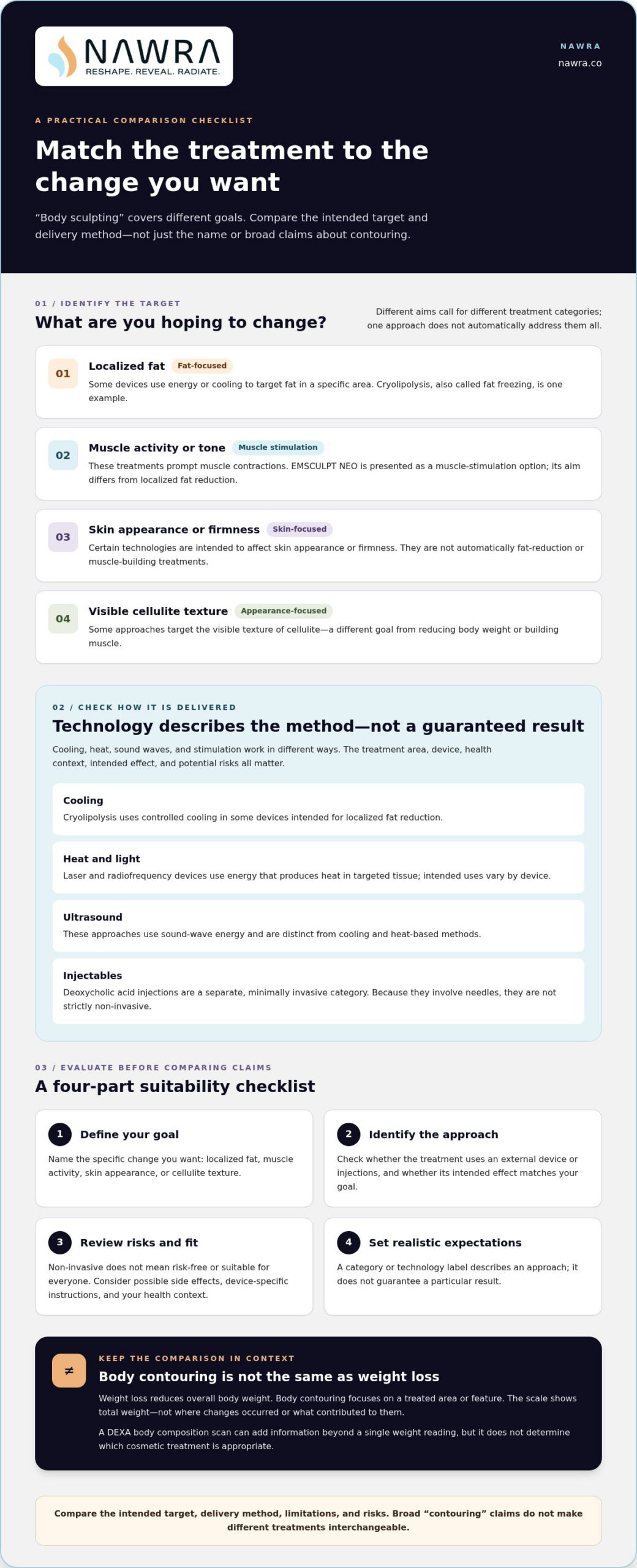
Compare non-invasive body sculpting alternatives by their target, not by broad claims about “contouring.” Common goals include:
- Localized fat reduction: Some devices use energy or cooling to target fat in a specific area. Cryolipolysis (fat freezing) is one example of a fat-focused approach.
- Muscle stimulation: These treatments use stimulation to prompt muscle contractions. Their aim differs from procedures intended to reduce localized fat.
- Skin-focused changes: Certain technologies are intended to affect skin appearance or firmness. They aren’t automatically fat-reduction or muscle-building treatments.
- Cellulite appearance: Some approaches target the visible texture of cellulite, which is distinct from reducing body weight or building muscle.
How Is Body Sculpting Different From Weight Loss?
Weight loss means reducing overall body weight. Body contouring, by contrast, focuses on a treated area or a particular feature, such as localized fullness, muscle tone, or skin appearance. A cosmetic treatment shouldn’t be treated as a substitute for weight management, obesity treatment, or a broader health intervention.
The scale reports total weight, not where changes occurred or what contributed to them. Your weight might stay similar while body composition changes, or the scale might move without showing which areas changed. A body composition measurement, such as a DEXA scan, can add information beyond a single weight reading, but it doesn’t determine which cosmetic treatment is appropriate.
What Does Non-Invasive Mean in This Context?
Generally, non-invasive procedures don’t involve surgery or an incision. Some use external devices that deliver energy or cooling to a targeted area. The label doesn’t mean a procedure is risk-free, sensation-free, or suitable for everyone. The method, intended effect, possible side effects, and device-specific instructions all matter.
Injectable procedures are sometimes grouped into body-sculpting roundups, but they aren’t strictly non-invasive because they involve injections through the skin. Keep the categories distinct when comparing options. The U.S. Food and Drug Administration (FDA) provides consumer information about medical devices, including device-related safety considerations. Review that information alongside guidance from a qualified healthcare professional, particularly if you have health concerns or are unsure whether a treatment fits your circumstances.
How Non-Invasive Body Sculpting Alternatives Work
Different devices use different physical mechanisms, but a technology label alone doesn’t show whether a treatment fits your goal. Cooling, heat, sound waves, and electrical or electromagnetic stimulation work in different ways and are used for different intended effects. The treatment area, device, individual health context, and realistic outcome all matter. A category describes an approach, not a guaranteed result.
Non-invasive body contouring uses external techniques to target changes in shape or appearance without surgery, rather than to reduce overall body weight. This distinction helps put technology claims in context. Fat-focused methods aim at localized fat; muscle stimulation focuses on muscle activity; skin-focused approaches target skin appearance. These goals may appear together in broad marketing, but they aren’t interchangeable.
- Cooling: Cryolipolysis uses controlled cooling in some devices intended for localized fat reduction. The cooling method doesn’t make every device or treatment plan identical.
- Heat and light: Laser and radiofrequency devices use energy that produces heat in targeted tissue. Their intended uses vary by device, so the technology name alone can’t establish likely results.
- Ultrasound: These approaches use sound-wave energy. They’re distinct from cooling and heat-based methods, even when all appear under the fat-reduction label.
- Injectables: Deoxycholic acid injections are a separate, minimally invasive category. Because they involve needles, they aren’t strictly non-invasive, and their use should be considered separately from external devices.
Cooling, Heat, Ultrasound, and Injectable Approaches
These categories describe how an approach is delivered, not a simple ranking of effectiveness. A cooling device and a heat-based device may both be presented as fat-focused, yet their mechanisms differ. Injectable procedures differ again because a substance is placed through the skin. Compare the intended target, method, and potential risks rather than assuming one technology is a more powerful version of another.
Muscle Stimulation Is a Different Body-Sculpting Goal
Muscle-stimulation approaches focus on prompting muscle activity or supporting muscle tone. That isn’t the same aim as reducing fat in a treated area. NAWRA offers EMSCULPT NEO as a muscle-stimulation option, so compare it with treatments intended for muscle activity rather than treating it as interchangeable with fat-reduction procedures. The article EMSCULPT NEO and body-contouring science can add context.
Start with the change you want, then assess whether the treatment’s stated mechanism matches it. If your goal is muscle stimulation, a fat-focused device may not address that goal. If your goal is skin appearance, muscle stimulation may not be the relevant category. Learn more about EMSCULPT NEO at NAWRA as one option for exploring muscle stimulation.
Compare Body Sculpting Alternatives by the Change You Want
Technology names can sound precise while leaving the central question unanswered: what change is this approach intended to address? Compare non-invasive body sculpting alternatives by goal first, then consider how the method is delivered and what it can’t do. Cooling, heat, and ultrasound may appear in fat-focused options, but they aren’t the same as muscle stimulation or treatments aimed at skin appearance.
Choose a body-sculpting category by its intended target, because a treatment designed for fat, muscle, skin, or cellulite may not address the others. Use this as a comparison framework, not a ranking. Suitability and outcomes vary by technology and individual.
| Category | Intended goal | Broad approach | Key limitation |
|---|---|---|---|
| Fat-focused devices | Target localized fat | May use cooling, heat, laser, or ultrasound, depending on the device | Doesn’t address muscle tone or guarantee weight loss; effects and risks vary by device |
| Muscle stimulation | Focus on muscle activity or tone | Uses a device to stimulate muscle activity | Not a substitute for a fat-removal procedure or a method of overall weight management |
| Skin-focused treatments | Address skin appearance or firmness | May use energy-based technologies, depending on the treatment | Shouldn’t be assumed to reduce fat, build muscle, or resolve every cause of skin laxity |
| Cellulite-focused approaches | Target the appearance of cellulite | Methods vary by technology and treatment | A change in cellulite appearance isn’t the same as fat reduction or weight loss |
| Injectable procedures | May target localized fat in a specific area | Use injections, making them minimally invasive rather than non-invasive | Involve a different procedure and risk profile than external devices |
Which Options Target Localized Fat, Muscle, or Skin?
For localized fat, compare the specific device and its intended use. Cooling, heat-based methods such as radiofrequency or laser, and ultrasound are broad technology categories, not interchangeable treatments. EMSCULPT NEO belongs in the muscle-stimulation category. It isn’t surgical fat removal. Skin-focused approaches and cellulite treatments also deserve separate consideration, since changes in skin appearance or texture aren’t equivalent to reducing fat or increasing muscle tone.
What Are the Main Trade-Offs Between Categories?
External devices and injectable procedures differ in how they’re delivered, and each category has its own intended effect and limitations. The least invasive-sounding option isn’t automatically the right fit. Results, timing, and possible side effects depend on the technology and individual circumstances, so avoid comparing claims as if every method were tested under identical conditions. Focus on the target, delivery method, and realistic scope of change.
A practical comparison starts with your priority: localized fullness, muscle tone, skin appearance, or cellulite. Then check whether the category is designed for that goal and whether its limits align with your expectations. If the aim is muscle stimulation, NAWRA’s EMSCULPT NEO is an option to understand within that category, not a universal alternative for every body-contouring concern.
How to Evaluate Suitability, Safety, and Realistic Expectations
A careful decision starts with a defined goal, not a trending treatment name. Use this sequence to compare options without assuming that a device is suitable for everyone or that an assessment guarantees eligibility, safety, or a particular result.
- Define the change you want. Be specific: are you focused on a localized area, muscle tone, skin appearance, or cellulite?
- Identify the treatment category. Check whether the method is designed for that goal, rather than relying on broad language such as “sculpting” or “toning.”
- Review risks and limitations. Consider how the treatment is delivered, potential side effects, and the possibility that the outcome may differ from your expectations.
- Set a realistic measure of progress. Decide what change you’ll track and remember that appearance goals aren’t the same as weight-loss or general health goals.
Health context matters. Medical history, current concerns, and individual circumstances can affect whether a procedure is appropriate. Discuss relevant questions with a qualified healthcare professional, and use the U.S. Food and Drug Administration’s consumer information to understand that devices have specific intended uses, limitations, and potential risks. No single source or conversation can promise a particular outcome.
Questions to Clarify Before Choosing a Treatment
Ask what change a treatment is intended to address, how it works, and what it isn’t designed to change. Compare those answers with your goal and personal health context. “Most popular” doesn’t establish a match. A precise treatment name or polished claim also can’t replace clear information about the method, its limits, possible side effects, and expected course of change.
For example, if your main goal is muscle tone, clarify whether the approach focuses on muscle stimulation. If you’re concerned about skin appearance, find out whether the treatment is intended to address skin rather than fat. This simple match-check can reveal a gap between the marketing headline and the change you actually want.
How to Set Realistic Expectations and Track Progress
Keep appearance goals separate from weight loss and overall health goals. Choose a consistent measure suited to the question: photographs taken under similar conditions may help document visible changes, while a body composition assessment can offer information beyond scale weight. Explore DEXA body composition measurements as one way to bring more structure to how you understand body composition.
Track the same measure over time, and don’t treat normal day-to-day variation as proof of success or failure. A scale alone can’t show every change in body composition, and measurements don’t guarantee a cosmetic result. NAWRA offers DEXA body composition scans and EMSCULPT NEO, a muscle-stimulation option. If that category aligns with your goal, explore EMSCULPT NEO at NAWRA as one step in your evaluation.
Explore Non-Invasive Body Sculpting at NAWRA in Los Alamitos
A clear goal makes the next step more useful. If you’re comparing non-invasive body sculpting alternatives, decide whether you’re focused on muscle stimulation, localized fat, skin appearance, or another concern. The category matters. A service designed around one goal shouldn’t be presented as a universal solution for every body-contouring interest.
Where EMSCULPT NEO Fits Among the Alternatives
NAWRA offers EMSCULPT NEO as a muscle-stimulation option. That places it in a different category from procedures intended to reduce localized fat. It isn’t a substitute for surgical fat removal, a treatment for obesity, or a promise of a particular result. Understanding that distinction helps you assess whether muscle stimulation aligns with the change you want to explore.
Use your goal to guide the conversation. Someone interested in muscle tone may want to learn about a muscle-stimulation approach, while someone focused on skin appearance has a different objective. Treatment names alone don’t show whether the intended effect matches your priorities. For more context, read the guide titled EMSCULPT NEO in Los Alamitos.
Clear expectations matter as much as a clear category. Consider what change you’re looking for, what you understand about the treatment’s intended role, and which questions you still have. A discussion with a qualified healthcare professional can help you consider your health context and relevant concerns, but it can’t guarantee eligibility, safety, or an outcome.
A Clear Next Step for Los Alamitos and Nearby Communities
NAWRA is located in Los Alamitos and serves nearby communities, including Cypress, Cerritos, Long Beach, Seal Beach, La Palma, Buena Park, Lakewood, Anaheim, Norwalk, Irvine, Laguna Niguel, Newport Beach, Huntington Beach, Bellflower, Tustin, Fullerton, and Yorba Linda. Local readers can explore EMSCULPT NEO specifically as a muscle-stimulation option, distinct from fat-focused or skin-focused approaches.
Before taking a next step, write down your main goal in plain language. Note whether you want to learn about muscle stimulation or have a different body-contouring concern. Bring relevant health questions and expectations into the discussion, and focus on understanding the approach rather than comparing broad marketing claims. This keeps the decision grounded in your priorities.
If muscle stimulation is the category you want to explore, learn more about NAWRA’s approach to EMSCULPT NEO. A defined goal gives you a focused starting point and helps you decide what questions to ask next.
Make Your Next Step More Intentional
Before choosing a treatment, turn your goal into a clear question: what change are you hoping to explore, and what information would help you make a considered decision? That shift can make comparisons more useful by keeping the focus on fit and informed expectations rather than on whichever claim sounds most compelling.
For people considering non-invasive body sculpting alternatives, clarity is a practical starting point, not a promise of a particular result. Bring your priorities and relevant health questions into the conversation, then take time to understand how an option aligns with them. A measured decision is better than a rushed one.
NAWRA’s precision-focused approach can help you explore a next step with a defined goal in mind. Explore NAWRA’s precision-focused body-contouring services and take the next step with your priorities in focus.
Frequently Asked Questions
What is the difference between non-invasive body sculpting and weight loss?
Non-invasive body sculpting focuses on a specific area or appearance goal, while weight loss means reducing overall body weight. For example, a person may want to address the contour of one area without aiming to change their total weight. These treatments aren’t weight-loss programs or obesity care. If your main goal is weight management or a health change, discuss suitable options with a qualified healthcare professional.
Can non-invasive body sculpting alternatives build muscle as well as reduce fat?
Some technologies may combine different approaches, but don’t assume every device targets both muscle and fat. The intended effect depends on the specific treatment and device. If muscle tone is your priority, look for a muscle-stimulation option; if localized fat is the concern, examine fat-focused methods separately. The phrase non-invasive body sculpting alternatives covers different categories, not one treatment that delivers every type of change.
How do cryolipolysis, radiofrequency, and ultrasound body contouring differ?
Cryolipolysis uses controlled cooling, radiofrequency uses electrical energy that produces heat, and ultrasound uses sound-wave energy. These describe different mechanisms, not a reliable ranking of results. Device design and intended use can vary within each category. For a useful comparison, identify the target area, learn what the specific device is intended to do, and consider its limitations and possible side effects rather than choosing by technology name alone.
Are non-invasive body sculpting treatments risk-free?
No. Non-invasive describes how a procedure is delivered, not whether it has zero risk. Temporary redness, swelling, or tenderness can occur with some treatments, and rare complications have been reported with particular technologies. The FDA provides device-related consumer safety information, but your health context matters too. Before proceeding, discuss relevant medical concerns with a qualified healthcare professional and review the risks associated with the specific procedure being considered.
Do non-invasive body sculpting results last permanently?
There’s no universal guarantee that results will be permanent. Effects depend on the technology, the individual, and how the body changes over time. Avoid relying on broad promises that don’t specify the treatment and intended outcome. Ask what kind of change is being described and how it will be assessed. A consistent record, such as comparable photographs or measurements, can help you observe changes without assuming they will last indefinitely.
Is EMSCULPT NEO a fat-reduction treatment or a muscle-stimulation treatment?
NAWRA offers EMSCULPT NEO as a muscle-stimulation option. It shouldn’t be treated as interchangeable with procedures intended to reduce localized fat. If you’re considering it, clarify whether your main goal relates to muscle stimulation and discuss how the service fits your personal circumstances. A clear goal helps keep expectations focused on the treatment category rather than broad body-contouring claims.
Where can I explore non-invasive body sculpting options near Los Alamitos?
NAWRA is located in Los Alamitos and serves nearby communities, including Cypress, Cerritos, Long Beach, Seal Beach, La Palma, Buena Park, Lakewood, Anaheim, Norwalk, Irvine, Laguna Niguel, Newport Beach, Huntington Beach, Bellflower, Tustin, Fullerton, and Yorba Linda. NAWRA offers EMSCULPT NEO and DEXA body composition scans. Explore these options with your specific goal in mind, and discuss health questions with a qualified healthcare professional.