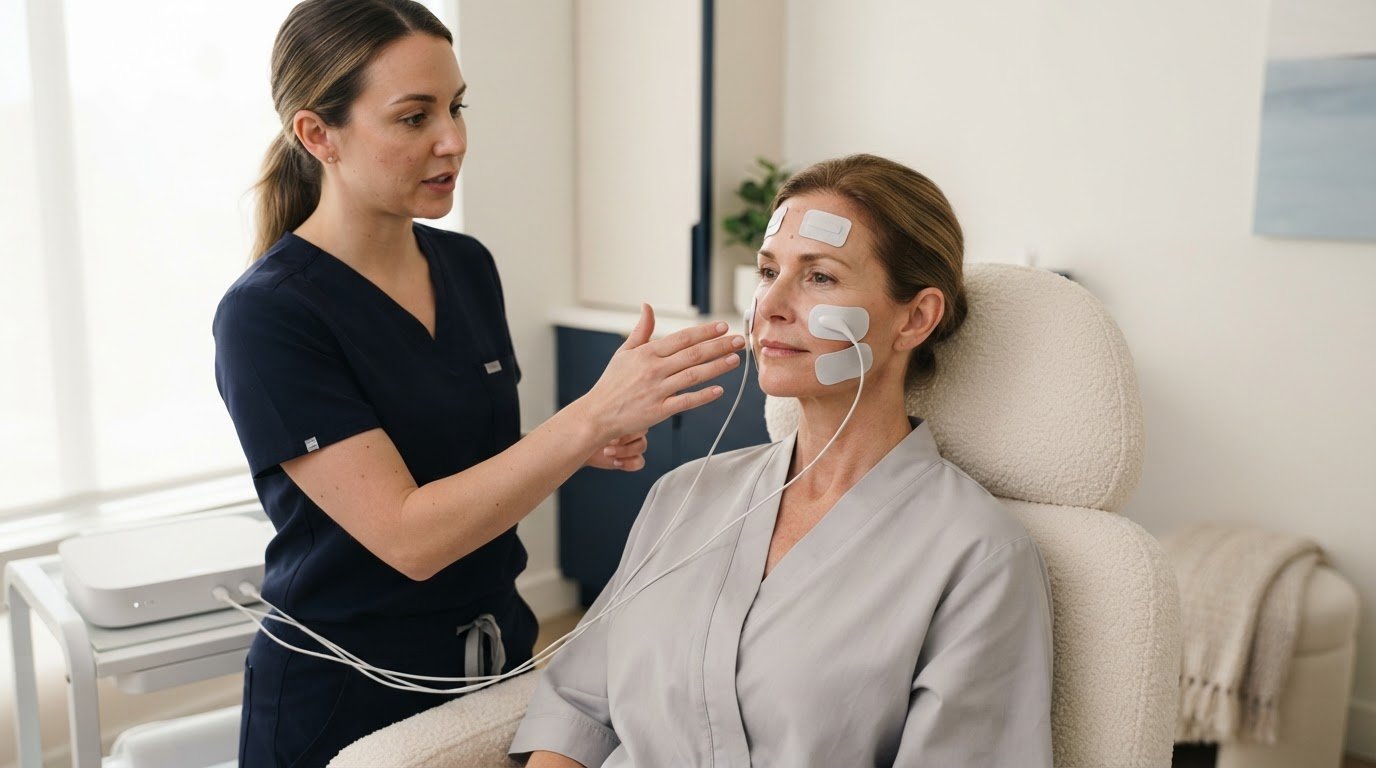
Emface isn’t a filler substitute. In the Emface vs. fillers comparison in Irvine, the key difference is what each treatment targets: EMFACE combines radiofrequency with synchronized electromagnetic energy to address facial skin and underlying muscles, while fillers are injected to add volume or support in a specific area. EMFACE uses no needles or injections, and its effects develop gradually rather than providing immediate added volume.
It makes sense to compare them: both are non-surgical options for facial rejuvenation, but they address different concerns. EMFACE focuses on skin and underlying facial muscles; fillers can restore volume in areas such as the cheeks. One may better suit your goals, or the treatments may complement each other.
This guide explains what EMFACE does, how it differs from fillers, and why it can’t replace an injectable when the goal is to fill a hollow or add cheek volume. You’ll also learn how the treatments may work together and what to consider when choosing an approach for your face.
Key Takeaways
- Match the treatment to your goal: Emface focuses on facial skin and underlying muscles, while fillers add targeted volume or support.
- Understand the timing difference: filler volume is visible immediately, while Emface results develop gradually through a series of treatments.
- Emface can’t fill a hollow or replace cheek volume from filler, but the treatments may complement each other.
- Learn how radiofrequency energy and facial electromagnetic stimulation work together to address skin and muscle tone.
- Use your main concern, such as reduced firmness or lost facial volume, to guide which treatment approach may fit your goals.
Does Emface Work?
EMFACE is a non-invasive treatment that combines radiofrequency and synchronized electromagnetic energy. Its approach differs from fillers, which use injections to add volume or support in targeted areas.
There isn’t a single typical cost for Emface treatment in Irvine, California. The price depends on the treatment plan, including the number of sessions and areas addressed, and is provided after a quote request.
Treatment Approaches and Results
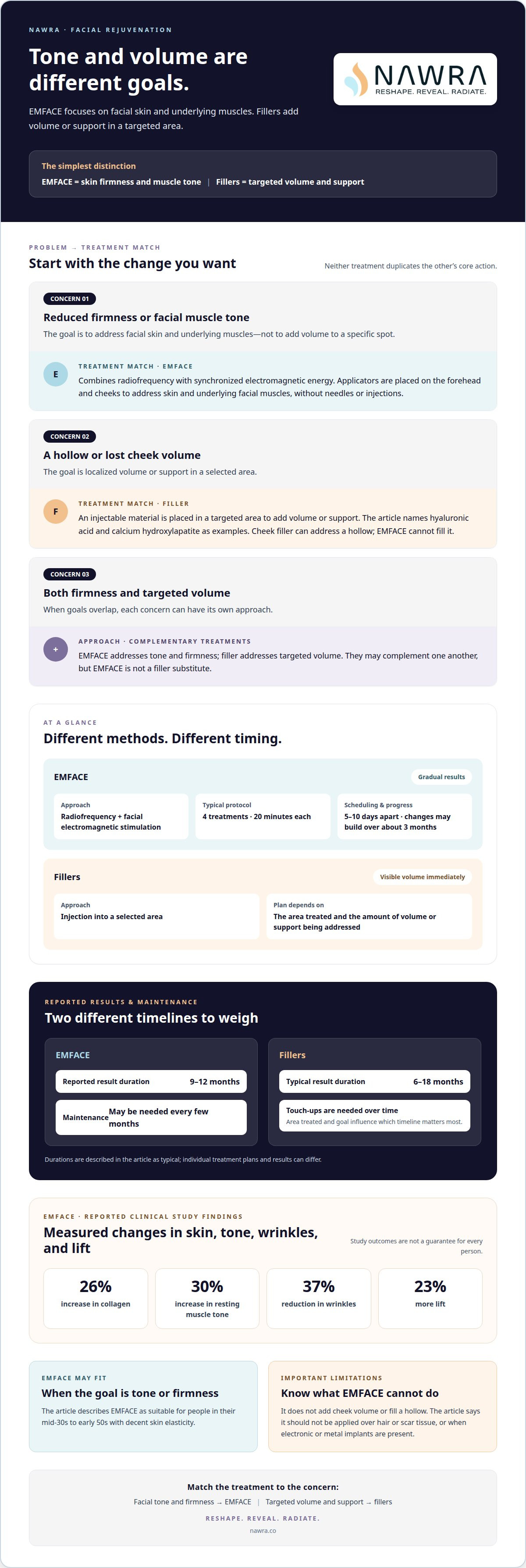
EMFACE applicators are placed on the forehead and cheeks to address skin and underlying facial muscles without needles. Fillers take a different approach: an injection places material in a targeted area to add volume or support. EMFACE suits concerns involving tone and firmness; it doesn’t add cheek volume or fill a hollow the way cheek filler can.
| Option | Approach | Primary focus | Result timing |
|---|---|---|---|
| Emface | Radiofrequency and facial electromagnetic stimulation | Skin and facial muscles | Gradual |
| Fillers | Injection into a targeted area | Volume and support | Immediate |
Choose based on whether your priority is facial tone or targeted volume.
Sessions and Results Timeline
Emface results develop gradually through a series of sessions, rather than appearing as immediate added volume. A typical protocol consists of four 20-minute treatments scheduled 5-10 days apart. Changes may build over about three months, so the treatment’s progress follows a different timeline from the visible volume effect of filler injections.
Results Longevity and Maintenance
Emface results aren’t permanent and typically require periodic maintenance. Reported results typically last 9-12 months, while maintenance sessions may be needed every few months to sustain benefits. This gradual treatment cycle differs from fillers, whose results typically last 6 to 18 months before touch-ups are needed. The area treated and the goal influence which timeline matters most.
Reported Clinical Study Results
Reported Emface clinical studies found an average 26% increase in collagen and a 30% increase in resting muscle tone. They also reported a 37% reduction in wrinkles and 23% more lift. These findings describe measured study outcomes, not a guarantee for every person. They help explain why Emface is discussed as a treatment for facial tone and skin, rather than as a volume replacement.
What’s the difference between EMFACE and fillers?
The right choice depends on whether your priority is facial tone or targeted volume. For readers comparing Emface vs. fillers in Irvine, the key distinction is how each treatment creates its effect.
There isn’t one typical cost for dermal fillers in Irvine per syringe. The price depends on the filler type and treatment area, and is provided after a quote request.
Treatment Mechanisms
EMFACE combines radiofrequency with high-intensity facial electromagnetic stimulation to target skin and underlying muscles. Dermal fillers instead use injectable materials, including hyaluronic acid or calcium hydroxylapatite, to add volume or support in selected areas. For example, cheek filler can address a hollow; EMFACE doesn’t fill that hollow or add cheek volume.
The methods also differ in timing and purpose. Filler creates immediate volume, while EMFACE is used for skin firmness and muscle tone. Neither duplicates the other’s core action. The comparison of Emface versus fillers in Irvine is most useful when it starts with the specific change you want, not a general preference for an advanced treatment.
Treatment Duration and Recommended Sessions
An EMFACE session typically takes 20-30 minutes. A standard treatment protocol consists of four sessions over two weeks, so the plan involves a series rather than one appointment. Filler is injected into a selected area, and the amount and placement depend on the volume or support being addressed.
There’s no universal syringe count for filler. The area treated and the amount of volume being restored shape the plan. During a consultation, distinguish a broad tone concern, such as reduced firmness, from a localized concern, such as a hollow cheek. That distinction makes the treatment goal more precise.
Candidates and Treatment Selection
People seeking improved skin firmness or facial muscle tone may consider EMFACE; people seeking targeted volume may consider filler. EMFACE is described as suitable for people in their mid-30s to early 50s with decent skin elasticity. It shouldn’t be applied over hair or scar tissue, or when electronic or metal implants are present.
Those goals can also overlap. Someone concerned about both facial firmness and cheek volume may consider a plan that gives each concern its own approach. EMFACE addresses tone; filler addresses targeted volume. The Emface-versus-fillers choice in Irvine should therefore follow the intended result and treatment area, rather than treating these options as interchangeable.
Can Emface replace Botox or fillers?
No. EMFACE, Botox, and fillers aren’t interchangeable: EMFACE addresses facial muscle tone and skin, while fillers add volume. Botox is also an injectable treatment, so the right comparison starts with the concern you want to address.
Effects on Facial Muscles and Skin
EMFACE combines radiofrequency with synchronized electromagnetic stimulation. The treatment creates muscle contractions while radiofrequency energy targets skin. This non-invasive approach is designed for facial rejuvenation without surgery or injections. Its focus differs from filler, which adds volume to a selected area, and from Botox, which is an injectable option.
Clinical study reports describe changes in collagen, elastin, wrinkles, and lift after EMFACE treatment. Those outcomes reflect a skin-and-tone approach, not added volume or a direct replacement for every injectable. If a cheek hollow is the main concern, EMFACE doesn’t fill it. If the goal is improved firmness, its treatment mechanism is more relevant.
That distinction matters for planning. Separate the concern into skin quality, facial muscle tone, movement-related lines, or volume loss. Each points toward a different treatment effect. EMFACE focuses on the first two; filler addresses targeted volume. Botox remains a separate injectable category rather than another name for either approach.
Safety and Possible Side Effects
EMFACE has no needles or injections, and clients can return to daily activities immediately after treatment. It is non-invasive and zero downtime. By contrast, filler injections can cause swelling or bruising, which usually resolves within a few days.
EMFACE shouldn’t be applied over hair or scar tissue, or when a client has electronic or metal implants. These are important screening details because the applicators are placed on the face and the treatment uses electromagnetic stimulation. A suitable treatment plan accounts for these exclusions before treatment.
Recovery instructions also differ by approach. After Emface or radiofrequency treatment, avoid hot tubs and heavy exercise for 24 hours. This short restriction doesn’t change the treatment’s non-invasive nature, but it is part of planning around the session. Filler recovery instead involves allowing time for injection-related swelling or bruising to settle.
Choose based on the effect you want, the treatment mechanism, and relevant safety factors. EMFACE can support facial tone and skin goals, but it doesn’t replace filler for volume or make Botox equivalent to a non-invasive treatment.
Combining EmFace and fillers
EMFACE and fillers can be combined because they address different facial concerns. EMFACE targets skin and underlying muscles; filler adds volume or support in a selected area. A plan might use EMFACE to address overall firmness while filler restores volume in a hollow. The treatments complement each other, but neither performs the other’s main function.
The distinction starts with the desired change. EMFACE combines radiofrequency with high-intensity facial electromagnetic stimulation. Fillers are injected to add volume to a targeted area. If the concern is reduced skin firmness and facial tone, EMFACE addresses that focus. If the concern is a hollow cheek or lost volume, filler addresses the localized contour. Combining them makes sense when both concerns are part of the goal.
EmFace’s action involves two technologies working on different tissue targets. Radiofrequency energy targets skin, while electromagnetic stimulation triggers rapid muscle contractions. These contractions are described as 20,000 “mini workouts” per session. That muscle stimulation doesn’t add volume. Filler, by contrast, provides volume or support through injection, rather than muscle action or radiofrequency.
A practical planning sequence begins by separating the concerns: identify where tone or firmness is the priority, then mark any areas where volume is the priority. For example, a person may want improved facial firmness and added cheek support. The first goal points to EMFACE; the second points to filler. This clear division helps define what each treatment is intended to change before building a combined plan.
Timing also needs to reflect each treatment’s role. A typical EmFace session takes 20-30 minutes, and its standard protocol consists of four sessions over two weeks. Filler results appear immediately after injection, while EmFace results develop gradually. These different timelines matter when planning around a preferred appearance or an event. The treatment schedule should account for the course of EmFace and the immediate volume effect of filler.
Combining approaches doesn’t mean every face needs both. EMFACE alone addresses tone and firmness goals; filler alone addresses targeted volume loss. The combination applies when both goals are present. A useful treatment discussion names the intended action for each area, such as improving firmness across the face or restoring cheek volume. That keeps the plan focused, specific, and aligned with the result each technology is designed to provide.
How EmFace combines radiofrequency energy and HIFES technology
The term “synchronized” describes EMFACE’s use of radiofrequency and HIFES within one treatment approach. It doesn’t mean the energies are interchangeable. Each technology contributes a different action, so understanding the pairing means distinguishing the intended skin effect from the intended muscle effect.
Radiofrequency is the skin-directed component; HIFES provides electromagnetic stimulation to facial muscles. That distinction explains the treatment’s design without reducing it to a single, undifferentiated energy. The combined approach is intended to address two tissue targets in a coordinated treatment, rather than focusing only on skin or only on muscle.
When assessing aesthetic technology, it helps to separate three ideas: the energy used, the tissue targeted, and the outcome being measured. The technology description identifies the first two. Clinical measurements address the third. Keeping those categories distinct makes it easier to understand what a reported outcome relates to, without assuming that one mechanism explains every visible change.
This also puts technology claims in context. A description of coordinated energy delivery explains how the device is designed to work; it doesn’t, by itself, establish how much change an individual will see. Treatment goals, targeted tissue, and outcome measures are separate parts of the discussion. Clear terminology keeps those distinctions visible.
EMFACE’s paired approach is relevant when facial treatment goals involve both skin and underlying muscle. It isn’t a general-purpose solution for every facial concern. Matching the technology to the intended tissue gives a more precise basis for discussing its role in an aesthetic plan, instead of relying on broad labels such as “lifting” or “rejuvenation.”
When reviewing device information, focus on whether a claim describes the technology, a measured result, or an individual treatment goal. Those are not the same statement. Understanding that difference can make a consultation more specific and help frame the role of synchronized energy in a facial treatment plan.
To explore whether this technology fits your facial goals, review EmFace treatment options and consider which outcome you want to prioritize.
Timing can add context to the distinction between the technology and the outcome. Subtle EmFace lifts may appear in two to four weeks as collagen matures and muscle tone develops. Results may continue to develop for up to 3 to 6 months as collagen remodeling matures, so an early observation may not reflect the full course of change.
Pura Vida Med Spa says meaningful Emface results develop fully 1 to 3 months after treatment as collagen remodeling matures. These timelines describe possible development rather than a guaranteed result for every person. They also show why it is useful to discuss both the intended tissue targets and when an outcome is being assessed, instead of treating the treatment mechanism and visible change as the same thing.
NAWRA
NAWRA offers EMFACE for clients focused on facial tone, while fillers address targeted volume through injections. If your goals extend beyond facial rejuvenation, NAWRA’s other offerings address different wellness priorities. DEXA Body Composition provides a body composition scan, while EMSCULPT NEO, ExoPod Full-Body Therapy, and BOA Lymphatic Drainage offer additional non-invasive wellness options.
The key is to keep the goals distinct: facial tone, facial volume, and broader body-composition or wellness interests call for different approaches. Understanding that difference can help you decide what to discuss with NAWRA. Contact NAWRA to discuss which offering aligns with your goals.
Choose a Plan That Fits Your Priorities
A useful next step is to define what you want to change and what outcome would feel right to you. Consider whether your priority is facial definition, skin quality, or a more refreshed overall appearance. Also think about your preferred pace: immediate visible change or a treatment plan whose effects develop over time. Clear priorities make a treatment discussion more focused and help distinguish the result you want from the method used to achieve it.
If you’re weighing Emface or fillers in Irvine, bring those priorities to a conversation with NAWRA. Its broader wellness offerings include EMSCULPT NEO, DEXA Body Composition, and ExoPod Full-Body Therapy. A thoughtful plan begins with your goals, then aligns the approach to them. Contact NAWRA to discuss your options and take the next step with clarity.
Frequently Asked Questions
What is EMFACE?
EMFACE is a non-invasive facial treatment that uses synchronized radiofrequency and HIFES energy. It is designed to address facial skin and underlying muscle without needles, distinguishing it from injectable approaches. The treatment is intended for aesthetic goals, not disease care. These services have not been evaluated by the FDA and are not intended to diagnose, treat, cure, or prevent any disease.
Comparing the Contenders: Which Is Right for You?
Choose according to the change you want: improved firmness, more facial tone, or added volume in a specific area. EMFACE suits skin and tone goals; fillers are used for targeted volume. For readers comparing options around Irvine, nearby service areas include Los Alamitos, Cypress, Cerritos, Long Beach, Seal Beach, La Palma, Buena Park, Lakewood, Anaheim, Norwalk, Laguna Niguel, Newport Beach, Huntington Beach, Bellflower, Tustin, Fullerton, and Yorba Linda.
How is the EMFACE procedure performed and how does it feel?
For treatment, applicators are placed over the forehead and cheeks after the face is cleansed. The device delivers radiofrequency energy and electromagnetic stimulation, producing facial muscle contractions. Treatment involves no needles or injections and is non-invasive, with zero downtime. The muscle action is a concrete part of the experience; individual sensations vary, so the procedure is best understood by its applicators and energy delivery.
What Are EmFace and Non-Surgical Face Lift Treatments?
EMFACE is a non-surgical facial rejuvenation treatment, not a surgical facelift. It uses energy-based technology to address facial skin and underlying muscles without incisions. That makes it a different category from surgery and injectables that add volume. Think of “non-surgical face lift” as a broad aesthetic description, not a promise that a treatment duplicates the structural changes of surgery.
What areas can be treated?
EMFACE applicators are intended for the forehead and cheeks. Those placements define the areas addressed by the treatment; they don’t mean every facial concern in those regions has the same cause. For instance, forehead or cheek skin and tone goals differ from a cheek hollow that needs added volume. Matching the goal to the treatment area helps keep expectations focused on what the method targets.
What is the treatment protocol?
A typical EmFace protocol consists of four 20-minute treatments scheduled 5-10 days apart. The face is cleansed before treatment, and results develop gradually, building over about three months. This schedule is a course rather than a single appointment. Planning around the full series matters because the intended effects develop over time, rather than appearing as an immediate volume change after one session.
Which lasts longer?
Dermal filler results typically last six months to two years, depending on filler type. EmFace results typically last 9-12 months and aren’t permanent; periodic maintenance may be needed. The ranges overlap, so neither option lasts longer in every comparison. For fillers, the type and treatment area matter; for EmFace, the gradual treatment course and maintenance plan shape how long the effects are sustained.
How does Emface work compared with dermal fillers?
EMFACE uses energy to target facial skin and underlying muscles; dermal fillers are injected to add volume or support in a selected area. For example, a goal of improved tone points toward EMFACE, while filling a hollow points toward filler. The approaches can complement each other when both goals are present, but EMFACE doesn’t replace the volume added by a filler injection.