

A single Emsella visit usually isn’t the whole course. For people asking how many Emsella sessions are needed in Buena Park, a typical plan is six sessions, scheduled twice weekly over three weeks, with each session lasting about 30 minutes. Results vary, but benefits may last several months, and many patients maintain them for 9 to 12 months before considering maintenance sessions.
That gives you a useful starting point, not a promise that everyone needs the same schedule or will see changes on the same timeline. Symptoms, starting pelvic floor strength, and response during the course can all shape what comes next. This guide explains how the session count is typically set, what may affect progress, when changes might become noticeable, and how maintenance sessions could fit into a longer-term plan.
Key Takeaways
- Understand how symptom severity and treatment response can shape the number of sessions in an individual plan.
- Learn how Emsella stimulates pelvic floor muscle contractions and what that means for treatment.
- Recognize that improvements may develop over time, including after the initial course ends.
- See how maintenance or booster sessions may fit into longer-term planning.
How many Emsella sessions will I need?
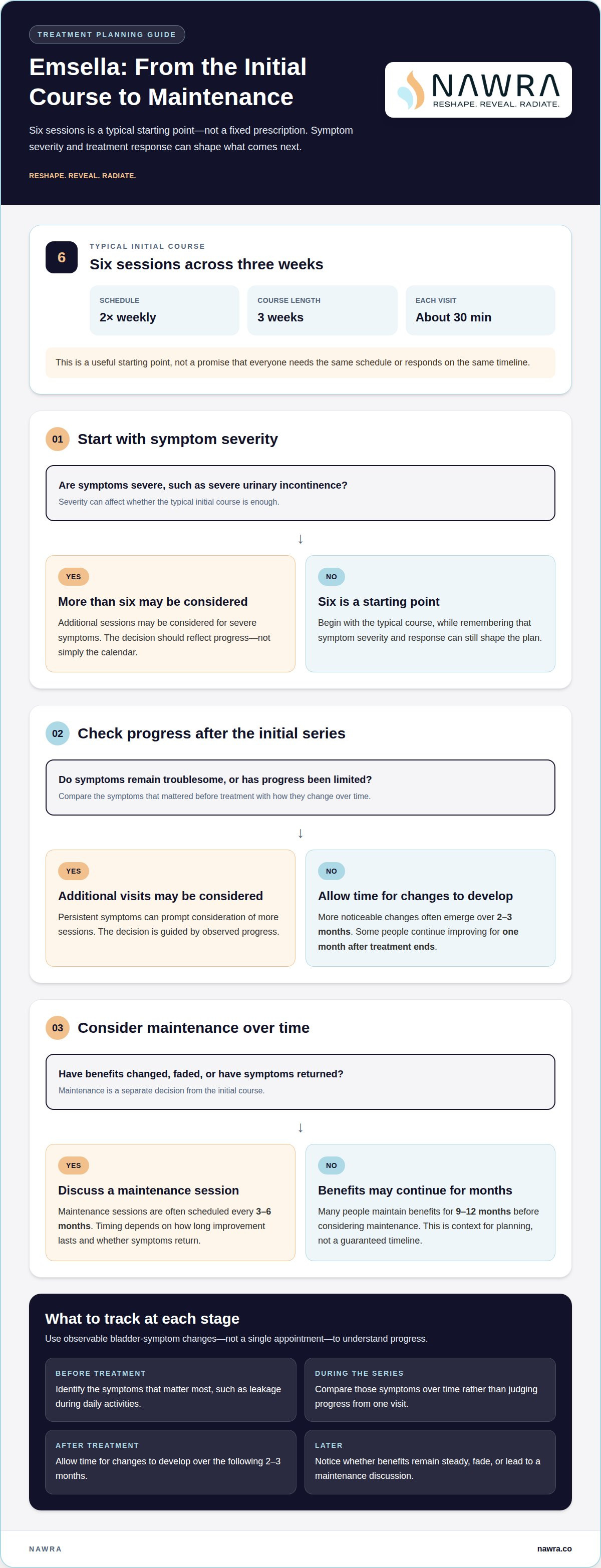
A typical Emsella course includes six sessions, scheduled twice weekly over three weeks. Each appointment lasts about 30 minutes. For readers asking how many Emsella sessions are needed in Buena Park, six is a useful starting point, not a fixed prescription. Symptom severity and response during treatment can affect whether the initial course is enough.
People with severe urinary incontinence may need more than six sessions. Additional visits can be considered if symptoms remain troublesome after the initial series. The decision should reflect progress, not simply the calendar. A treatment plan should distinguish the usual starting course from any additional sessions considered for persistent symptoms.
Improvement may develop gradually. More noticeable changes often emerge over two to three months, rather than immediately after one appointment. Some people notice changes earlier, while others need more time. Tracking bladder symptoms during and after the course can help show whether the initial plan is addressing the concerns that prompted treatment.
Benefits may continue to develop after the last visit. Some people continue improving for one month after treatment ends. Results may last several months, and many maintain benefits for nine to twelve months before considering maintenance sessions. These timelines offer context for planning, not a promise of a specific outcome.
Maintenance is a separate decision from the initial course. Sessions are often scheduled every three to six months. If bladder-control benefits continue, a later booster may be considered if those benefits change. Timing depends on how long improvement lasts and whether symptoms return.
To assess the course, focus on observable changes at each stage:
- Before treatment: Identify the symptoms that matter most, such as leakage during daily activities.
- During the series: Compare those symptoms over time, rather than judging progress from one visit.
- After treatment: Allow time for changes to develop over the following two to three months.
- Later: Consider whether benefits remain steady, fade, or prompt a maintenance discussion.
The question of how many Emsella sessions are needed in Buena Park should be considered alongside session length, symptom severity, and progress. A 30-minute visit helps define the time commitment, but it can’t predict the response. Emsella is non-surgical; that distinction alone doesn’t determine how many sessions someone may need.
In brief, six sessions is the typical starting course, usually scheduled twice a week over three weeks. More than six may be considered for severe symptoms or limited progress. Maintenance can be discussed later, based on how long benefits last and how bladder symptoms change.
How Does the Emsella Chair Work?
The Emsella chair uses electromagnetic stimulation to activate pelvic floor muscles. The treatment is designed to trigger muscle contractions without requiring the person to contract those muscles voluntarily. During a session, the person sits on the chair while the device delivers stimulation. These contractions are central to the process, rather than a separate exercise performed by the patient.
A single 28-minute session can produce more than 11,000 pelvic floor muscle contractions. That number describes the treatment’s repeated contractions, not 11,000 separate movements a person must perform. The contractions engage the muscles in a focused pattern. The intended goal is to support pelvic floor strength and bladder control through repeated stimulation.
Electromagnetic stimulation prompts these contractions by activating the pelvic floor muscles, which contract and release during treatment. This differs from physical therapy exercises, where a person practices voluntary muscle engagement. Both approaches focus on pelvic floor function, but the stimulation method and how the muscles are activated differ.
The chair format also shapes the experience. The patient remains seated while the treatment runs, rather than completing a series of conventional floor exercises. A session is commonly described as about 30 minutes, with a single-session description specifying 28 minutes. Those figures refer to treatment duration, not to how long improvement takes to develop.
- Stimulation: Electromagnetic energy activates pelvic floor muscles.
- Contraction: The muscles contract repeatedly during the session.
- Training focus: Repeated contractions aim to support muscle strength and bladder control.
- Comparison: Physical therapy exercises rely on voluntary muscle engagement, rather than chair-based stimulation.
The reported figure of more than 11,000 contractions helps explain why the session is described as intensive. It does not, by itself, tell a person how strong their pelvic floor is or how symptoms may change. Treatment count and response are separate questions: the chair delivers the stimulation, while the overall plan reflects the person’s symptoms and progress.
For a useful discussion, connect the treatment method to the outcome that matters in daily life. For example, describe whether bladder-control symptoms occur during movement, routine activities, or other situations. That context helps clarify whether pelvic floor stimulation aligns with the treatment goal. Emsella is non-surgical, but the number of contractions alone cannot establish an individual result.
How long results may last
Emsella results can emerge in stages, rather than at one fixed point. Some people notice subtle changes after a few sessions, while many notice improvement within two to four weeks. Others report benefits after three to four sessions. These timelines describe different points in treatment, not a single deadline for everyone.
Early changes may involve urinary symptoms, such as fewer leakage episodes or better bladder control during daily activities. The useful measure is whether a specific symptom changes, not simply whether a session feels different. For example, someone tracking leakage during a regular activity can compare that symptom over the course of treatment.
Progress can continue after the final appointment. Some people continue improving for one month after treatment. The end of a treatment series therefore doesn’t necessarily mark the end of changes in pelvic floor function. A practical review compares symptoms before treatment, during the course, and in the weeks after completion.
How long benefits last also varies. Emsella results may continue for several months, and many people maintain benefits for nine to twelve months before considering maintenance sessions. That period is a useful planning reference, not a guarantee of how long any one person will experience changes.
Maintenance planning depends on how improvement changes over time. If better bladder control continues, the initial results remain relevant to daily life. If benefits fade, a discussion about maintenance may help determine whether another series fits the treatment goals. Timing should reflect whether symptoms persist or return, rather than a date alone.
Keep the review focused on observable changes across three stages:
- During treatment: Note when a urinary symptom first changes, including the number of sessions completed.
- After the final session: Continue observing symptoms during the following month, when improvement may still develop.
- Over subsequent months: Track whether benefits remain steady or gradually diminish.
- Before maintenance: Use the symptom pattern and the duration of benefit to guide the next treatment discussion.
For example, someone who notices improvement after three sessions may still experience further change in the following weeks. Another person may notice little difference at first but report gradual progress after completing treatment. These examples show why early response and lasting benefit are separate measures.
In short, first changes may appear within two to four weeks, and improvement can continue for one month after treatment. Benefits may last several months, with nine to twelve months serving as a common point for considering maintenance. Tracking urinary symptoms over time makes these milestones more useful than relying on a single appointment.
How often should Emsella sessions be scheduled?
A usual Emsella schedule is twice per week for three weeks. This creates a six-session course, with appointments distributed across a short treatment period. Each session lasts about 30 minutes, so the treatment itself is relatively brief. The recurring visits, rather than one appointment, make up the initial series.
For example, someone attending twice a week completes the standard course over three weeks. Appointment days can be arranged around the person’s calendar while keeping the planned frequency in view. A consistent schedule makes it easier to complete the series within its usual timeframe and review symptom changes throughout the course.
Spacing appointments across the week helps distinguish a regular treatment plan from occasional visits. Emsella sessions are usually scheduled twice a week during the initial series, rather than as a single monthly appointment. The three-week course provides a common scheduling framework. Severe symptoms or limited progress may shape an individual plan.
Maintenance follows a different rhythm from the initial course. Emsella maintenance sessions are often scheduled every three to six months. That interval is a planning reference after the initial series, not an instruction to continue twice weekly indefinitely. Whether maintenance makes sense depends on how bladder symptoms and treatment benefits change over time.
- Initial series: Plan around twice-weekly appointments over three weeks.
- Session length: Allow about 30 minutes for each treatment appointment.
- Progress review: Track changes throughout the series and after completion.
- Maintenance: Consider the three-to-six-month interval as a common reference point.
Pelvic floor physical therapy follows a different visit pattern. A plan commonly spans six to ten visits over several weeks. This comparison can clarify that schedules vary by method, but it doesn’t make the approaches interchangeable. The appropriate schedule reflects the treatment being used and the symptoms being addressed.
Appointment frequency gives the treatment course a clear structure. Someone can plan the six visits as a defined series, then assess how symptoms respond. For instance, changes noticed during the first part of the course can be compared with symptoms after the final appointment. This is more informative than judging the schedule from a single visit.
When arranging a course, focus on three points: the twice-weekly pattern, the three-week timeframe, and a review after the series. If someone needs more than the usual six sessions, the schedule may extend beyond that initial framework. Later maintenance can be considered separately, guided by symptom patterns and how long benefits last.
In practical terms, the standard schedule is two appointments each week for three weeks, followed by a review of progress. Maintenance sessions may be considered every three to six months. This separates the initial treatment schedule from later follow-up and gives the plan a clear beginning, course, and reassessment point.
How many Emsella sessions are offered by clinics in Buena Park
For a Buena Park patient, the clearest starting point is the usual Emsella course: six sessions. The standard schedule is twice weekly over three weeks, with each appointment lasting about 30 minutes. This describes a common treatment course, not a count of every clinic’s packages or a guarantee that each person needs the same number.
“Sessions offered” can mean different things. A clinic may describe the usual course, present a package, or outline a plan tailored to symptoms. Those aren’t interchangeable. Six sessions is the typical starting series; an individual treatment plan may extend beyond it when urinary symptoms are severe or progress remains limited.
When reviewing an Emsella plan in Buena Park, focus on what the session count represents. Is it the initial series, or does it include later maintenance? A starting course is completed over three weeks. Maintenance is considered separately, often every three to six months, depending on how benefits and symptoms change.
The number alone also leaves out treatment duration. Each appointment takes about 30 minutes. Six appointments therefore represent a planned series of visits, rather than one extended treatment. The twice-weekly schedule helps clarify the expected cadence and the time commitment across the initial course.
A useful discussion connects the proposed schedule to the reason for treatment. For example, someone with persistent leakage may need a different plan from someone with milder symptoms. Symptom severity and response help determine whether the usual six-session series is sufficient or whether additional sessions warrant consideration.
- Clarify the count: Identify whether the number refers to the initial course or maintenance.
- Understand the schedule: The usual series runs twice weekly for three weeks.
- Account for visit time: Allow about 30 minutes per appointment.
- Relate the plan to symptoms: Severity and progress inform whether more sessions may be considered.
After the initial series, results may continue developing for two to three months. That makes the session count only one part of the decision. Reviewing symptoms after treatment helps determine whether benefits are developing, continuing, or fading. Maintenance sessions can then be discussed as a separate phase.
For Buena Park residents comparing Emsella plans, the practical benchmark is six initial sessions, not a universal local package count. A clear plan distinguishes the starting course from additional or maintenance visits. It should also explain how symptom response relates to the proposed schedule, without presenting the typical course as a guaranteed outcome.
To discuss a session plan based on your symptoms and treatment goals, schedule an Emsella consultation.
NAWRA: Emsella
NAWRA offers Emsella for people exploring non-surgical support for pelvic floor strength and bladder control. If urinary symptoms are affecting daily activities, or you’re weighing a standard course against possible maintenance, Emsella may be a relevant option to discuss. The typical schedule provides a useful reference, while symptom severity and treatment response help shape individual needs.
Use this guide to frame your questions around session frequency, expected progress, and how long benefits may last. A focused conversation can connect those considerations with your treatment goals, without assuming one schedule suits everyone. Contact NAWRA to discuss Emsella and whether it aligns with your needs.
Choose a plan that fits your next step
Deciding how many Emsella sessions are needed in Buena Park is only part of planning care. The next step is connecting your treatment goals with the symptoms you want to address and the progress you hope to track. A focused conversation can clarify what matters most to you and whether Emsella aligns with those priorities.
NAWRA also offers EMSCULPT NEO, DEXA Body Composition, and ExoPod Full-Body Therapy as distinct wellness services. For pelvic floor concerns, keep the discussion centered on Emsella and your individual goals. A useful plan should make the process clear, practical, and grounded in your needs.
Contact NAWRA to discuss Emsella, and take the next step with a clearer sense of your options.
Frequently Asked Questions
How many Emsella treatments will I need to undergo?
A typical starting course includes six Emsella treatments. The number may change if urinary symptoms are severe or progress during the course is limited. For example, someone tracking leakage during exercise can discuss whether that symptom changes as treatment continues. The plan should connect the session count to the concern being addressed, rather than treating a standard course as a personalized prediction.
How long will my results last?
Results may last several months, and many people maintain benefits for nine to twelve months before considering maintenance. Tracking a specific symptom, such as leakage during a daily activity, can make the timeline easier to assess. If that symptom gradually returns, it provides a useful basis for discussing next steps. Changes can also continue after the final treatment, so the end of the course isn’t the only point to assess progress.
Are more sessions required for severe urinary incontinence?
People with severe urinary incontinence may need more than six sessions. A typical starting course may not be enough for every symptom pattern. For example, ongoing leakage after the initial series can prompt a review of progress and treatment goals. Additional sessions aren’t automatic; symptom severity and response to treatment are relevant considerations.
Are the results permanent?
No, Emsella results shouldn’t be considered permanent. Benefits can last for months, but pelvic floor strength and bladder symptoms can change over time. If improvement fades, a maintenance discussion can address whether further sessions fit the person’s needs. For example, someone whose bladder control improves and later declines can use that change to guide a review, rather than assuming one course provides lasting results indefinitely.
What Can Emsella Help With?
Emsella is used for urinary incontinence and pelvic floor weakness. It stimulates pelvic floor muscles while the person remains seated and fully clothed. Someone experiencing leakage during routine activities, for example, can discuss whether the treatment aligns with their pelvic floor goals. Emsella focuses on pelvic floor muscle stimulation; it doesn’t replace an evaluation of symptoms or establish the cause of urinary concerns.
How many Emsella sessions are typically recommended for best results?
Six sessions are the typical starting recommendation, not a universal guarantee of the best result. The standard series is planned around the person’s symptoms and response. A useful question is whether the goal is to address a particular urinary symptom or pelvic floor weakness. That distinction helps frame progress and whether the initial course should be followed by a separate discussion about maintenance.
How long does each Emsella session take?
Each Emsella session lasts about 30 minutes. The treatment takes place while the patient is seated fully clothed, so the session itself doesn’t involve changing into treatment clothing. For scheduling, distinguish the treatment duration from the time needed to travel to the appointment or settle in. The 30-minute figure describes the session, not the total time spent on every part of a visit.
How long do Emsella results last, and are maintenance sessions needed?
Benefits may last several months, and many people maintain them for nine to twelve months before considering maintenance. Maintenance sessions are often scheduled every three to six months, but they aren’t automatically required for everyone. Someone whose urinary symptoms remain improved may have different needs from someone whose symptoms return. Timing discussions can focus on how long benefits last and the changes that matter in daily life.