Treatment: infrared sauna pod · Medically reviewed by Rasiq Ahmed, MD · Updated August 2026
The short answer: Recovery is not passive. When training volume, stress, and poor sleep stack up, the nervous system stays in a sympathetic state and tissue repair slows. Infrared heat raises core temperature and drives circulation at a much lower ambient air temperature than a traditional sauna, which most people find easier to tolerate for longer.
You are training consistently and feeling worse for it. Soreness that used to clear in a day now lingers for three. Sleep is shallow. Your resting heart rate has crept up. Sessions that felt manageable a month ago feel heavy.
The instinct is to train harder. Usually the problem is on the other side of the equation.
Recovery is not passive
Adaptation doesn’t happen during training. Training is the stimulus; the adaptation happens afterward, during recovery — and recovery is an active physiological process with requirements of its own.
When training load, work stress, poor sleep, and life demands stack up, the autonomic nervous system tends to remain in a sympathetic-dominant state — the alert, mobilized mode. In that state, the parasympathetic processes associated with repair, digestion, and deep sleep are suppressed.
The pattern is recognizable: tired but wired. Exhausted at 10pm, alert at 11:30. Sore without a clear reason. Motivated but flat.
This isn’t a character problem. It’s a physiological state, and the useful interventions are the ones that shift it.
Where heat exposure fits
Deliberate heat exposure is one of the more interesting recovery tools because it produces a genuine physiological stress that the body adapts to — while simultaneously, in most people, prompting a parasympathetic shift afterward.
Raising core temperature triggers a cascade: peripheral blood vessels dilate, heart rate rises, cardiac output increases, blood is redistributed toward the skin, and the body begins sweating to shed heat. In the period after exiting the heat, many people experience a pronounced relaxation response.
Infrared saunas produce that core temperature rise differently from traditional ones. Rather than heating the air to a high temperature and letting the air heat you, infrared emitters produce radiant energy absorbed directly by the body. The practical consequence is that a similar physiological effect can be achieved at a much lower ambient air temperature.
Infrared versus traditional sauna
| Infrared sauna | Traditional (Finnish) sauna | |
|---|---|---|
| Ambient temperature | ~110–150°F | ~160–200°F |
| Heating mechanism | Radiant energy absorbed by body | Heated air and surfaces |
| Humidity | Low | Variable; steam optional |
| Typical session | 20–45 min | 10–20 min |
| Airway heat load | Lower | Higher |
| Tolerability | Generally easier for heat-sensitive people | More intense |
| Research base | Smaller, growing | Larger, includes long-term cohorts |
An honest note: the substantial long-term epidemiological research on sauna use comes overwhelmingly from traditional Finnish sauna populations. The infrared evidence base is considerably smaller. Where the physiological mechanism is the same — core temperature elevation and cardiovascular response — it’s reasonable to expect overlap, but that is an inference, not a demonstrated equivalence. Anyone citing Finnish cohort mortality data as direct proof of infrared benefits is stretching.
Near, mid, and far infrared
Infrared is divided by wavelength, and different sources emphasize different bands:
- Near-infrared (NIR) — shortest wavelength, most superficial absorption. Most often discussed in relation to skin and localized tissue effects.
- Mid-infrared (MIR) — intermediate. Associated with circulatory effects.
- Far-infrared (FIR) — longest wavelength. The band most used for whole-body heating and core temperature elevation.
Marketing in this category tends to make confident claims about wavelength-specific benefits that outrun the available evidence. The reliably supported effects are the ones driven by core temperature rise and increased circulation, which is primarily a far-infrared function.
What the research actually supports
Worth separating into tiers.
Reasonably well supported:
- Acute cardiovascular response — heart rate elevation, vasodilation, increased cardiac output — that in some respects resembles moderate aerobic exercise
- Increased peripheral circulation during and after exposure
- Subjective improvement in perceived recovery and reduced muscle soreness in athlete populations
- Reported improvement in sleep quality and relaxation, though largely from self-report measures
- Long-term observational data — from traditional sauna cohorts — associating frequent use with favorable cardiovascular outcomes
Plausible, evidence still developing:
- Heat shock protein expression and its role in cellular repair, well established in laboratory models with less direct human outcome data
- Modest blood pressure effects with regular use
- Benefits for exercise-associated inflammation
Not supported:
- “Detoxification.” Toxin clearance is performed by the liver and kidneys. Sweat is overwhelmingly water and electrolytes, and the quantity of any meaningful toxin excreted through it is negligible.
- Significant fat loss. Weight lost in a sauna is water, and it returns with rehydration.
- Large calorie burn figures. The energy cost of thermoregulation is real but modest, and the numbers cited in marketing are usually not defensible.
We would rather be the page that tells you this.
Why a pod
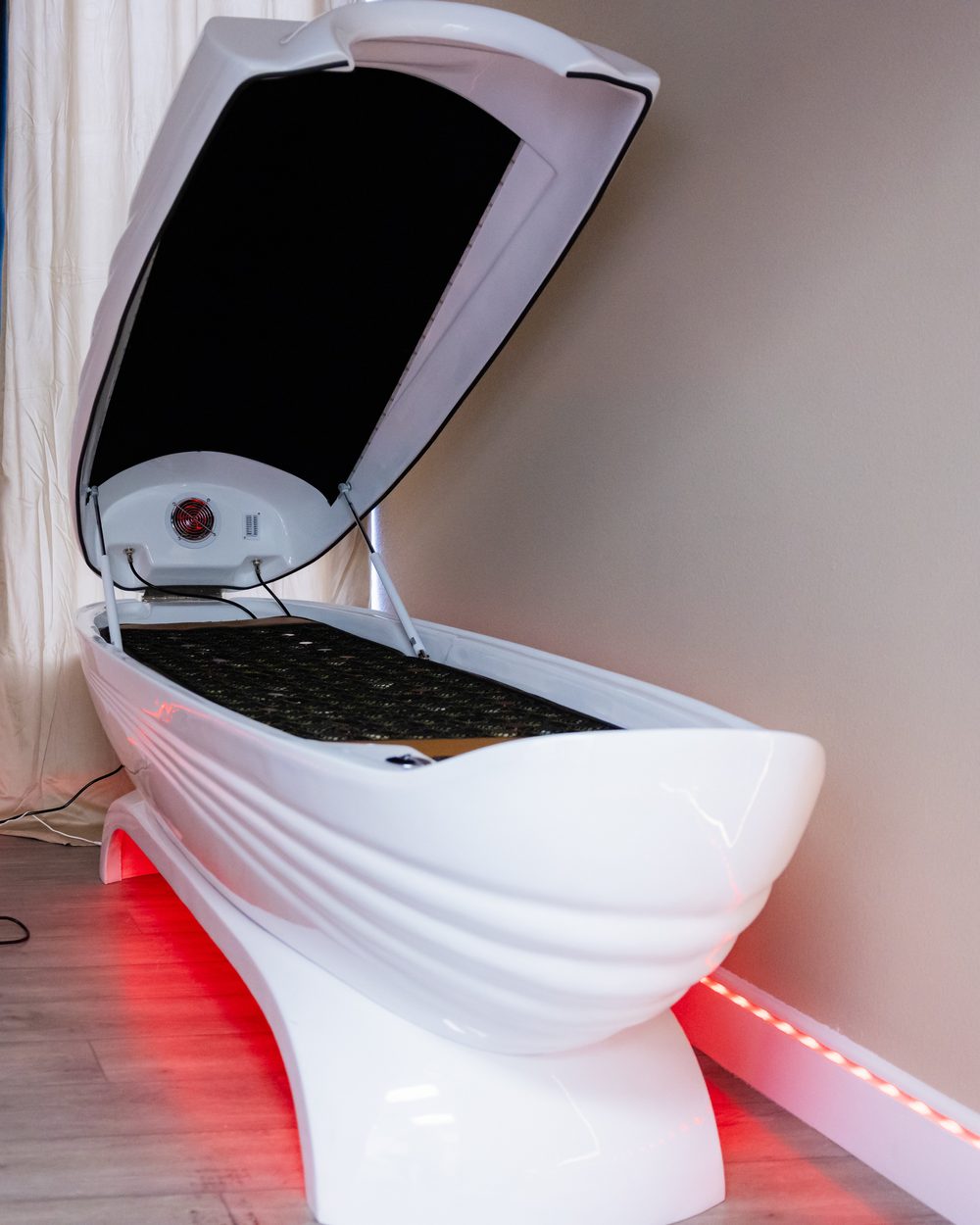
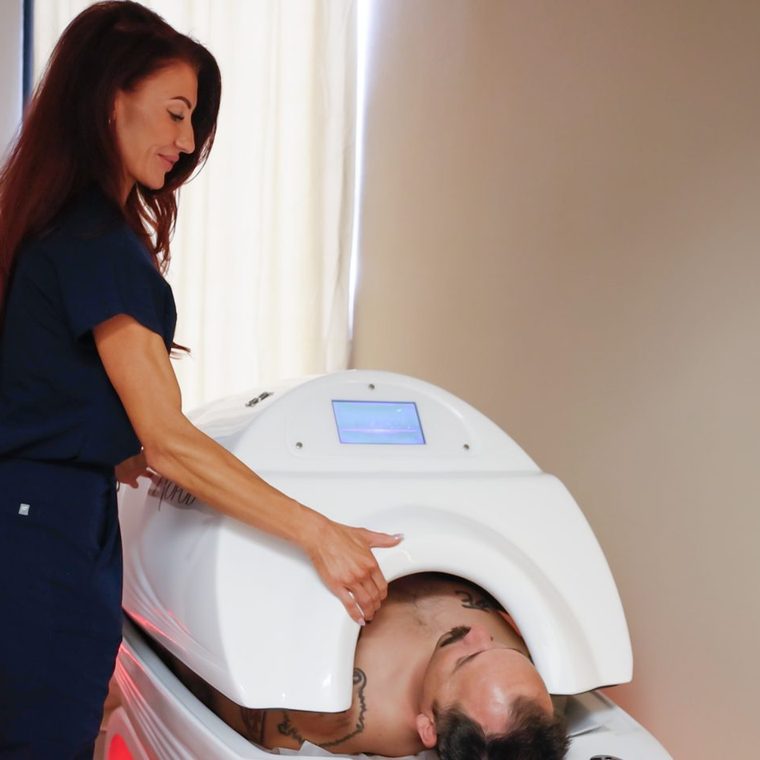
An infrared pod encloses the body while leaving the head outside the heated chamber.
The practical differences: you breathe room-temperature air, which many people find substantially more comfortable and which reduces the airway heat load. Sessions can run longer at tolerable intensity. And it’s a more accessible format for people who find full enclosure claustrophobic or who don’t tolerate a hot-air environment well.
For a first experience with deliberate heat, or for someone with mild heat sensitivity, the pod is usually the easier entry point.
What a session is like
You’ll change into light clothing or a provided wrap. The pod is preheated; you lie down and the chamber closes around your body with your head remaining outside.
The first several minutes feel like pleasant warmth. Heat builds gradually, and sweating typically begins around the 10 to 15 minute mark. Sessions generally run 20 to 40 minutes depending on your tolerance and experience.
Practical points:
- Hydrate before, during, and after — bring water
- Don’t come on a completely empty stomach or immediately after a heavy meal
- Avoid alcohol entirely before a session
- Sit up slowly afterward; blood pressure can drop and lightheadedness is common
- Cool down gradually rather than going straight into cold
- Start conservatively — 15 to 20 minutes on your first visit
Contraindications and cautions
Consult your physician before using infrared heat if you have:
- Cardiovascular disease, including heart failure, unstable angina, recent cardiac events, or significant arrhythmia
- Uncontrolled hypertension or hypotension
- Pregnancy — elevated core temperature is a concern, particularly in the first trimester
- Conditions affecting thermoregulation, including multiple sclerosis (heat sensitivity is common), autonomic dysfunction, and some spinal cord injuries
- Medications affecting sweating, blood pressure, or heat tolerance — including diuretics, beta blockers, some antihistamines, anticholinergics, and certain psychiatric medications
- Photosensitivity or a photosensitizing medication
- Implanted devices — pacemakers, defibrillators, insulin pumps
- Acute injury with active inflammation — heat may be inappropriate in the first 48–72 hours
- Fever or active infection
Do not use a sauna after drinking alcohol. Do not use one if you are significantly dehydrated. If you feel dizzy, nauseated, or unwell at any point, end the session.
Frequency and stacking
The observational sauna research suggests a dose relationship — more frequent use associates with stronger effects — but that data comes from traditional sauna populations and shouldn’t be over-extrapolated.
A reasonable starting point for most people is two to four sessions weekly, building from shorter sessions as tolerance develops.
Around training: heat exposure immediately after resistance training may interfere with some adaptation signaling, so if muscle growth is your priority, consider separating them by several hours or using rest days. For recovery and relaxation, timing is more flexible.
Common pairings: sauna followed by sequential compression therapy (BOA Max 2) is a frequent combination — heat to open circulation, compression to assist lymphatic return.
Booking in Los Alamitos
The infrared pod at Nawra Wellness Studio, 5122 Katella Ave., Suite 201, Los Alamitos, is available as a single session, in packages, or as part of a recovery membership. Serving Orange County, Long Beach, and the surrounding area.
New clients complete a brief health screening. If you have any of the conditions above, we’ll ask you to check with your physician first.
Frequently asked questions
What’s the difference between infrared and a regular sauna?
Infrared uses radiant energy absorbed directly by the body, achieving a similar core temperature rise at a much lower air temperature. Traditional saunas heat the air. Most people find infrared easier to tolerate for longer.
How long should a session be?
Start with 15 to 20 minutes and build toward 30 to 40 as tolerance develops. Longer is not automatically better.
How often can I use it?
Two to four times weekly suits most people. Daily use is generally well tolerated by healthy, well-hydrated individuals.
Does infrared sauna help you lose weight?
Weight lost during a session is water and returns with rehydration. Heat exposure is a recovery and circulation tool, not a fat loss method.
Does it detox your body?
Detoxification is performed by the liver and kidneys. Sweat is primarily water and electrolytes. Claims about sweating out significant toxins are not supported.
Is it safe if I’m pregnant?
Elevated core temperature during pregnancy is a recognized concern. We do not recommend sauna use during pregnancy without explicit physician clearance.
Can I use it if I have a heart condition or take blood pressure medication?
Consult your physician first. Heat exposure produces a genuine cardiovascular response and interacts with several common medications.
Should I use it before or after a workout?
After is more common for recovery. If hypertrophy is your primary goal, consider separating heat exposure from resistance training by several hours.
What do I wear?
Light athletic clothing or a provided wrap. Bring water and a towel.
This article is educational and not medical advice. Heat exposure carries risk for people with certain medical conditions and for those taking medications affecting cardiovascular function or thermoregulation. Consult your physician before beginning regular sauna use.