
The closest alternative to liposuction may be the option that doesn’t try to do the same job. If you’re searching for alternatives to liposuction near me, start by defining your goal: address a localized area, focus on muscle stimulation, or better understand your body composition. These goals point to different treatment categories.
It’s reasonable to want clear answers before weighing surgical and non-surgical treatments. They differ in purpose, process, and trade-offs, and non-surgical body contouring shouldn’t be treated as a surgical equivalent. Compare what each approach is designed to address, how it is delivered, and what assessment is relevant, rather than relying on the biggest promise.
This guide compares treatment categories and practical considerations to help you narrow your options. It also explains how NAWRA’s EMSCULPT NEO, a non-invasive body-contouring and muscle-stimulation service, may fit a muscle-stimulation goal, and how DEXA body composition scans can add measurement context. If you’re in Los Alamitos or nearby Orange County communities, you’ll have a clearer basis for an informed next step.
Key Takeaways
- Begin with the change you want, such as addressing a localized area or focusing on muscle stimulation.
- When comparing alternatives to liposuction near me, distinguish surgical procedures from non-surgical treatment categories. They are not interchangeable.
- Compare options by intended goal, invasiveness, recovery considerations, and the assessment used to guide a decision.
- Narrow your options in sequence: define your priority, identify the relevant treatment category, then weigh its trade-offs.
- NAWRA offers EMSCULPT NEO for non-invasive body contouring and muscle stimulation, and DEXA scans for body-composition measurement.
What does an alternative to liposuction actually mean?
Searching for alternatives to liposuction near me can bring up treatments that sound similar but are designed to do different things. Liposuction is a surgical procedure that removes fat from the body. “Alternative” is a broad label for other approaches, which may focus on localized fat, muscle stimulation, or another body-contouring goal. The label doesn’t mean a treatment works like surgery or produces the same degree of change.
Start by identifying the change you want. Someone concerned about a localized area is asking a different question from someone focused on muscle tone or better insight into body composition. Skin appearance is another consideration, and shouldn’t automatically be assumed to change with a fat-focused method. Match your goal to a treatment’s stated purpose, then compare the process and trade-offs. Suitability and outcomes vary by person and approach, so an individualized clinical assessment matters.
Liposuction and non-surgical treatments address different decisions
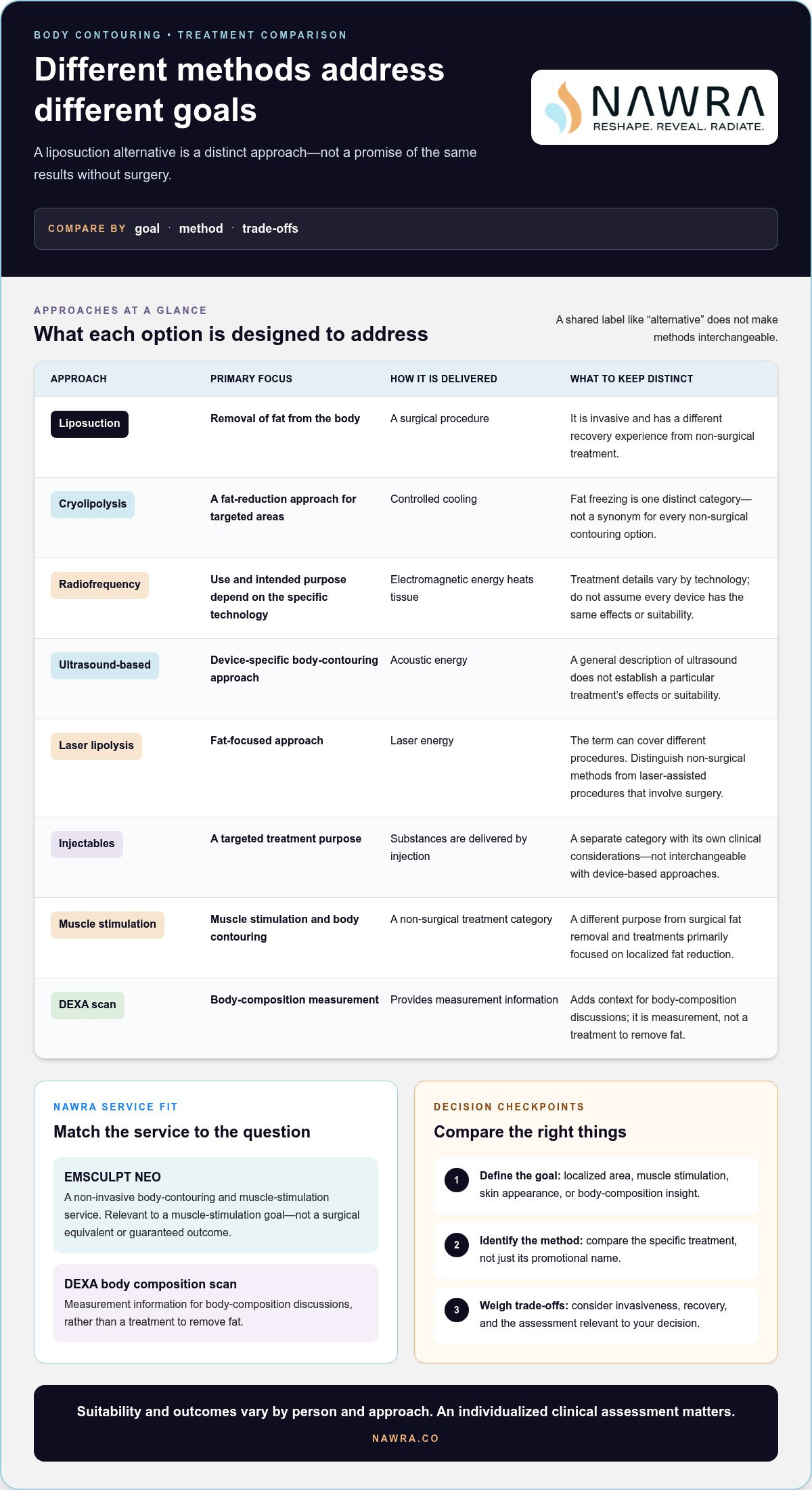
Liposuction is an operation. Non-surgical treatments use other methods and shouldn’t be described as surgery without incisions. For example, cryolipolysis uses controlled cooling as a fat-reduction approach. Cryolipolysis (fat freezing) is one distinct category, not a synonym for every non-surgical contouring option.
The trade-offs differ, too. Surgery is invasive and has a different recovery experience from non-surgical treatment. The specifics depend on the procedure and individual circumstances. Non-surgical doesn’t mean risk-free, suitable for everyone, or equivalent in effect to an operation. Marketing terms such as “non-surgical liposuction” can blur these distinctions. Look past the label and identify the method, intended goal, and relevant assessment.
A liposuction alternative is a distinct approach to body contouring, not a promise of the same results without surgery.
Start with the outcome you want to change
Be specific about your priority. A localized-fat concern may lead you to explore fat-focused technologies. A muscle-tone goal points toward muscle-stimulation treatments, which have a different purpose. If your goal is to understand body composition, measurement can add context without being a treatment to remove fat.
NAWRA offers EMSCULPT NEO as a non-invasive body-contouring and muscle-stimulation service. It’s relevant to a conversation about muscle stimulation, not a surgical equivalent or a guaranteed outcome. NAWRA also offers DEXA body composition scans, which provide measurement information for body-composition discussions. These services answer different questions, so match the option to your priority.
Before comparing individual technologies, write down what you want to change and which trade-offs matter to you, such as invasiveness or recovery. This simple step makes a search for alternatives to liposuction near me more focused and helps separate a treatment’s actual purpose from its promotional name.
How non-surgical liposuction alternatives differ by treatment approach
“Non-surgical” describes how a treatment is delivered, not what it’s designed to change. Some approaches focus on localized fat. Others involve injections, muscle stimulation, or body contouring. Grouping treatments by purpose makes comparisons more useful than treating every device or procedure as a version of liposuction.
Fat-focused technologies are not all the same
Fat-focused technologies use different methods to address targeted areas. Their names can sound technical, but the basic distinctions are straightforward:
- Cryolipolysis uses controlled cooling as a fat-reduction approach. Its method and considerations differ from treatments that use heat or sound energy.
- Radiofrequency uses electromagnetic energy to heat tissue. Its intended use and treatment details depend on the specific technology.
- Ultrasound-based treatments use acoustic energy. Devices differ, so a general description of ultrasound doesn’t establish a particular treatment’s effects or suitability.
- Laser lipolysis uses laser energy as part of a fat-focused approach. The term can cover different procedures, so distinguish non-surgical methods from laser-assisted procedures that involve surgery.
Cryolipolysis (fat freezing) is one named category. Its description shouldn’t be applied to radiofrequency, ultrasound, or laser treatments. For each technology, the treatment area, protocol, evidence, and suitability may vary. Don’t assume that a result, timeline, or safety profile associated with one device applies to another. Evaluate claims for the specific method, not just its broad category.
Injectables form another category. They involve substances delivered by injection for a targeted treatment purpose, rather than energy applied through a device. They have their own clinical considerations and aren’t interchangeable with fat-freezing or other device-based approaches. A qualified clinical assessment can help clarify whether a particular method is appropriate for an individual’s goals and circumstances.
Muscle stimulation is a different comparison category
Muscle-stimulation treatments belong in the comparison, but they shouldn’t be confused with surgical fat removal or technologies whose primary purpose is localized fat reduction. Their stated focus is muscle stimulation and body contouring. A person seeking a change in muscle tone is asking a different question from someone considering a fat-focused procedure.
NAWRA offers EMSCULPT NEO as a non-invasive body-contouring and muscle-stimulation service. Consider it when that focus aligns with your priorities, not as a surgical equivalent or a promise of a specific result. NAWRA’s article “EMSCULPT NEO Los Alamitos: The Science of Body Contouring” explores the service in more detail.
To keep the comparison grounded, identify the treatment’s stated purpose, the area it addresses, and the relevant assessment. For a closer look at NAWRA’s EMSCULPT NEO service, consider whether its muscle-stimulation focus fits the change you want to pursue.
Compare liposuction alternatives by invasiveness, goals, and trade-offs
A side-by-side comparison shows where options differ, but it can’t determine which treatment is right for you. Compare the intended goal first. Then consider how invasive the approach is, what recovery may involve, and whether an individualized assessment guides the decision. The categories below are broad, and details can vary by procedure or technology.
| Approach | Intended goal | Invasiveness | Recovery considerations | Assessment |
|---|---|---|---|---|
| Liposuction | Surgically remove fat from selected areas. | Surgical procedure. | Involves a recovery period; the experience depends on the procedure and individual circumstances. | Yes. A clinical discussion is needed to consider suitability, risks, and goals. |
| Non-surgical fat-focused treatments | Address localized fat using a specific technology, such as cooling, radiofrequency, ultrasound, or laser. | Non-surgical approaches differ by method; the category does not imply one shared process. | Recovery considerations vary by technology and individual. Don’t assume one method’s recovery applies to another. | Yes. The target area, approach, and personal suitability need consideration. |
| Muscle-stimulation services | Focus on muscle stimulation and body contouring, rather than surgical fat removal. | Non-invasive options are distinct from surgery and from fat-focused procedures. | Expectations and considerations depend on the service and personal circumstances. Avoid assuming a particular outcome or timeline. | Yes. An assessment can clarify whether the approach aligns with the person’s goal. |
What to compare before deciding
Use the same questions for each option: What change is it designed to address? Is the method surgical, non-surgical, or non-invasive? What does recovery involve for that specific procedure? What assessment helps determine whether it fits your circumstances? Keep these criteria separate. Low invasiveness doesn’t by itself tell you what a treatment can change, and a recovery description doesn’t establish suitability.
For example, if your concern is a localized area of fat, a muscle-stimulation service may not address the same goal as a fat-focused treatment. If your priority is muscle stimulation, comparing only fat-removal approaches misses the point. An assessment should consider your goal, the treatment’s intended use, and relevant individual factors, including potential risks.
Why non-surgical does not mean identical to surgery
Non-surgical approaches may be less invasive than an operation, but their methods and aims differ. Liposuction surgically removes fat; non-surgical fat-focused technologies use other approaches, while muscle-stimulation services have a distinct focus. Don’t assume the scale or nature of change will match surgery. Results and timing can vary by technology and individual, so promotional comparisons shouldn’t be treated as predictions.
Compare treatments by the change they’re designed to address, not by the assumption that a non-surgical option replicates surgery. If you’re researching alternatives to liposuction near me, use the table to frame questions for an individualized clinical discussion. Clear goals, realistic expectations, and relevant assessment make for a more useful comparison than a broad “before and after” promise.
How to decide which liposuction alternative fits your goals
A focused decision starts with your desired change, not a device name. Someone comparing alternatives to liposuction near me may want to address localized fat, focus on muscle stimulation, or understand body composition. Those goals call for different conversations. Use this four-step framework to narrow the options before discussing suitability with a qualified clinical professional.
A four-step framework for narrowing your options
- Describe the change you want. Be concrete. Is your priority a specific area of localized fat, muscle tone, skin appearance, or clearer information about body composition? Separate the concern you want to address from the result you hope a treatment will produce.
- Identify the broad category. A fat-focused technology, a muscle-stimulation service, and a body-composition scan serve different purposes. A category can help you decide what to explore, but it can’t establish whether a particular option is suitable for you.
- Review the trade-offs. Compare how the approach is delivered, its intended goal, recovery considerations, and known limitations. Keep each question specific to the treatment rather than assuming details carry over from another technology.
- Seek an individualized assessment. Bring your goal and questions to a qualified clinical discussion. Ask how the option relates to your concern, what factors affect suitability, and what realistic outcomes and risks to consider. Assessment connects general treatment information with individual circumstances.
This sequence helps you avoid comparing unlike options. If your main concern is localized fat, focus your research on fat-directed approaches. If your priority is muscle stimulation, consider services designed around that goal rather than treating them as fat-removal procedures. If you’re unsure what you want to measure or track, a body-composition assessment may add context before you decide what kind of intervention, if any, aligns with your goals.
Use measurement to add context, not promises
Body-composition data can provide a reference point for discussing progress beyond appearance alone. NAWRA offers DEXA body composition scans as an assessment option. A scan provides measurement information; it isn’t a body-contouring treatment, a diagnosis, or a substitute for clinical evaluation. It can’t guarantee how a person will respond to a treatment. Its value is in adding context to a conversation about goals and change.
For more on how this type of measurement fits into wellness, explore NAWRA’s DEXA Scan Los Alamitos: Precision Body Composition for High-Performance Wellness article. Consider whether a measurement would help clarify the question you’re trying to answer. More data doesn’t automatically mean a particular treatment is needed.
Bring your priorities together: define the goal, match it to a relevant category, weigh the trade-offs, and discuss personal suitability. If you’re in Los Alamitos or nearby Orange County communities, explore NAWRA’s body-composition and body-contouring services as part of an informed next step.
Explore non-surgical body contouring at NAWRA near Los Alamitos
For readers comparing alternatives to liposuction near me, a local option is most useful when its purpose is clear. NAWRA offers EMSCULPT NEO, a non-invasive body-contouring and muscle-stimulation service. It may fit a goal that includes muscle stimulation and contouring. It isn’t surgical liposuction, a replacement for the procedure, or a promise of a specific result.
What to expect from a goal-focused discussion at NAWRA
Start by describing the change you’re considering. If you’re focused on muscle stimulation, EMSCULPT NEO is a service to discuss in that context. If you’re seeking surgical removal of fat, that is a different treatment category and decision. Clear language keeps the conversation aligned with what a service is designed to address, rather than what a broad label or advertisement might suggest.
Keep the questions practical: Does the service’s stated focus match your goal? What factors should inform an assessment of suitability? What expectations are realistic for your individual circumstances? These questions support an evidence-conscious discussion without assuming a particular outcome. Personal goals and responses vary, so a treatment description alone can’t determine what is appropriate for you.
NAWRA also offers DEXA body composition scans. A scan can add measurement context to a conversation about body composition, but it isn’t a body-contouring treatment or a guarantee of change. Keeping measurement and treatment distinct can help clarify whether you’re looking for information, a muscle-stimulation service, or a fat-focused approach.
Find a local next step in Orange County
NAWRA serves Los Alamitos and nearby Orange County communities. If you’re in Cypress, Cerritos, Long Beach, or Seal Beach, location may be one part of your search. The other is fit: whether the service’s focus corresponds to the change you want to explore. A clear comparison lets you weigh local relevance alongside purpose, limitations, and personal suitability.
For a closer look at the service and how it’s described, Explore NAWRA’s body-contouring services. Review EMSCULPT NEO as a non-invasive body-contouring and muscle-stimulation option, then consider whether that focus aligns with your priorities. If your goal is different, use the distinctions in this guide to frame your next clinical discussion around the approach that addresses it.
Make your next step specific to your goals
Your next step doesn’t need to be choosing a treatment immediately. Start with one clear question: what kind of change are you seeking, and what information would help you assess your options? That focus can make a search for alternatives to liposuction near me more useful, especially when treatment labels blur different goals and trade-offs.
If you’re considering a non-invasive approach, use your priorities to guide a focused discussion rather than expecting one option to address every concern. NAWRA’s body-contouring and measurement services offer a local starting point for exploring those questions in Los Alamitos and nearby Orange County communities.
Explore NAWRA’s body-contouring services and consider whether EMSCULPT NEO’s muscle-stimulation focus fits the change you want to discuss. A thoughtful next step begins with clarity, realistic expectations, and a plan that reflects your goals. Move forward informed and at your own pace.
Frequently Asked Questions
Is there a non-surgical alternative to liposuction?
Yes, non-surgical treatments exist, but there isn’t one universal substitute for liposuction. Some are intended to address localized areas, while muscle-stimulation services have a different focus. Before comparing them, write down the specific change you want and practical considerations, such as how much recovery time you can accommodate. A qualified clinician can discuss how your goals and health context relate to a particular option.
Can EMSCULPT NEO replace liposuction?
No. EMSCULPT NEO and liposuction are different treatment categories, with different purposes and processes. NAWRA offers EMSCULPT NEO as a non-invasive sculpting and muscle-stimulation service; liposuction is surgery. If you’re considering EMSCULPT NEO, frame the discussion around whether its muscle-stimulation focus fits your priorities. Don’t assume it will produce the same kind or degree of change as surgery.
How do I find alternatives to liposuction near me in Orange County?
Compare local options by their stated purpose, invasiveness, and recovery considerations, then consider whether each aligns with your goal. NAWRA is in Los Alamitos and serves nearby communities including Cypress, Cerritos, Long Beach, Seal Beach, La Palma, Buena Park, Lakewood, Anaheim, Norwalk, Irvine, Laguna Niguel, Newport Beach, Huntington Beach, Bellflower, Tustin, Fullerton, and Yorba Linda. Review the specific service and discuss personal suitability with a qualified clinician.
What is the difference between fat reduction and muscle stimulation?
Fat-reduction approaches focus on localized fat, while muscle-stimulation services focus on stimulating muscle. This distinction helps you avoid choosing a service based only on the broad phrase “body contouring.” If your main priority is muscle stimulation, ask how that focus relates to your goal. NAWRA offers EMSCULPT NEO as a non-invasive sculpting and muscle-stimulation service, but individual outcomes shouldn’t be assumed from the category alone.
Are non-surgical alternatives to liposuction right for everyone?
No. A treatment may not suit every person or match the change they want. Before deciding, consider whether the service’s stated purpose addresses your concern, and discuss relevant health context, potential risks, and realistic expectations with a qualified professional. Be wary of broad promises that imply the same outcome for everyone. A careful assessment puts general treatment information in the context of your individual goals.
Can a DEXA scan tell me which body-contouring treatment to choose?
No. A DEXA body-composition scan provides measurement context; it doesn’t select a treatment, diagnose a condition, or guarantee a result. NAWRA offers DEXA body composition scans to support a more informed discussion about measurements and goals. If you’re trying to understand body composition rather than appearance alone, a scan may add useful context. A qualified professional can help interpret what the information does and doesn’t indicate.