A facial-lifting treatment should be judged by more than the first mirror check. Emface therapy in Fullerton combines radiofrequency with HIFES muscle stimulation. A typical course is four sessions spaced about a week apart, with changes continuing to develop after the series.
It’s reasonable to want a clear picture of what the treatment does and when to expect visible changes. Emface uses radiofrequency to heat tissue and HIFES to stimulate facial muscle activity. Consider results over time rather than judging them immediately after a session.
This article explains how Emface works, what facial-lifting and toning results may look like, and how progress is assessed. It also covers the usual treatment schedule, when results may become more apparent, and how long they may last. The aim is a practical, evidence-focused overview to help you understand the timeline and decide whether this approach fits your goals.
Key Takeaways
- A typical Emface course involves four sessions spaced about a week apart, with changes continuing to develop afterward.
- Emface pairs radiofrequency tissue heating with HIFES muscle stimulation to address skin and facial muscle tone.
- Assess results across the treatment timeline, looking at facial lifting, toning, and wrinkle appearance rather than relying on an immediate impression.
- Results may last for months, and maintenance timing depends on how your facial changes develop.
- Clinical findings offer useful context, but understanding what each measurement represents helps set realistic expectations.
HOW MANY EMFACE TREATMENTS ARE NEEDED TO SEE RESULTS?
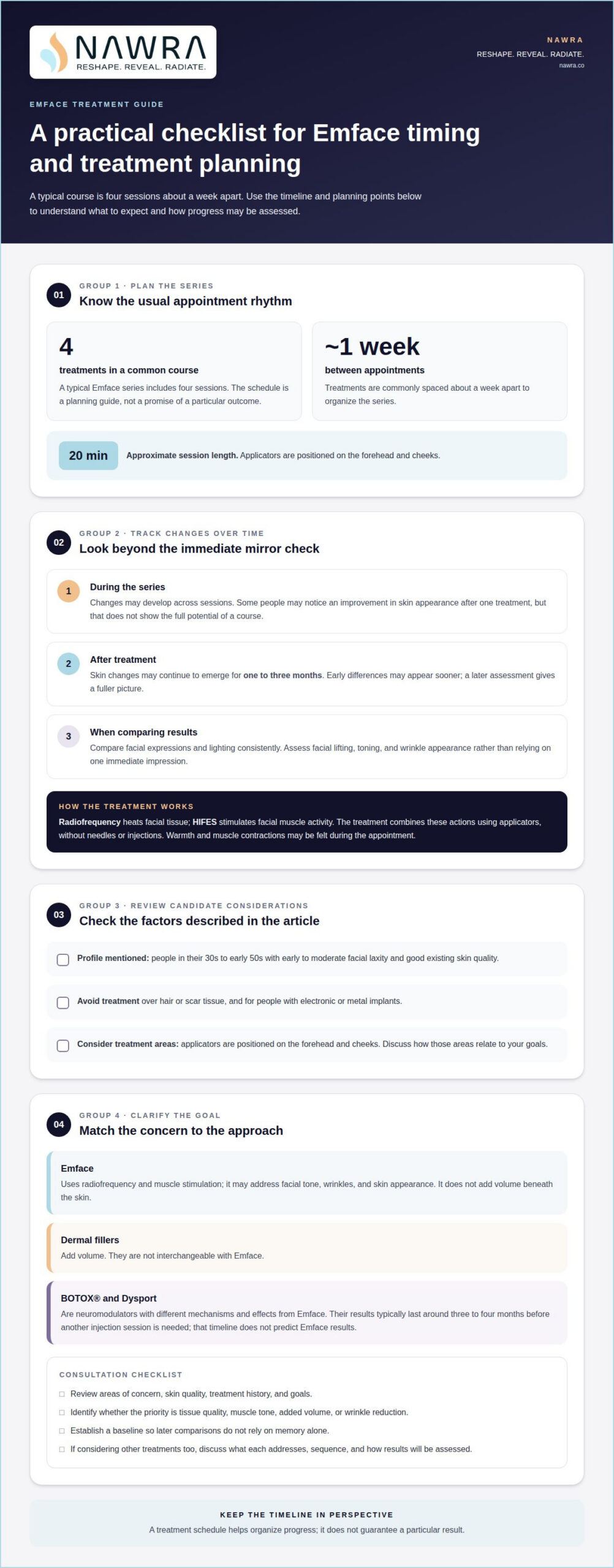
A typical Emface course includes four treatments, usually scheduled about a week apart. Changes may develop across the sessions and afterward. If you’re considering Emface therapy in Fullerton, this schedule can help you understand the usual time commitment before planning appointments.
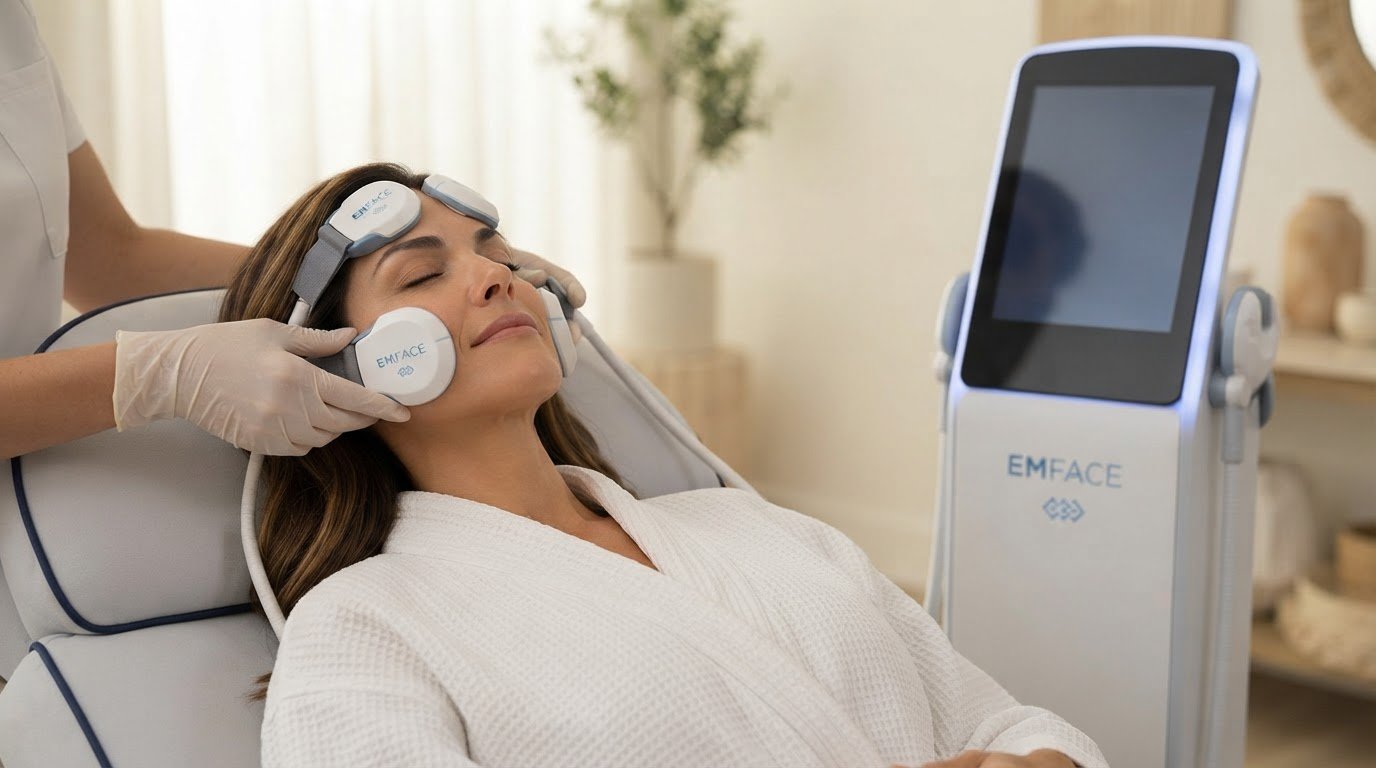
A 20-minute procedure uses applicators on the forehead and cheeks. Those treatment areas, the starting degree of facial laxity, and the desired change shape the plan.
Session Length and Recommended Series
Each Emface session takes about 20 minutes, and a common course consists of four treatments. That schedule helps set practical expectations for time and progress.
Some people may notice an improvement in skin appearance after one treatment, but this doesn’t show the full potential of a course. A series also gives the practitioner opportunities to review facial response as treatments progress. Emface is non-invasive and has zero downtime, so you can return to everyday activities after a session. The course length is a planning guide, not a promise of a particular outcome.
Treatment Schedule and Results Timeline
Treatments are commonly spaced one week apart, with improvements generally becoming clearer after the series. This interval allows time between appointments while keeping the treatment schedule organized.
Skin changes may continue to emerge for one to three months after treatment. Early differences may appear sooner, but a later assessment gives a fuller picture. Compare facial expressions and lighting consistently instead of relying on a single mirror check immediately after a session.
Who may be a good candidate? Emface may suit people in their 30s to early 50s with early to moderate facial laxity and good existing skin quality. Avoid treatment over hair or scar tissue, and for people with electronic or metal implants.
During a consultation, the provider reviews your areas of concern, skin quality, treatment history, and goals. This helps distinguish concerns Emface targets, such as facial tone and wrinkles, from changes addressed by other approaches. Emface uses radiofrequency and muscle stimulation; it doesn’t add volume beneath the skin like a dermal filler.
The applicators are positioned on the forehead and cheeks, focusing treatment on those areas. The provider can explain how they relate to your goals and establish a baseline for assessing visible changes. A defined starting point makes later comparisons more useful than relying on memory.
Emface may appeal to people seeking facial toning without needles or surgery. It isn’t interchangeable with dermal fillers: fillers add volume, while Emface uses energy and muscle stimulation. A consultation can clarify your main concern and whether the treatment areas align with your goal.
Does Emface Work?
Emface combines synchronized radiofrequency and HIFES muscle stimulation in one facial treatment. Radiofrequency heats tissue, while HIFES stimulates facial muscle activity. These energy-based actions target different structures during the same procedure. This explains why Emface is neither simply a skin treatment nor a muscle workout. It combines tissue heating and muscle stimulation rather than relying on either alone.
Radiofrequency delivers controlled heat to facial tissue. HIFES, short for high-intensity facial electrical stimulation, prompts muscle contractions. Together, these actions are intended to support skin quality and facial muscle tone. The device delivers the energies through applicators, not needles or injections. You may feel warmth and muscle contractions during the appointment.
Some descriptions use “electromagnetic stimulation” or “HIFEM” when discussing facial muscle treatments. The Emface technology described here is HIFES, paired with radiofrequency. These terms shouldn’t be treated as interchangeable: HIFES names Emface’s facial muscle-stimulation method. The distinction matters because a device’s technology, placement, and purpose help define what the procedure is designed to address.
Radiofrequency and muscle stimulation have distinct roles: heating affects tissue, while HIFES stimulates muscle activity. Their synchronized application combines these mechanisms in one treatment. That doesn’t mean every concern responds in the same way. Wrinkles, skin texture, and facial tone are separate outcomes, so an assessment should identify your priority and how progress will be evaluated.
Emface differs from dermal fillers and BOTOX®. Fillers add volume, while BOTOX® and Dysport are neuromodulators. Their mechanisms and effects differ from Emface’s combination of radiofrequency and HIFES. Results from BOTOX® or Dysport typically last around three to four months before another injection session is needed. That timeline doesn’t predict how long Emface results last; these are separate treatments with distinct purposes.
If you’re considering Emface alongside dermal fillers or BOTOX®, discuss all the treatments during planning. Consider which concern each addresses, what sequence makes sense, and how results will be assessed. This avoids treating different approaches as substitutes. A clear plan keeps the goal specific: tissue quality, muscle tone, added volume, or wrinkle reduction.
For a closer look at the treatment approach, review Emface treatment information as you consider which facial concerns to discuss at an appointment.
Duration of results and maintenance sessions
Emface results develop over time, so an immediate mirror check won’t show the full change. Understanding the recovery and follow-up timeline helps put changes in facial appearance into context.
Emface may improve facial tone, wrinkles, and skin appearance. Results may last six months or more, and some results from a treatment series may be maintained for up to one year.
Before treatment, during the appointment, and afterward, expect preparation guidance, warmth and muscle contractions, then a gradual results timeline. Med Lounge advises specific sun and skincare precautions around sessions.
Recovery and Gradual Results
Recovery describes how the skin may respond after treatment as results continue to develop. Temporary effects and longer-term changes occur on different timelines.
Emface has zero downtime, but mild redness, swelling, or flaking may last a few days. These short-term effects don’t indicate the final facial result. Changes in collagen and appearance can continue after the appointment, so assess fine lines and tone over time rather than immediately.
Med Lounge advises using a gentle cleanser and moisturizer for 24-48 hours after treatment. It also advises avoiding exfoliants, retinoids, and active ingredients such as AHAs and BHAs for 2-3 days afterward. Broad-spectrum sunscreen with SPF 30+ is recommended daily.
For the first 24 hours after a session, Med Lounge advises avoiding excessive sun exposure, saunas, and intense workouts. It also advises waiting 7-10 days before facial treatments such as chemical peels or microneedling.
Assessing Results Over Time
Assess results by comparing facial changes at consistent points over time, rather than relying on an immediate impression. This helps distinguish temporary skin responses from developing changes in appearance.
Improvements may appear in the weeks after sessions. Full results are reported to be noticeable around 90 days after the last procedure, while meaningful changes may develop over one to three months. Comparing photos with similar lighting and facial expressions can make changes in fine lines and tone easier to evaluate.
Reported timelines vary: Emface results may last six months or more, and results after a treatment series may be maintained for up to one year. These describe possible longevity, not a fixed expiration date. Collagen production may continue for several months, helping explain why the final appearance can emerge after the treatment course.
Maintenance is often discussed in relation to how results change over time. Med Lounge recommends maintenance sessions every few months to help sustain results. Consider the interval alongside observed facial changes and personal goals, rather than treating one date as right for everyone.
Before a session, Med Lounge advises avoiding excessive sun exposure and tanning for at least one week. It also advises avoiding exfoliating products, including retinoids or acids, for three days before an appointment. These preparation steps, followed by appropriate aftercare, provide a framework for tracking recovery and results.
Facial lifting, toning, and wrinkle reduction
EMFACE targets facial wrinkles, skin tone, and muscle tone through synchronized radiofrequency and HIFES stimulation. Reported outcomes describe different changes, so understand “lifting” through specific measures rather than as a single broad claim.
Facial Muscle Stimulation and Lifting
Facial muscle stimulation activates underlying muscles, while reported brow elevation offers one measure of lifting. In reported data, brow elevation was 23% at a three-month follow-up after HIFES treatment.
That figure describes a measured brow change, not a guaranteed result for every facial area. It helps distinguish a specific lifting outcome from broader claims about contour or rejuvenation. Timing matters too: a follow-up assessment captures change after treatment, not an immediate effect.
Facial Contouring and Muscle Density
Facial contouring refers to changes in visible facial definition, while muscle tone describes a separate treatment outcome. Reported EMFACE clinical studies describe a 30% increase in overall muscle tone.
Muscle tone and muscle density aren’t identical measures, so the reported tone figure shouldn’t be presented as an increase in density. A change in facial tone may influence how the contour appears, but it doesn’t establish added volume or a specific reshaping effect. EMFACE is non-invasive and does not involve surgery.
Wrinkle Reduction and Rejuvenation
Wrinkle reduction focuses on lines, while facial rejuvenation can include broader changes in skin appearance. EMFACE clinical studies report a 37% reduction in wrinkles, a finding distinct from measures of muscle tone.
Radiofrequency is intended to support collagen production, while HIFES stimulates facial muscles. These mechanisms explain why the treatment addresses more than one tissue target. They don’t mean every wrinkle or skin concern responds identically; the relevant outcome depends on the concern being assessed.
Clinical findings also use defined assessment points. The cited average MFAST facial toning score improved by 37 percent at the 4-month evaluation point. MFAST is a facial toning measure, not a direct percentage of visible lift. That distinction makes the number more useful: it identifies what was assessed and when.
Different figures shouldn’t be combined into one promised result. The 23% brow elevation, 30% muscle tone increase, and 37% wrinkle reduction refer to separate outcomes. A careful comparison identifies the treatment target first, then considers the matching measure. Brow position, wrinkles, and facial tone are related aesthetic concerns, but they aren’t interchangeable endpoints.
For a practical assessment, define the desired change before treatment: softer wrinkles, improved tone, or a more lifted brow appearance. Then compare the same facial area under consistent conditions over time. This keeps EMFACE rejuvenation goals specific and helps distinguish a measured result from a general impression.
Clinical evidence and reported outcomes
Clinical evidence for EMFACE should be read by outcome, assessment timing, and study type. These details show what researchers measured, rather than treating “facial rejuvenation” as one result. The described clinical trials evaluated patients at 1 and 4 months post-treatment. That timing helps distinguish early changes from outcomes measured later.
Different endpoints answer different questions. A wrinkle assessment concerns visible lines; a facial toning score measures a different aspect of appearance. The reported average MFAST facial toning score improved by 37 percent at the 4-month evaluation point. It should be interpreted as a score change, not as a 37 percent lift or a prediction for each patient.
Other reported figures describe separate outcomes. Clinical studies report a 30% increase in overall muscle tone and a 37% reduction in wrinkles. A reported 23% brow elevation was maintained at a three-month follow-up after HIFES treatment. These measures aren’t interchangeable: each reflects a distinct aesthetic endpoint and evaluation method.
A published EMFACE case series reported patient satisfaction of approximately 90 percent. Satisfaction offers useful context about patient experience, but it doesn’t measure collagen and elastin production or quantify wrinkle change. A case series also differs from a controlled clinical trial. Reading the design alongside its outcome helps clarify what the figure can, and cannot, tell readers.
EMFACE combines radiofrequency and HIFES, so its proposed effects involve both tissue heating and muscle stimulation. This helps explain why studies assess skin appearance and facial tone separately. A measured change in one outcome doesn’t prove a change in another. For example, a muscle-toning score alone cannot establish how much fine lines changed.
“Non-invasive” describes an approach without surgery, not an absence of sensation or all possible skin responses. You may feel warmth and muscle contractions during treatment. Assess the procedure’s effects using the specific outcome and follow-up point, rather than relying on an immediate impression. Fillers work differently, adding volume instead of using synchronized energy.
The clearest takeaway is to connect each EMFACE claim to its measure: wrinkle change, brow position, muscle tone, or satisfaction. Study timing matters too; the 1- and 4-month assessments capture different points after treatment. To discuss how facial outcomes are assessed, explore the EMFACE treatment approach and identify the changes most relevant to your goals.
NAWRA: ExoPod Full-Body Therapy
NAWRA’s ExoPod Full-Body Therapy is a natural next step if your wellness goals extend beyond facial treatment. Emface focuses on facial appearance, while ExoPod offers a full-body therapy option. The right direction depends on your concern; the services aren’t interchangeable.
If your focus is body composition, DEXA Body Composition can assess it. For body-contouring goals, EMSCULPT NEO may be relevant. These options address different needs, so start by identifying your goal and discussing which service fits.
Contact NAWRA to discuss ExoPod Full-Body Therapy and your wellness goals.
Choose Your Next Step With Clarity
Use your facial goals to guide the next conversation. If you’re considering Emface therapy in Fullerton, begin with the change you want to assess, such as facial tone, wrinkles, or overall appearance. A focused discussion can connect your goal with an appropriate treatment plan without treating every aesthetic concern the same way.
If your priorities extend beyond facial aesthetics, NAWRA also offers EMSCULPT NEO, DEXA Body Composition, and ExoPod Full-Body Therapy. Each addresses a different wellness or body-composition goal. Identify what matters most to you, then discuss the option that fits.
Bring your questions and goals to the conversation. Contact NAWRA to discuss Emface and explore a clear path forward. A thoughtful first step can make your next decision feel more focused and informed.
Frequently Asked Questions
What is Emface?
Emface is a non-invasive facial aesthetic treatment designed to address skin appearance and underlying muscle tone. It may suit people seeking facial rejuvenation without needles or surgery. It doesn’t add volume, so it serves a different purpose from injectable fillers. Before considering it, identify the change you want to assess, such as facial tone or wrinkles, then discuss whether that concern matches the treatment’s purpose.
Can Emface replace Botox or fillers?
No. Emface, Botox, and fillers work differently and address different concerns. Fillers add volume, while Botox is a neuromodulator; Emface uses energy-based treatment. Someone seeking added fullness, for example, has a different goal from someone focused on facial tone. Discuss each concern separately during treatment planning. Don’t assume one approach delivers another’s effects; combining treatments requires an individualized plan.
How Long Does It Take to See Results?
Changes may develop over the weeks following treatment and continue to emerge after the sessions. Assess progress by comparing consistent photographs and focusing on one concern, such as brow position or fine lines. Immediate appearance isn’t the only measure. A later comparison can show gradual changes more clearly than memory or a single mirror check.
What should I discuss before treatment?
Discuss your goals, treatment areas, medical history, and any electronic or metal implants before an appointment. EMFACE shouldn’t be applied over hair or scar tissue, and implant status matters for treatment planning. Ask how progress will be assessed and whether your desired change matches the treatment’s purpose. These services have not been evaluated by the FDA and are not intended to diagnose, treat, cure, or prevent any disease.
When might I see a change?
Some people may notice a change in appearance after an early session, while fuller results can develop gradually. Timing depends on the outcome being assessed and the person’s response. Take comparison photographs with similar lighting and facial expressions instead of judging from different images. This gives you a consistent way to notice changes over time and discuss them at follow-up.
What is EMFACE therapy and how does it work?
EMFACE therapy is a needle-free facial procedure combining radiofrequency and HIFES energy. Radiofrequency heats tissue, while HIFES stimulates facial muscle activity. Applicators are used on the forehead and cheeks, focusing treatment on those areas. You may feel warmth and muscle contractions during a session. This combination is intended to address skin and muscle concerns together, rather than adding volume like a filler.
Where can I get EMFACE treatment in Fullerton, California?
NAWRA offers EMFACE at 5122 Katella Avenue, Suite 201, Los Alamitos, California 90720. The studio serves Fullerton and nearby communities, including Cypress, Cerritos, Long Beach, Seal Beach, La Palma, Buena Park, Lakewood, Anaheim, Norwalk, Irvine, Laguna Niguel, Newport Beach, Huntington Beach, Bellflower, Tustin, and Yorba Linda. Its Los Alamitos location provides a local option for people considering treatment in the Fullerton area.
How many EMFACE sessions are recommended, and how long does each session take?
A common course is four EMFACE sessions, with appointments generally spaced about a week apart. Each procedure takes about 20 minutes. That gives you a practical way to estimate the time commitment: a short appointment repeated across a planned series. The treatment plan should also account for your goals and facial areas of concern, rather than treating the session count as a measure of guaranteed results.