The right candidate for a needle-free facelift in La Palma is typically someone in their 30s, 40s, or 50s who wants to address visible signs of aging without surgery. The goal is subtle facial rejuvenation, not the same change as a surgical lift. Suitability depends on the concern being treated and the type of result you’re seeking.
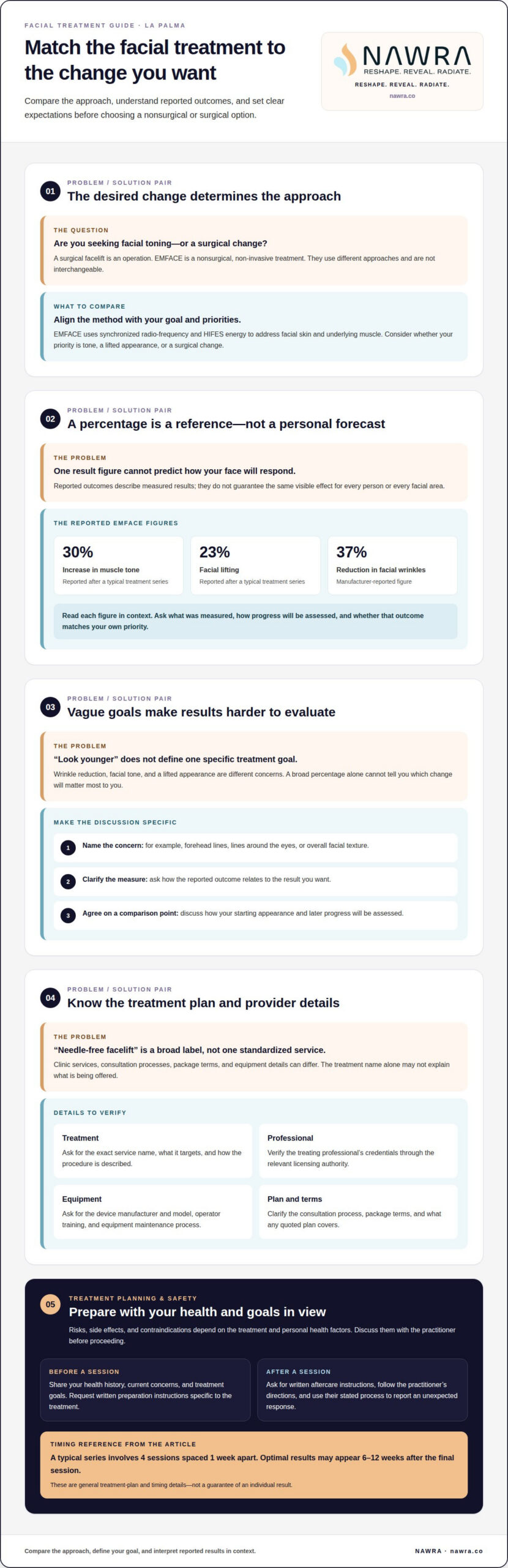
It’s reasonable to want clear expectations before choosing a facial treatment. A typical treatment series involves four sessions spaced one week apart, and reported wrinkle reduction is 37%; optimal results may appear 6-12 weeks after the final session. This guide explains who may be a good candidate, how needle-free facial services compare with surgical options, and what the reported results can tell you as you consider your next step.
Key Takeaways
- Match the treatment approach to your facial goals, and understand how nonsurgical options differ from surgical services.
- Read reported wrinkle-reduction results in context, rather than treating a study figure as a personal prediction.
- Compare the available options in La Palma by the concerns they address and the treatment approach they use.
- Understand what can influence treatment planning, how results develop, and what safety considerations matter.
- Use a clear assessment of your goals and health considerations to decide what questions to discuss before choosing a treatment.
Surgical and nonsurgical facial services
Choosing between a surgical facelift and a nonsurgical option starts with the change you want. Compare the treatment approach, recovery demands, and reported outcomes before deciding.
EMFACE Muscle and Skin Toning
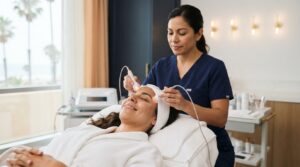
EMFACE is a nonsurgical facial treatment intended to tone facial muscles and skin. Its reported outcomes include a 30% increase in muscle tone after a typical treatment series. That figure describes reported results, not a personal prediction. When assessing suitability, identify your main concern, such as facial tone, and decide whether a nonsurgical approach matches your goals.
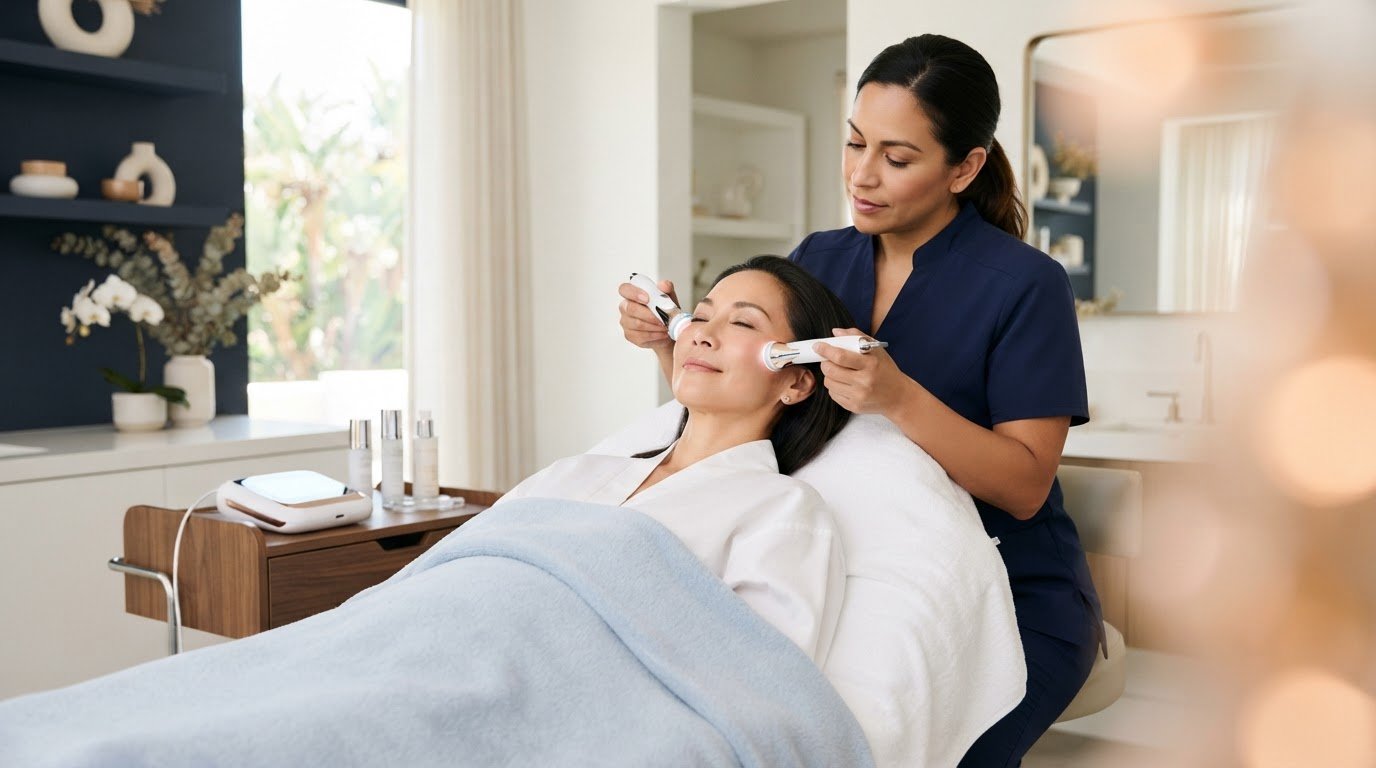
Surgery and nonsurgical treatments take different approaches to facial aging. A surgical facelift is an operation, while EMFACE is a non-invasive treatment that uses synchronized radio-frequency and HIFES energy for facial skin and underlying muscle. They aren’t interchangeable. Clarify whether your goal is facial toning or a surgical change, then compare the approach with your priorities.
Expected Rejuvenation and Facial Lifting
Reported facial lifting after a typical EMFACE series is 23%. This result should be read alongside the reported muscle-tone change, not as a guarantee of the same visible effect for every person. Facial rejuvenation can refer to different goals, including improved tone or a lifted appearance. Define which outcome matters most before comparing treatments, then assess whether the reported lifting measure aligns with that goal.
La Palma clinics may have different consultation, package-pricing, financing, and special-offer policies. Ask for a clear explanation of the consultation process and any package terms before committing, including what the quoted plan covers.
Preparation, Aftercare, and Safety
Before an EMFACE session, prepare by sharing your health history, current concerns, and treatment goals with the practitioner. Ask for written preparation and aftercare instructions specific to the treatment. Risks, side effects, and contraindications depend on the treatment and personal health factors, so discuss these before proceeding. Follow the practitioner’s aftercare directions and report any unexpected response through their stated process.
To assess a La Palma provider’s credentials and equipment, take two practical steps: verify the treating professional’s credentials through the relevant licensing authority, and ask for the device manufacturer and model. You can also ask about the operator’s training and equipment maintenance process. These details help you understand who performs the treatment and what equipment is used.
Reported wrinkle reduction
The manufacturer reports a 37% reduction in facial wrinkles after a typical EMFACE treatment series. That figure offers a concrete reference point, but it shouldn’t be read as a prediction for every face. Use it to frame questions about the result being measured, the treatment plan behind the reported outcome, and whether wrinkle reduction matches your own priority.
Start with a specific concern, such as forehead lines, lines around the eyes, or overall facial texture. These examples help focus the discussion, but they aren’t separate outcome claims. For a needle-free facelift in La Palma, ask how the treatment addresses your particular concern and how progress is assessed.
A percentage alone doesn’t describe the full visible change. The 37% figure summarizes reported wrinkle reduction, while your own assessment should include what you can see and what matters to you. Consider the starting appearance of the area, the treatment goal, and the way progress will be reviewed. Clear expectations make it easier to distinguish a reported result from a personal target.
- Define the concern: Name the facial area or wrinkle pattern you want to address.
- Clarify the measure: Ask how the treatment’s reported wrinkle reduction relates to the result you’re seeking.
- Set a comparison point: Discuss how your starting appearance and later progress will be assessed.
For a needle-free facial treatment in La Palma, use the 37% report as one consideration, not the only decision factor. The practical question is whether the treatment’s intended outcome aligns with your specific concern. A person focused on a particular line may evaluate progress differently from someone seeking a broader facial refresh. Naming that difference helps keep the conversation focused.
Set a goal you can describe clearly. “Reduce the appearance of lines around my eyes” is more specific than “look younger.” Ask how the treatment relates to that goal and how progress will be reviewed. This keeps the conversation focused on your priorities rather than a broad promise.
The reported 37% reduction can help you understand the scale of the claim associated with EMFACE. It can’t tell you exactly how your face will look or which areas will show the most noticeable change. In La Palma, use the figure to guide specific questions and compare the proposed approach with your desired result. For a broader view of facial wellness options, consider how your treatment goal fits into your overall plan.
La Palma Clinics for Needle-Free Facelifts
For a needle-free facelift in La Palma, identify the exact treatment and method rather than relying on the label alone. “Needle-free facelift” is a broad term, not one standardized service. EMFACE, for example, combines synchronized radio-frequency and HIFES energy to address facial skin and underlying muscle.
Use a treatment-specific search rather than relying only on general phrases such as “facial rejuvenation.” Then compare each result against the service details. A clinic describing skin care or facial treatments generally hasn’t necessarily identified a needle-free lifting treatment. Look for the treatment’s exact name, what it targets, and how the clinic describes the procedure.
A useful local comparison records the same details for each La Palma option:
- Clinic identity: Record the business name and La Palma location shown on its own service page.
- Treatment name: Note whether the page names a specific method or uses only a broad phrase.
- Purpose: Identify whether the described goal is facial tone, wrinkle appearance, or lifting.
- Consultation details: Look for how the clinic explains assessment and treatment planning.
- Terms: Review any stated package conditions, financing details, or special offers before making comparisons.
These steps prevent a common mismatch. For example, a page advertising a facial may describe cleansing or skin care, while a needle-free facelift refers to a different treatment goal. Read the service description itself, not just a headline, directory category, or social post. If the page names no treatment method, don’t assume that its general wording proves a specific service is available.
Compare like with like. A clinic’s explanation should connect the method to the concern it aims to address. If one La Palma page discusses skin texture and another describes lifting, those descriptions don’t establish equivalent services. Keep the distinction visible in your comparison notes, and avoid ranking clinics based only on broad marketing language.
To compare clinics for a needle-free facelift in La Palma, look for a current listing that names both the treatment and its location. Then check that the service description matches your goal. Searching for “facelift” alone can bring up surgery, general skin care, or unrelated facial services. A specific treatment name, method, and stated goal make for a more useful comparison.
How many sessions are typically needed, and how long do results last?
The manufacturer-reported EMFACE series consists of four sessions, spaced one week apart. This schedule gives a clear starting point for planning, but it doesn’t establish how long results will last. Separate the treatment schedule from the results timeline: one describes when sessions occur, while the other concerns changes after treatment.
After the final session, results don’t necessarily appear immediately. RefinedMD says optimal EMFACE results appear about 6-12 weeks after the final treatment. That timing helps set a practical assessment window. For example, judging facial changes the day after the last appointment wouldn’t match the period RefinedMD identifies for optimal results.
Use a consistent review process. Before treatment, identify the facial areas you want to assess. After the series, review those same areas with the practitioner. Comparing the same areas helps keep the discussion focused on changes in tone, lifting, or wrinkles rather than memory alone.
- Before session one: Define your main concern and the areas you’ll evaluate.
- During the series: Keep track of the four scheduled appointments.
- After the final session: Use the 6-12-week window as a guide for reviewing progress.
Lasting results and initial results are different questions. The 6-12-week period describes when optimal results appear, not how long they remain. How long a visible effect persists depends on factors such as the starting condition of the face, natural aging, and changes in facial skin and muscle over time. These factors shape how someone perceives and maintains a result.
Plan your expectations around the treatment sequence, not a single appointment. Four weekly sessions form the reported series, and the later review window provides a more appropriate point for assessing change. If you’re comparing a needle-free facelift in La Palma, ask how the clinic structures the series and tracks progress after the final visit. Clear timing helps you compare treatment plans without confusing session frequency with result longevity.
For your own assessment, record the concern you want addressed, then review it consistently after treatment. A specific example could be tracking the appearance of one facial area rather than judging your entire face at once. Discuss how the treatment plan accounts for your goals and what follow-up process is used. That approach keeps the four-session schedule, the 6-12-week results window, and longer-term expectations distinct.
What are the risks, side effects, and contraindications of needle-free facelift treatments?
“Needle-free” means the treatment doesn’t use injections, not that it has no risks. Methods differ, so their potential effects and suitability aren’t interchangeable. Before booking a needle-free facial treatment in La Palma, ask about the specific method, expected sensations, aftercare, and any reasons it may not be suitable for you.
Ask the practitioner to explain what you may feel during treatment, what responses can occur afterward, and which symptoms warrant follow-up. Request guidance specific to the device and treatment area. General claims about facials won’t answer questions about a particular method.
Your health history is an important part of the safety discussion. Share relevant health conditions, medications, recent procedures, and any history affecting the treatment area. Ask how these factors apply to the specific treatment. Don’t leave out a concern simply because the service is described as non-invasive.
Use these questions to structure the conversation:
- Method: What device or technique will be used, and what area will it treat?
- Risks: What side effects are associated with this specific method?
- Contraindications: Which health conditions, medications, or recent procedures could make treatment unsuitable?
- Aftercare: What should you do after the session, and what changes require follow-up?
- Response plan: Who should you contact if you experience an unexpected reaction?
Contraindications need a treatment-specific answer. Don’t assume that a condition that matters for one facial device applies to every needle-free service. Give the practitioner a complete history, then ask them to explain how each relevant factor changes eligibility, treatment settings, or timing. A clear answer should address your circumstances, not rely only on a generic safety statement.
Include equipment and practitioner details in your discussion. Ask which device is used, what training the practitioner has, and how the equipment is maintained. You can verify professional credentials through the relevant licensing authority. A device name alone doesn’t establish that a treatment is right for you.
Before proceeding, make sure you understand the method, possible effects, relevant contraindications, and aftercare. Ask for clarification if anything is unclear. A useful safety discussion connects the specific treatment with your health history and explains what to expect.
Possible sensations and side effects depend on the method, so ask what to expect and which reactions need follow-up. Health conditions, medications, recent procedures, or a history affecting the treatment area may influence suitability. Discuss these factors in relation to the specific treatment.
NAWRA: EMSCULPT NEO
If your goals also include body contouring and muscle stimulation, NAWRA offers EMSCULPT NEO. It combines radio-frequency heating with HIFEM electromagnetic energy to address fat and muscle in the same session. This is a body-focused treatment, not a substitute for facial rejuvenation.
DEXA Body Composition can add a data-informed view of body composition to a broader wellness plan. At NAWRA, every protocol starts with a clinical assessment before treatment, then measures again to track changes. The right service depends on whether your priority is facial rejuvenation, body contouring, muscle stimulation, or understanding body composition.
Contact NAWRA to discuss your goals, or visit nawra.co.
Choose a next step that fits your goals
Start with the change you want, then match it to a treatment designed for that concern. A needle-free facelift in La Palma may suit someone seeking nonsurgical facial rejuvenation, while body-focused services address different priorities. Keep those goals distinct so your next conversation stays specific and useful.
NAWRA offers Emface for facial treatment, alongside EMSCULPT NEO, DEXA Body Composition, and ExoPod Full-Body Therapy for separate wellness goals. If you’re ready to discuss facial services and clarify which option aligns with your priorities, contact NAWRA about facial services.
A clear goal is a strong starting point. Use it to take your next step with confidence.
Frequently Asked Questions
What is a needle-free facelift, and what treatments does it include?
A needle-free facelift describes a non-surgical facial approach without injections, but the term covers different methods. EMFACE, for example, combines synchronized radio-frequency and HIFES energy to address facial skin and underlying muscle. Ask which modality is being offered and what it is designed to address. These services have not been evaluated by the FDA and are not intended to diagnose, treat, cure, or prevent any disease.
What results can needle-free facelift treatments realistically achieve compared with injectables or surgery?
Expect a different treatment approach, not an equivalent version of injectables or surgery. Needle-free device treatments focus on goals such as facial tone or skin appearance. Injectables deliver substances through needles, while surgery involves an operation to change facial tissue. These methods aren’t interchangeable. To compare them, first identify your priority, such as softening the look of lines, improving tone, or pursuing a surgical change, then match the method to that goal.