

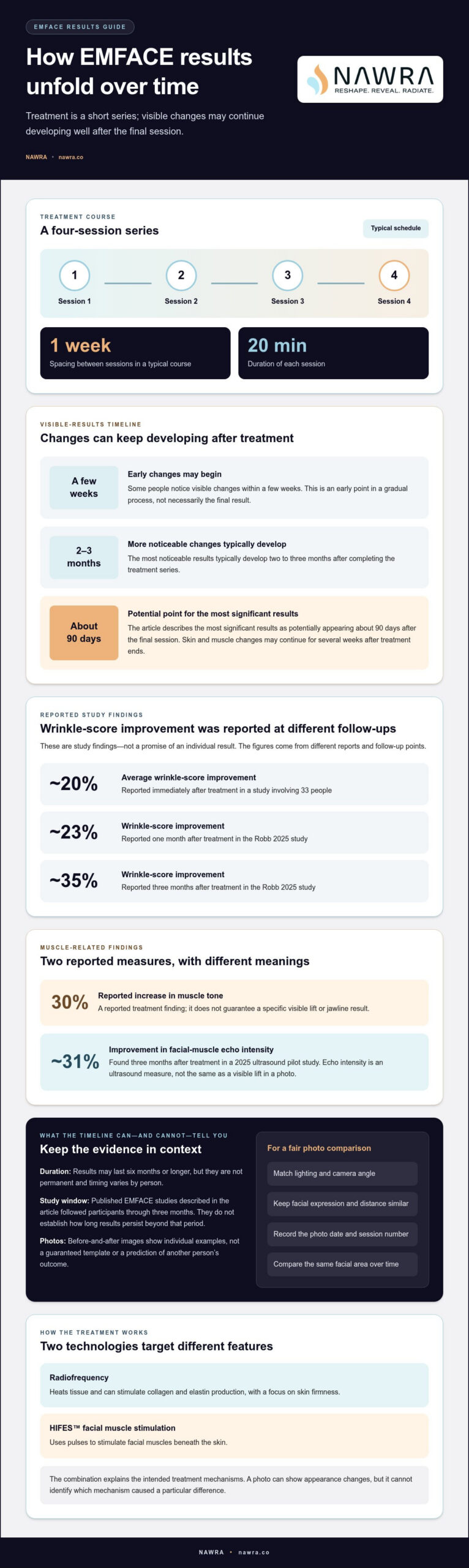
The first visible change isn’t usually the final one. With Emface, results may begin to show within a few weeks, while the most noticeable changes typically develop two to three months after the treatment series; the most significant results may appear about 90 days after the final session. For Emface before-and-after results in Cerritos, the timeline matters as much as the photo comparison.
It’s reasonable to want clear evidence of what a treatment may change and when. EMFACE combines radiofrequency with facial muscle stimulation, and visible changes may continue developing over time rather than appearing all at once.
This article explains how EMFACE works, what a session involves, and how to interpret before-and-after photos. You’ll also learn what the results timeline can show, what it can’t establish on its own, and how to assess whether EMFACE aligns with your goals.
Key Takeaways
- Use the treatment timeline to set realistic expectations, including when changes may become more noticeable after the series.
- Learn what radiofrequency and facial muscle stimulation each contribute to Emface results.
- Understand the typical treatment schedule and what to expect during and after a session.
- Assess before-and-after photos more carefully by looking for consistent angles, lighting, and facial expression.
- See how skin concerns and treatment goals can shape suitability, and when NAWRA’s EMSCULPT NEO may better fit body-contouring goals.
How soon can I expect to see results after starting Emface treatments?
EMFACE combines radiofrequency and facial muscle stimulation, unlike Botox, fillers, or Ultherapy. These treatments work through different mechanisms and timelines, so EMFACE results don’t predict outcomes from them.
Individual Result Variability
Individual result variability means people can show different visible changes after the same treatment schedule. Before-and-after photos illustrate examples, not a guaranteed template for your appearance.
Compare photos taken with similar lighting, facial expression, camera angle, and distance. A smile, shadow, or tilted head can change how facial contours and wrinkles appear. Note when each photo was taken, too. Some EMFACE images show results one month after the fourth treatment, while others may capture a different point in the process.
Skin laxity, facial features, and the changes a person wants to address all affect what stands out in a photo. A wrinkle-focused comparison may show something different from one emphasizing facial contour. Treat each pair as an individual example, not a forecast. EMFACE is non-invasive, and a photo alone cannot predict how another person’s results will develop.
Results Timing and Duration
The results timeline describes when visible changes may emerge and continue developing after treatment. Some people notice changes within a few weeks, while the most visible results typically develop two to three months after completing treatment.
The most significant EMFACE results may appear about 90 days after the final session. Skin and muscle improvements can continue for several weeks after treatment ends. This gradual progression matters when comparing photos: an image taken soon after the series may not show the same changes as one taken later.
Results may last six months or longer, but they aren’t permanent. That duration is a general expectation, not a fixed endpoint for everyone. Published EMFACE studies described here followed participants through three months, so their findings don’t establish how long results persist beyond that period.
Treatment Schedule and Progress
A typical EMFACE course involves four sessions spaced one week apart, with each session taking 20 minutes. This schedule creates a treatment series, but visible changes can continue after the final appointment.
One study involving 33 people reported an average wrinkle-score improvement of about 20% immediately after treatment. The Robb 2025 study reported about 23% improvement one month after treatment and about 35% at three months. These figures describe study findings, not a promised personal outcome.
For a useful progress comparison, record the date and session number alongside each photo. Compare the same facial area under similar conditions, then consider changes at the end of the series and later. Elastin and skin firmness may change over time, so an early snapshot may not capture the full appearance shift. According to the National Library of Medicine, patients in a treatment study lay supine without anesthesia, with cosmetic products, jewelry, and prominent hair cleared before treatment.
How Emface combines radiofrequency and facial muscle stimulation
EMFACE pairs facial muscle stimulation with radiofrequency energy. These mechanisms target different features, helping explain why photos may show changes in both facial tone and skin appearance.
Radiofrequency and Muscle Stimulation
EMFACE combines synchronized radiofrequency and HIFES™ facial muscle stimulation in one treatment. The combination matters because skin and muscle contribute differently to facial appearance.
Radiofrequency energy heats tissue and can stimulate collagen and elastin production. HIFES generates pulses that stimulate facial muscles. One approach targets skin firmness; the other activates muscles beneath the skin. Together, they offer a non-invasive approach that differs from treatments focused on only one tissue layer.
For example, a before-and-after photo might show changes in skin texture, facial contour, or both. The technologies explain the intended mechanisms, but a photo alone cannot identify which one drove a particular visible change. Compare consistent angles and lighting to assess appearance, not to diagnose changes beneath the skin.
Facial Contouring and Jawline Definition
Facial contouring describes visible changes in the face’s shape, including the jawline and cheek area. This distinction matters because a sharper-looking contour in a photo doesn’t necessarily show a change in the neck.
Frame comparisons around the same facial landmarks, such as the cheek outline and lower face. Keep the head position consistent; even a slightly raised chin can alter the jawline’s appearance. If a photo includes the neck, treat it as visual context rather than proof of a treatment effect there.
EMFACE’s combined approach may support changes in facial appearance through muscle stimulation and skin-focused radiofrequency. It isn’t surgical contouring, and a single photograph cannot establish the cause of a visible difference. Review a series of consistent images for a clearer comparison.
Muscle Tone and Rejuvenation
Muscle tone refers to the firmness and support associated with facial muscles. It matters because changes in muscle support can affect how facial contours appear.
EMFACE treatment has been reported to increase muscle tone by 30%. A 2025 ultrasound pilot study found about 31% improvement in facial-muscle echo intensity three months after treatment. Echo intensity is an ultrasound measure, so it isn’t the same as a visible lift in a photograph.
These findings offer two different ways to describe outcomes: a reported muscle-tone change and an imaging measure. Neither guarantees a specific jawline result for each person. For readers comparing non-surgical facial options, Cryo Facial treatment is another facial service to explore, though it uses a different approach.
Treatment benefits and downtime
EMFACE is a non-invasive facial treatment that uses radiofrequency and facial muscle stimulation. A typical course involves four sessions, with each appointment spaced one week apart.
How many EMFACE sessions are needed, and how far apart are they? A typical course includes four sessions, usually one week apart. Each session takes 20 minutes.
What should you expect during an EMFACE appointment, including preparation and recovery? According to the National Library of Medicine, participants were treated lying down without anesthesia, with cosmetic products, jewelry, and prominent hair cleared from the face. Treatment requires no needles or numbing, and no recovery time is described afterward.
The appointment itself is brief, but temporary effects can occur. Redness and swelling generally resolve within 1-2 days, and a warm sensation may last up to an hour after treatment. These effects are distinct from a planned recovery period that keeps someone away from regular activities.
EMFACE treatment is intended for the face. In before-and-after comparisons, the jawline, cheeks, forehead, and eye area can serve as separate visual landmarks. Keep the angle, expression, and lighting consistent when comparing each area. A change in chin position, for example, can affect how defined the jawline looks.
That distinction helps set expectations. A photo focused on the forehead may make different changes noticeable than one framed around the cheeks or eye area. Images show appearance, not the precise mechanism behind a visible difference. Don’t assume one comparison demonstrates the same effect in every facial region.
Radiofrequency and muscle stimulation address different facial tissues. If considering EMFACE alongside another facial treatment, consider the intended treatment area and recovery profile of each. A brief description of one therapy doesn’t establish how a combined plan will feel or appear.
Maintenance sessions every 6 to 12 months can help extend and enhance effects. This interval is a general maintenance reference, separate from the initial four-session course. The treatment plan and follow-up schedule are different parts of the overall process.
EMFACE requires no needles or numbing, but temporary redness, swelling, or warmth can still factor into scheduling. For example, someone planning an event may prefer to account for the possible 1-2-day period when redness or swelling resolves. That’s a practical timing consideration, not a promise that every person will experience those effects.
Is Emface safe for all skin types?
EMFACE is described as suitable for all skin types. Skin type alone, however, doesn’t establish whether its intended effects match someone’s goals. The treatment combines radiofrequency with facial muscle stimulation, so expectations should focus on those targets: skin and muscle. For example, someone seeking facial rejuvenation for mild to moderate skin laxity has a goal that aligns with the treatment’s stated focus. If you’re looking for a different change, clarify that during a consultation.
Suitability also means distinguishing safety from results. “Suitable for all skin types” describes the range of skin types; it doesn’t mean everyone will see the same change. EMFACE is described as most effective for mild to moderate skin laxity. Use that as a practical reference: identify whether laxity is your concern, then compare it with the treatment’s intended focus. A before-and-after photo can illustrate an example, but it can’t establish your likely result.
Consider your treatment goal before comparing EMFACE with fillers or other facial rejuvenation approaches. A consultation can clarify whether your priority is skin firmness, facial muscle tone, or another appearance concern. Those goals aren’t interchangeable. Radiofrequency and muscle stimulation describe EMFACE’s approach; they don’t mean it serves every purpose associated with fillers or other treatments. Naming the desired change precisely makes it easier to assess whether the treatment aligns with your goal.
Realistic expectations matter because “non-invasive” describes an approach, not a guaranteed degree of change. EMFACE uses radiofrequency and facial muscle stimulation rather than surgery. Its stated focus includes mild to moderate laxity, with skin and muscle as distinct targets. For example, someone looking for a subtle improvement in firmness can compare that aim with the treatment’s purpose. If you expect a different type of facial change, discuss that goal during a consultation.
Use a simple suitability framework: identify your concern, define the appearance change you want, and compare both with EMFACE’s focus. Skin type is one consideration, but the treatment’s stated targets matter too. Mild skin laxity, for example, differs from a goal centered on facial volume. Clear expectations help prevent a mismatch between why you’re considering treatment and what radiofrequency plus muscle stimulation is designed to address. This keeps the decision grounded in your goals, not a single photo.
EMface before-and-after patient photos
EMFACE photos can show visible changes in wrinkles, facial contours, and skin texture. They can’t show collagen levels or explain which treatment mechanism produced a difference. Read each comparison as visual evidence, not a complete record of what changed beneath the skin.
Start with the image conditions. Compare photographs with similar lighting, camera distance, facial expression, and head position. For example, a raised chin can make the jawline look more defined, while stronger lighting can soften visible shadows. These differences affect appearance, so consistent framing makes comparisons more useful.
Next, note the treatment timing attached to each image. Photos taken at different points in the treatment timeline don’t show equivalent stages. A pair taken before treatment and several weeks afterward captures a different moment from one taken months later. Record the session milestone and photo date when reviewing progress.
Look at one feature at a time. For wrinkles, compare the same area, such as the forehead or the lines beside the mouth. For contour, use consistent views of the cheeks and lower face. This prevents a broad impression of a “lifted” appearance from replacing a focused comparison of what actually looks different.
Some descriptions report changes in wrinkles and facial lift, but these outcomes should not be treated as measurements visible in photographs. Another reported figure describes a 26% increase in collagen. These figures describe reported treatment outcomes, not measurements visible in patient photographs. A photo can show the appearance of wrinkles or lift; it can’t confirm collagen change.
Use captions as context, not proof. A caption may identify the number of sessions or time between images, helping explain the comparison. It doesn’t tell you whether lighting, expression, or camera position stayed identical. For example, a relaxed face in one image and a smile in another can change how wrinkles appear.
Skin tightening is another phrase you may see in photo descriptions. Separate that label from observable details, such as smoother-looking skin or a more defined facial outline. “Improves” can describe the appearance shown, but it doesn’t quantify the change unless the comparison includes a defined measurement.
A practical review uses three checks: consistent image conditions, clear treatment timing, and a specific feature to compare. Apply the same checks to each before-and-after pair, then distinguish visible appearance from claims about collagen or treatment intensity. This makes photos easier to interpret without treating one person’s result as a template.
To discuss what facial changes matter most to you, start an EMFACE conversation and bring your questions about photo comparisons and treatment goals.
NAWRA: EMSCULPT NEO
NAWRA offers EMSCULPT NEO, a non-invasive body-contouring and muscle-stimulation service. It may be relevant if your goals extend beyond facial appearance to body contouring. Different treatment areas call for different approaches, so first define whether your priority is facial rejuvenation or body composition.
For a data-focused view of physical progress, targeted body assessments can provide a related evaluation. ExoPod Full-Body Therapy and BOA Lymphatic Drainage are also available for distinct wellness goals. These services address different needs; they aren’t substitutes for EMFACE’s facial focus.
If you’re considering a body-focused service or want to discuss which goal to prioritize, contact NAWRA to continue the conversation.
Make your next step a clear one
Before choosing a facial treatment, define the change you want to evaluate. Is your focus a softer appearance of wrinkles, firmer-looking skin, or a different facial contour? Clear priorities make it easier to discuss what matters and judge progress against your own goals, rather than someone else’s photos.
For a more grounded view of Emface before and after in Cerritos, keep a consistent record of your starting appearance and later comparisons. Similar lighting, angle, and expression make differences easier to assess. Bring your questions and priorities to a conversation about whether EMFACE aligns with the outcome you’re seeking. Individual results vary and are not guaranteed, so a personalized discussion can help set realistic expectations.
Contact NAWRA about Emface to discuss your goals and next steps. A thoughtful plan starts with clarity, and you can take that step at your own pace.
Frequently Asked Questions
What is Emface®?
EMFACE® is a non-invasive facial treatment that pairs synchronized radiofrequency with HIFES™ facial muscle stimulation. The radiofrequency component targets skin, while HIFES activates facial muscles. The approach is designed to address skin and muscle together, without needles or surgery. If your concern is facial volume or another change beyond those targets, identify that goal separately before comparing treatment options or photographs.
How many sessions are recommended?
A typical Emface course includes four sessions, usually spaced one week apart. Each appointment takes 20 minutes, which can help with calendar planning. Keep a simple record of each session date and later photo comparisons. That record makes it easier to distinguish changes seen during the treatment course from changes appearing afterward. Individual plans can depend on treatment goals and facial concerns.
Does Emface Really Lift the Face Without Surgery?
EMFACE may create a lifted-looking facial appearance without surgery, but it isn’t a surgical lift. The treatment combines radiofrequency and facial muscle stimulation, and reported outcomes include increased lift. Photos may help show changes in facial contours, but they don’t establish the amount of change for everyone. Compare images taken with similar lighting, expression, and head position to judge visible differences more fairly.
How can I get the best results?
Follow the recommended treatment schedule and keep a consistent record of your progress. For useful comparisons, take photos from the same angle and distance, under similar lighting, with a relaxed expression. Note each photo’s date and where you are in the treatment course. This can’t guarantee a particular outcome, but it makes changes easier to assess and gives you specific observations to discuss during a consultation.
Is There Any Downtime?
Emface is described as requiring no recovery time, so most people can return to daily activities after a session. Temporary redness or swelling generally resolves within 1-2 days, and a warm sensation may last up to an hour. Those short-lived effects can matter when planning around an event. For example, allow time before an important photo occasion rather than scheduling based on an assumption that every face reacts identically.
What Do Clinical Studies Show?
Clinical studies have assessed outcomes such as wrinkle scores and facial-muscle measurements, rather than guaranteeing a specific appearance for each person. The studies described here followed participants through three months, limiting what they can establish about longer-term outcomes. These services have not been evaluated by the FDA and are not intended to diagnose, treat, cure, or prevent any disease. Study findings are evidence, not promises.
What is EMFACE and how does the treatment work?
EMFACE is a facial treatment that combines synchronized radiofrequency and HIFES™ energy. Radiofrequency heats tissue, while HIFES delivers pulses that stimulate facial muscles. The two components act on different facial structures during the same treatment, addressing skin and underlying muscle without needles. This helps explain why before-and-after comparisons may show changes in both skin appearance and facial contour, though photos cannot identify the cause beneath the skin.