
What if the most useful wellness insight isn’t another promise, but a measurement you can understand? If you’re searching for a data-driven wellness clinic near me, you may want more than polished claims. You want to know what an assessment measures and how its results could inform your next step.
That desire for clarity makes sense. DEXA body-composition scans, resting metabolic rate (RMR) tests, and VO2 Max assessments each measure different things. None is a diagnosis or a complete picture of health. Their value comes from understanding what the numbers mean in context and using them to guide a practical wellness conversation.
This guide explains what these assessments measure, how they differ, and how to connect a personal goal with a relevant next step. At NAWRA in Los Alamitos, assessments are offered alongside targeted services such as EMSCULPT NEO, Emface, Emsella, and recovery therapies. Measurement and treatment serve different purposes, but both can help shape a more focused approach for people in Los Alamitos and nearby communities.
Key Takeaways
- Match an assessment to the question you want to explore: DEXA, RMR, and VO2 Max each provide a different kind of measurement.
- Use results as context for a wellness conversation, not as a diagnosis or a standalone plan.
- When comparing a data-driven wellness clinic near me, look for clear explanations of what each measurement can and cannot tell you.
- More tests don’t automatically mean better guidance. Focus on assessments that connect to your goal and a practical next step.
- Explore how NAWRA’s assessments and targeted body-contouring and recovery services fit into a measured wellness approach in Los Alamitos and nearby communities.
What a Data-Driven Wellness Clinic Near You Actually Does
Data-driven wellness uses relevant measurements to inform a broader wellness plan, not replace personal context or clinical care. A number is only a starting point. Its usefulness depends on what was measured, how it relates to your goal, and what you choose to do with the information.
A structured approach has three parts: assessment, interpretation, and a considered next step. An assessment collects a specific type of information. Interpretation explains what that information can and cannot tell you in light of your goals. A next step may involve a wellness service, a change to an existing routine, or a conversation with an appropriate healthcare professional. An assessment does not diagnose a disease or guarantee a particular result.
This measured approach sits within the broader field of digital health, which brings technology and health-related information together. For an individual, the practical value isn’t simply having more data. It’s understanding what a measurement means, and what it doesn’t.
What makes a wellness approach measurable?
Measurements provide an objective reference point. Personal goals and context help make that reference useful. For example, someone curious about body composition could use a DEXA scan to review body-composition information, then consider how it relates to their priorities. The scan supplies data; it doesn’t prescribe a treatment or establish what that person should want to change.
That distinction keeps the process transparent. Assessment data describes what was measured. A recommendation is a separate judgment about a possible next step. An outcome may or may not follow. A responsible wellness conversation keeps these categories distinct rather than presenting a measurement as proof of a promised result.
Who may benefit from a more structured approach?
A measurable starting point may be useful if you want clearer information about body composition, metabolism, aerobic fitness, or recovery. You don’t need to be an athlete. People seek clarity for different reasons, and no single assessment answers every wellness question.
At NAWRA, DEXA body-composition scans, RMR metabolic tests, and VO2 Max assessments provide different kinds of measurements. Each relates to a different question, so the relevant option depends on what you’re hoping to understand. A test chosen without a clear purpose can add numbers without adding clarity.
For people searching for a data-driven wellness clinic near me, location matters, but so does the quality of the explanation. NAWRA is in Los Alamitos and serves nearby communities including Cypress, Cerritos, Long Beach, Seal Beach, La Palma, Buena Park, Lakewood, Anaheim, Norwalk, Irvine, Laguna Niguel, Newport Beach, Huntington Beach, Bellflower, Tustin, Fullerton, and Yorba Linda. Start by defining the question you want answered, then consider which assessment, if any, can help inform a next step.
Which Wellness Measurements Can Help Clarify Your Starting Point?
Each assessment answers a different question. Choose based on the information you want, not on how many tests you can take. NAWRA offers DEXA body-composition scans, resting metabolic rate (RMR) tests, and VO2 Max assessments. The comparisons below can help you understand their distinct purposes before deciding whether one fits your goal.
DEXA, RMR, and VO2 Max: distinct questions, distinct measurements
Think of these assessments as different lenses, not interchangeable scores. DEXA can provide body-composition information beyond scale weight. RMR relates to energy your body uses at rest. VO2 Max assesses aerobic capacity. Each finding needs context: a number alone doesn’t establish what you should change or predict a specific outcome.
| Assessment | What it measures | Question it can inform |
|---|---|---|
| DEXA Body Composition | Body-composition data | What does my body composition show beyond my weight on a scale? |
| RMR Metabolic Test | Resting metabolic rate, related to resting energy expenditure | What information can help frame a conversation about my resting energy needs? |
| VO2 Max Test | Aerobic capacity | What does this assessment indicate about my aerobic fitness? |
For broader background on body-composition scanning, NAWRA’s DEXA scan guide explains the assessment in more detail. For a complementary perspective on body composition vs weight loss and measuring progress beyond pounds, explore how body-composition changes differ from changes on the scale. Match the test to the question: a DEXA scan isn’t simply another way to weigh yourself, RMR isn’t a universal calorie prescription, and VO2 Max results should be interpreted in context rather than treated as a standalone judgment of fitness.
What measurements cannot tell you on their own
A result is one data point, not a complete picture of health, habits, or personal goals. It doesn’t diagnose a condition, prescribe a universal plan, or guarantee how a treatment will work for an individual. The U.S. Department of Health and Human Services uses Healthy People 2030 data-driven objectives to track broad public-health goals; an individual assessment has a different, more focused purpose.
For anyone searching for a data-driven wellness clinic near me, the key is understanding what a test measures and how its findings may inform a next step. NAWRA’s assessments in Los Alamitos can support that focused conversation. Explore NAWRA’s wellness assessments as you consider which measurement best aligns with your question.
How to Compare Data-Driven Wellness Clinics in Orange County
A longer menu doesn’t automatically make a better plan. More tests can produce more numbers, but personalization comes from choosing measurements that relate to your goal and explaining their relevance. Start with the question you want help thinking through, then consider whether an assessment can meaningfully inform it.
Useful wellness data depends on relevant context: a measurement matters when it relates to a clear question, personal goals, and an appropriate next step. Keep that principle in view as you compare data-driven wellness options in Orange County. It shifts the focus from impressive-sounding services to useful information.
Questions that reveal whether measurements connect to your goal
Before considering an assessment, name the question or decision you want it to inform. Are you looking for body-composition information, insight into resting energy expenditure, or an assessment of aerobic capacity? Check whether the test description states what it measures and what it can help you understand. A clear explanation sets useful boundaries and makes it easier to judge whether the measurement fits your purpose.
- Goal fit: Does the measurement relate directly to the question you want to explore?
- Specificity: Is it clear what the assessment measures, rather than only what it is called?
- Interpretation: Can the findings be discussed in context, without treating one result as a complete picture?
- Next step: Is a possible service or action presented as an option, not as a promised outcome?
NAWRA offers DEXA body-composition scans, RMR metabolic tests, and VO2 Max assessments. Their different purposes show why selection should follow the question, not the size of a clinic’s menu. Someone interested in body composition may need a different starting point from someone seeking information about aerobic capacity.
How to distinguish a measured approach from marketing language
Specific descriptions are more useful than broad terms such as “transformation” or “optimization.” Look for a plain explanation of the measurement, its limits, and how it relates to a wellness goal. A measured approach also distinguishes wellness information from medical diagnosis. Results can inform a conversation, but they don’t automatically diagnose a condition, determine a universal plan, or guarantee an outcome.
Apply the same standard to services. A treatment and an assessment serve different purposes; a test doesn’t prove that a particular treatment is right for everyone. At NAWRA, measurements and targeted services are part of the same precision-wellness setting, but an assessment is useful only when it addresses the individual’s question. The goal is clarity, not a stack of reports.
If you’re searching for a data-driven wellness clinic near me, focus on fit: a relevant measurement, an understandable explanation, and a realistic next step. That framework can help you compare options across Los Alamitos and nearby Orange County communities without confusing more testing with more personalized care.
What to Expect When You Start a Measured Wellness Plan
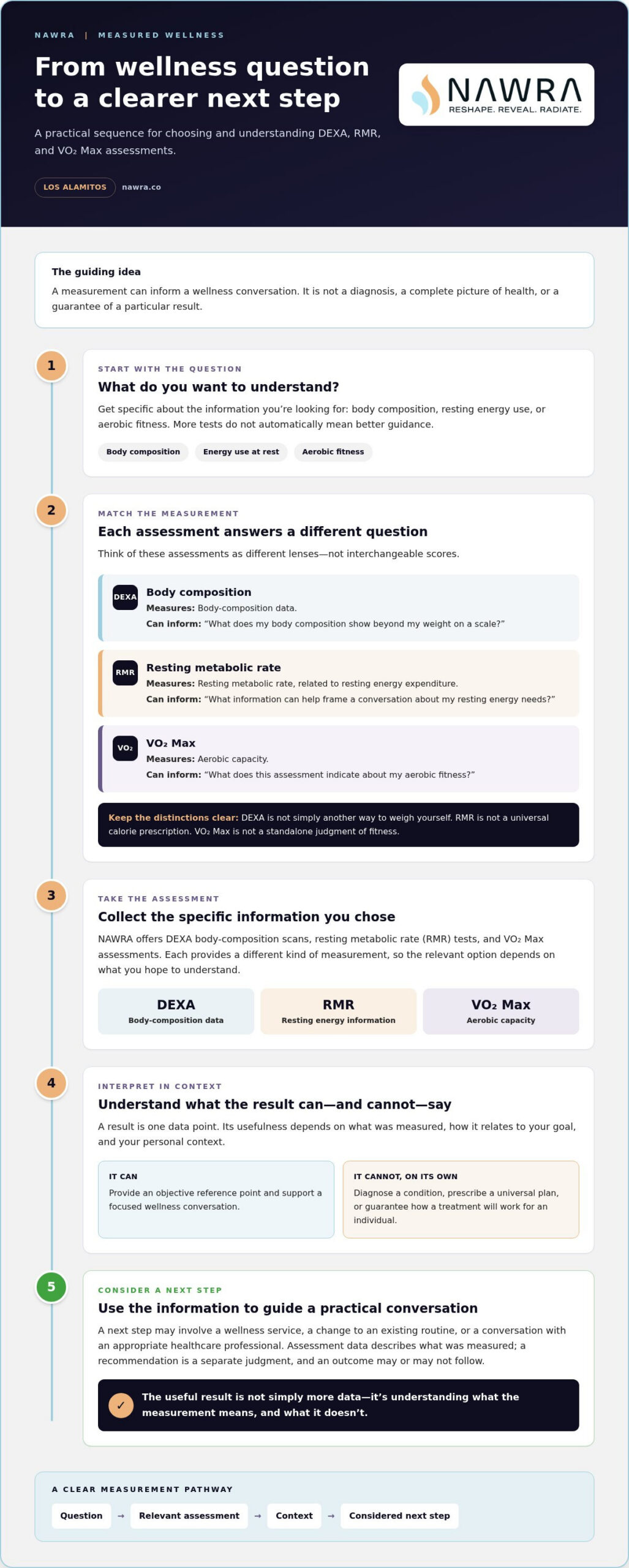
A measured wellness plan should have a clear sequence, not a pile of tests and treatments. Start with a goal, choose an assessment that relates to it, review what the findings mean, then consider a practical next step. Each stage has a purpose: the assessment provides information, and the discussion connects it to your priorities.
- Define your goal. Decide what you want to understand or work toward, such as body-composition information, resting energy expenditure, aerobic capacity, or recovery support.
- Select a relevant assessment. Choose based on the question it can help inform, not simply because it appears on a menu.
- Review the findings. Discuss what the result represents, its limits, and how it relates to your stated goal.
- Choose a next step. Consider a relevant service, a follow-up measurement, or another action that makes sense in context.
Prepare for an assessment with a clear question
Before your visit, write down the question you hope the assessment will help address. “I want to understand my body composition” is more actionable than “I want better wellness data.” Share relevant context and priorities during the visit, too. That gives the results a personal frame and keeps the conversation focused on what matters to you.
You don’t need to arrive with a complete plan. A clear starting question can guide a useful discussion about which assessment relates to it. The goal isn’t to force every concern into one test. It’s to understand the assessment’s purpose before deciding what to do with its findings.
Turn results into a practical next step
After reviewing a result, connect it back to your original question. If your goal involves recovery, for example, the discussion can focus on recovery options that relate to that priority. NAWRA offers ExoPod Full-Body Therapy, BOA Lymphatic Drainage, and Pain Relief & Recovery. A recovery therapy comparison can help you understand how those options differ while keeping the decision tied to your needs.
Progress tracking may also be part of a measured plan. Repeating an assessment at an appropriate point can provide a way to compare measurements over time. That comparison may inform a conversation about progress and next steps, but it doesn’t guarantee a particular change or establish a universal timeline. Interpret each result in context and keep your original goal in view.
If you’re looking for a data-driven wellness clinic near me in Los Alamitos or nearby communities, use the same sequence: clarify your goal, understand the assessment’s purpose, and consider a next step that fits. Explore NAWRA’s wellness assessments and services to see how they may relate to your priorities.
Explore NAWRA’s Data-Driven Wellness Services in Los Alamitos
NAWRA is a precision wellness and body-contouring clinic in the Los Alamitos area, serving nearby communities. Its offerings bring together assessments and targeted services, but the two have different purposes. Assessments provide information to support a wellness conversation. Body-contouring and recovery therapies are services to consider in relation to personal goals, not diagnostic tests or guaranteed outcomes.
Match NAWRA services to the question you want to explore
For body-composition questions, NAWRA offers DEXA body-composition scans. RMR metabolic testing and VO2 Max assessments provide different measurement options for people seeking information related to metabolism or aerobic capacity. Start with the question you want to explore, then consider the assessment that aligns with it.
NAWRA’s service categories also include:
- Body-contouring: EMSCULPT NEO is a body-contouring service, distinct from an assessment that measures or reports information.
- Facial and pelvic wellness services: Emface and Emsella are separate service options, each with its own focus.
- Recovery services: ExoPod Full-Body Therapy, BOA Lymphatic Drainage, ExoFreeze Cryo, and Pain Relief & Recovery offer additional choices to explore based on your priorities.
Keeping these categories distinct helps set expectations. A scan or test gives you assessment information; a service is a separate option. The right starting point depends on your goal and the purpose of the assessment, if one is relevant. You don’t need to treat every offering as part of a single plan.
Take the next step with a local wellness team
If you’re looking for a data-driven wellness clinic near me, a local setting can make it easier to explore assessment and service options in one place. NAWRA’s wellness clinic services and insurance information in Los Alamitos, CA are relevant to people in surrounding communities, including Los Alamitos, Cypress, Cerritos, Long Beach, Seal Beach, La Palma, Buena Park, Lakewood, Anaheim, Norwalk, Irvine, Laguna Niguel, Newport Beach, Huntington Beach, Bellflower, Tustin, Fullerton, and Yorba Linda.
Start by identifying the question or goal that matters most to you. Then explore the services with that priority in mind, whether you’re considering an assessment, body-contouring, facial or pelvic wellness services, or recovery support. A focused starting point makes the options easier to understand without assuming that one service fits everyone.
Explore NAWRA’s wellness services to review the assessment and service categories and consider which may be relevant to your goals.
Make Your Next Wellness Decision With Clarity
The next step doesn’t need to be a complete overhaul. Start with one question you want answered, then use relevant information to make a considered choice. Data can add perspective, but your priorities remain central. A measurement is most useful when it helps you decide what deserves attention next.
For people searching for a data-driven wellness clinic near me, NAWRA brings DEXA, RMR, and VO2 Max assessments together with body-contouring and recovery services in the Los Alamitos area. These options offer different starting points, not one prescribed path. Choose the question first, then let it guide which service you explore.
Explore NAWRA’s data-driven wellness services and consider which option aligns with your goals. A clear question is a strong place to begin, and an informed next step can be practical.
Frequently Asked Questions
Is a data-driven wellness clinic the same as a medical clinic?
Not necessarily. A data-driven wellness clinic focuses on assessments and services related to wellness goals, while a medical clinic provides medical care. NAWRA is a precision wellness and body-contouring clinic offering assessments and wellness services. If you have symptoms, need a diagnosis, or are managing a medical condition, consult a qualified healthcare professional. Wellness assessments can offer useful information, but they aren’t a replacement for medical evaluation.
Can a wellness assessment diagnose a health condition?
No. A wellness assessment provides information within its defined purpose, but it doesn’t diagnose a health condition. For example, a result from a body-composition scan or fitness assessment shouldn’t be treated as a medical finding. If a result raises a concern, or you’re experiencing symptoms, discuss the issue with a healthcare professional who can evaluate it in the appropriate clinical context.
Is a data-driven wellness clinic only for athletes?
No. Athletes may seek measurements related to fitness, but people with many kinds of wellness goals may also be interested in objective information. You might be curious about body composition, resting energy expenditure, or aerobic capacity without training competitively. If you’re searching for a data-driven wellness clinic near me, begin with the question you want to explore, not an assumption about who the services are for.
Can one test explain every aspect of my wellness?
No single assessment captures every dimension of wellness. A measurement is designed to address a particular question, so it can’t stand in for information it wasn’t designed to provide. For example, a result related to body composition won’t describe every aspect of fitness, recovery, or overall health. Treat each finding as one piece of information, and consider what other context may matter to your personal goal.
How often should I repeat a wellness assessment?
There isn’t one repeat schedule that fits every assessment and goal. The purpose of retesting is to compare information meaningfully, so consider whether another measurement would help answer a current question or inform a decision. Discuss the timing and relevance of a repeat assessment with the clinic based on the test and your priorities. More frequent testing doesn’t automatically provide more useful insight.
Can I visit NAWRA from Long Beach, Cerritos, or Irvine?
Yes. NAWRA serves nearby communities including Long Beach, Cerritos, and Irvine, with its clinic in the Los Alamitos area. If you’re visiting from one of these cities, consider which assessment or service relates to your goal so you can choose a relevant starting point. NAWRA offers wellness assessments, body-contouring, and recovery services for people in the surrounding area.