
Results vary from person to person. In Emsella reviews for Cerritos, note when a reviewer first noticed a change: some report improvement after one session, while others describe progress after the third week.
The article describes a schedule of twice a week for three weeks, for six sessions in total. Emsella uses focused electromagnetic energy to stimulate pelvic floor muscle contractions. A response may develop during the treatment series or afterward. Early changes are not the only way to assess progress; symptom patterns over time matter, too.
This article explains how the chair works, what the treatment schedule involves, and when results may appear. It also considers how patients describe urinary symptoms and why bowel symptoms belong in a broader pelvic health discussion. The goal is to clarify what reviews can tell you, and what they cannot predict about an individual experience.
Key Takeaways
- Learn what patients may experience during a session, including how the treatment feels and what to expect while seated in the chair.
- Understand why patient reviews describe personal experiences rather than a reliable prediction of your own results.
- See how urinary leakage, frequency, and urgency can differ, and why describing each symptom clearly helps frame the discussion.
- Explore how constipation and bowel leakage fit into pelvic health conversations, without assuming one treatment addresses every concern.
- Find out when NAWRA’s Emsella offering may be a relevant next step for people considering professional pelvic floor treatment.
How does the chair work?
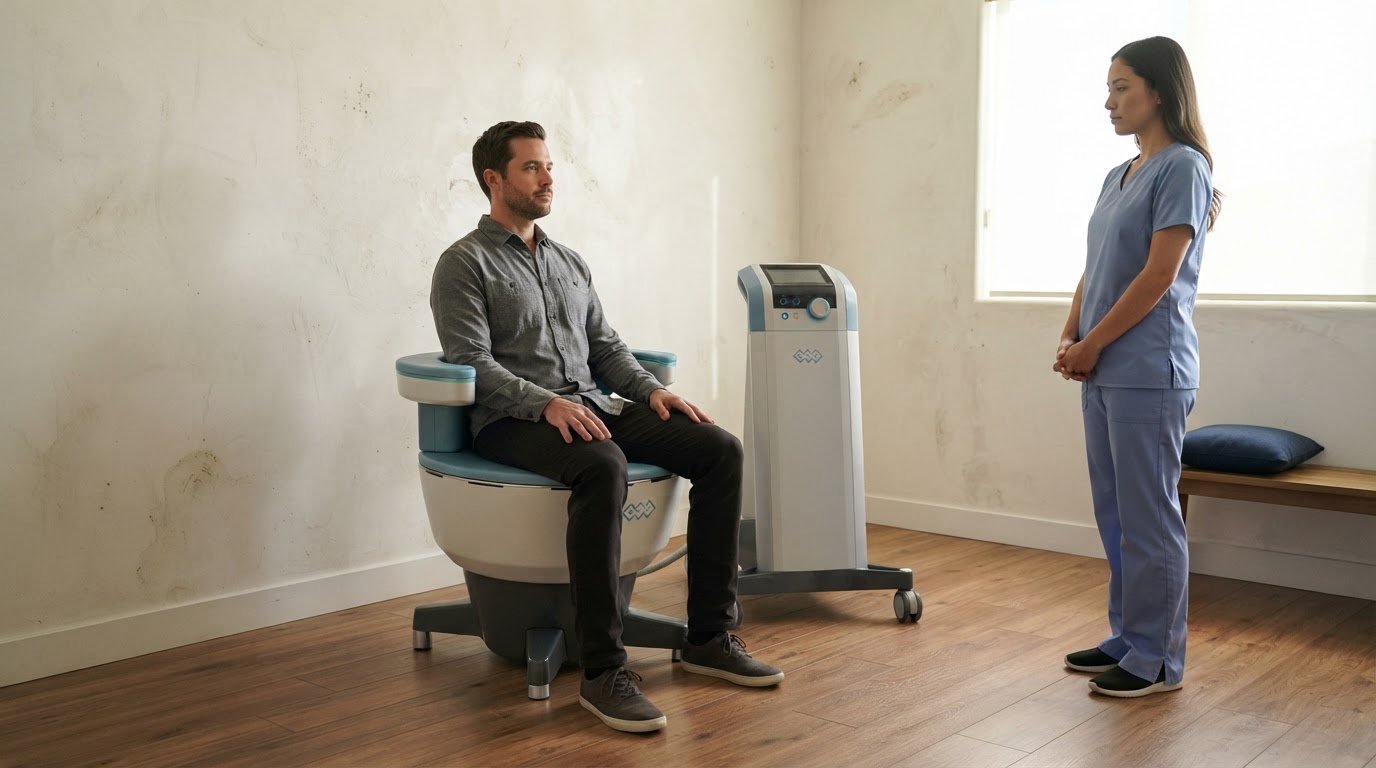
Emsella uses high-intensity focused electromagnetic, or HIFEM, technology to stimulate pelvic floor muscles. The induced contractions are involuntary, so patients sit through therapy rather than performing a series of exercises. A session involves repeated pelvic floor muscle contractions and lasts for a set period of time. Patients remain seated in regular clothes, and tingling in the pelvic area may occur during treatment.
The article describes a schedule of twice a week for three weeks, totaling six sessions. This course offers a structured period for treatment and observation. Some patients report improvement after one session; others describe changes after the third week. These different timelines show why a review reflects one person’s experience, not a schedule that applies to everyone.
Patient accounts may describe how a session feels, when symptoms begin to change, and how changes affect daily routines. One reviewer might mention an early change in leakage, while another focuses on progress later in the course. Look for the symptom, the point in the schedule, and the reported change. Those details make reviews more useful than a general rating.
A discussion with the care team can focus on your goals, symptoms, and treatment schedule, as well as what HIFEM therapy involves and how progress will be discussed during the six-session course. If you are considering Emsella, describe your concern precisely, such as leakage during activity or sudden urgency, to make the conversation more useful.
When comparing Emsella options near Cerritos, look for clear information about the chair, treatment process, and patient experiences. Reviews can offer context, but a review alone cannot establish whether a particular approach suits your needs.
Tingling in the pelvic area may occur during a session. Emsella is not suitable for people with metal implants, so implant history is an important safety consideration to discuss before treatment.
Consultations, financing, and package discounts are separate from the treatment schedule. The article describes a six-session protocol; do not assume that this establishes a clinic’s policies for consultations, payment, or packages.
When choosing a local provider, look for a clear explanation of the HIFEM mechanism, the 23-minute session, and the twice-weekly schedule. To assess device authenticity, look for clear identification of the Emsella chair and an explanation connecting that device to the treatment being delivered. Specific details matter more than broad claims in a review.
How Can I Make My Life with Urinary Incontinence Easier?
Begin by describing the symptom clearly. Urinary incontinence may involve leakage with stress or urge, and the pattern helps frame a discussion about pelvic floor concerns. Note when leakage happens, what activity or sensation comes before it, and how it affects daily routines. “I leak when I cough” is a more specific starting point than “my bladder feels weak.”
Risk factors and causes are not interchangeable. The information here identifies stress and urge incontinence but does not provide a verified list of individual risk factors. Start by recording the pattern: activity-related leakage, sudden urgency, or both. This distinction can help organize a discussion about pelvic floor function and relevant treatment options.
Emsella is a non-surgical, non-invasive treatment described for stress or urge urinary incontinence. It uses high-intensity focused electromagnetic technology to create pelvic floor muscle contractions, stimulating the muscles without requiring you to perform each contraction voluntarily. This differs from approaches centered on coached muscle training.
Reported results offer context, not a personal forecast. One report says 95% of patients who completed the treatment series described significant improvement in daily life. Another reports that more than two-thirds of patients became dry or used significantly fewer pads after treatment. These outcomes focus on urinary symptoms and daily impact. They don’t tell every patient what degree or timing of improvement to expect.
How does Emsella compare with pelvic floor physical therapy and other incontinence treatments? Emsella stimulates pelvic floor contractions using electromagnetic energy, while pelvic floor physical therapy focuses on assessment and guided muscle training. The approaches differ in method, and treatment selection depends on the symptom pattern and the individual’s needs.
For a practical discussion, bring specific examples rather than a general label: leakage during a walk, urgency on the way to the bathroom, or pad use during daily activities. Track whether the concern changes over time and describe what improvement would mean in real life. That might mean fewer interruptions, less leakage, or more confidence during a routine activity. Concrete details make progress easier to discuss alongside a treatment plan.
Patients considering Emsella can explore Emsella treatment as one option for pelvic floor stimulation. A focused conversation about symptoms, goals, and treatment expectations helps connect the method to the concern being addressed.
Emsella patient review
Patient reviews are most useful when they connect a symptom, a treatment point, and a reported change. Christi B. reported feeling 50% better with incontinence after three treatment sessions. Gillian A. of Irvine, California, reported a 50% improvement after five sessions. Those accounts describe individual experiences, not a standard result for every patient. The figures reflect what each reviewer reported, rather than a guarantee or a measure that applies to every treatment course.
The details in each account add context. Christi also described improved movement and posture during treatment. Gillian completed all sessions and said breathing techniques she learned contributed to her improvement. These details help distinguish reported urinary changes from other parts of each person’s experience. They also show why a specific account is more informative than a general rating. Note which changes a reviewer connects to treatment and which they describe alongside it.
One review mentions the patient’s history of two vaginal births. This is personal context, not proof that childbirth caused her urinary incontinence or that someone with the same history will respond similarly. Reviews describe individual circumstances; they cannot establish how another person’s medical history, symptoms, or treatment plan will affect outcomes. A patient’s history adds context but does not explain an outcome by itself.
When reading impressions of clinicians and staff, look for observable details rather than general praise. Does the patient describe clear explanations, respectful communication, or support through treatment? Reviews are easier to assess when they explain what happened, such as how the plan was discussed or progress followed. A concrete account of communication gives readers more to consider than adjectives alone.
A practical way to read an account is to note the patient’s urinary concern, the treatment stage, the reported change, and any other techniques involved. Gillian’s mention of breathing techniques is one example of an additional factor in a personal account. Christi’s report distinguishes an incontinence change from observations about movement and posture. Keeping these outcomes separate prevents one testimonial from being treated as evidence for every possible benefit. It also makes the review easier to compare with the concern you want addressed.
Cosmetic language can blur the purpose of a review. Urinary incontinence is a functional concern, so note whether an account describes leakage, its effect on daily life, or another outcome. Compare reviews by the experience they actually describe, not by star ratings alone. A specific account can prompt useful questions about care and progress while remaining one patient’s perspective. Focus on the reported symptom and the details behind any stated improvement.

Bladder frequency and urgency
Urinary frequency and urgency describe different experiences. Frequency means needing to urinate often; urgency means a sudden, difficult-to-delay need. Someone might visit the bathroom repeatedly without sudden urgency, or feel urgent sensations without frequent trips. Distinguishing these patterns is clearer than saying only, “My bladder is bothering me.”
Start with a simple symptom record. Note the time, what was happening, and whether urgency or leakage occurred. For example, record whether a sudden urge interrupted a drive or bathroom trips disrupted sleep. Add how the symptom affected your day, such as changing plans or locating bathrooms before errands. These details help describe the concern without treating one difficult moment as the whole pattern.
Colleen, age 30, appears in a testimonial about bladder problems and physical therapy. The account connects bladder concerns with a treatment experience, but it doesn’t provide a measured result or establish what caused her symptoms. That distinction matters: a testimonial can show how one person describes care, while symptom notes provide details about another person’s own frequency and urgency.
For a treatment discussion, distinguish sudden urgency from leakage during an activity. Emsella is described for stress or urge urinary incontinence, so the exact symptom pattern matters. A clear example, such as urine loss after an urgent sensation, gives more context than the general phrase “bladder issues.” It also keeps the focus on urinary function rather than an aesthetic goal.
To make a symptom record useful, note the situation, the sensation, and the effect each time. One entry might read, “Urgent sensation interrupted a meeting; no leakage.” Another might say, “Leakage followed a sudden urge while walking.” These examples distinguish urgency from leakage and help clarify what improvement would mean, such as fewer interruptions or more control during a routine activity.
Reviews can offer perspective, but they do not replace a specific account of your symptoms. Colleen’s testimonial mentions bladder problems and physical therapy, but does not explain every detail of her experience. Use patient stories as examples, then describe your own pattern concretely. That gives a treatment discussion a practical starting point and a clearer way to consider progress over time.
Constipation and bowel leakage
Constipation and bowel leakage are distinct concerns, even when both affect bowel routines. Constipation may involve difficulty passing stool; leakage means stool escapes unexpectedly. Describe the specific experience rather than using “pelvic floor problems” as a catch-all. For example, say whether the concern is difficult bowel movements, unexpected leakage, or both.
Start by recording the pattern in plain language. Note what happened, the situation, and how it affected daily activities. “Leakage occurred before reaching the restroom” describes a different experience from “bowel movements are difficult.” Include whether symptoms interrupt work, travel, or social plans. These examples help organize a discussion without assuming one cause explains every symptom.
Keep urinary and bowel symptoms distinct when describing them. They may occur together, but one does not automatically explain the other. A concise note might read, “Urinary urgency during errands; constipation on another day.” Clear distinctions help ensure a discussion of bladder symptoms does not overlook bowel concerns, or vice versa.
A treatment aimed at pelvic floor muscles should not be assumed to address every pelvic symptom. Emsella is described for stress or urge urinary incontinence; that description alone does not establish an effect on constipation or bowel leakage. A review about urinary symptoms is not proof of a bowel-related outcome.
Separate a procedure’s format from its purpose. “Non-invasive” describes an approach that does not involve surgery; it does not establish which symptoms the treatment addresses. If you are considering a non-invasive option, first identify the specific goal: urinary leakage, bowel leakage, constipation, or a combination. Describe each concern clearly.
For a useful symptom summary, capture the bowel concern, a real-life example, and its practical impact. For instance, explain that constipation makes a routine difficult or that unexpected leakage changes plans. Do not expect a particular result based on another patient’s account. Reviews describe individual experiences, and the symptoms they mention need to match the question you are considering.
If bowel symptoms are part of a broader pelvic floor concern, discuss pelvic floor treatment options in terms of the specific issue you want addressed. Keep constipation, bowel leakage, and urinary symptoms distinct so the conversation stays precise and the treatment goal remains clear.
NAWRA: Emsella
NAWRA offers Emsella for people considering professional pelvic floor treatment for urinary incontinence. If your symptoms match the concerns discussed above, it can be a next step to explore treatment goals and the session process. Share the specific issue you want addressed, such as leakage with activity or urge-related symptoms, and discuss how you’ll evaluate changes in daily life.
A focused conversation can clarify whether Emsella aligns with your priorities. NAWRA also offers EMSCULPT NEO, DEXA Body Composition, and ExoPod Full-Body Therapy, which address different wellness goals. For urinary symptoms, keep the discussion centered on Emsella and your individual objectives.
Contact NAWRA to discuss whether Emsella fits your goals.
Make your next step specific
Start by defining what progress would look like in your routine. Choose a clear marker, such as fewer interruptions, greater confidence during an activity, or less time planning around symptoms. A precise goal gives a treatment discussion direction and makes later reflection more meaningful. Keep the focus on function, not an abstract promise.
If you are comparing Emsella reviews in Cerritos, treat each account as context, not as a substitute for your personal priorities. Reviews offer perspective but cannot predict an individual response. Consider which concern you want to address, how changes will be discussed, and what would make the approach worthwhile.
A measured next step starts with an honest discussion of your goals and concerns. You don’t need to decide everything beforehand. Contact NAWRA to discuss Emsella and consider whether the treatment aligns with the outcome you want to pursue. Clear goals are a strong place to begin.
Frequently Asked Questions
How fast will I see results?
Some patients report changes after one session; others describe improvement by the third week. Treat these as different progress points, not promises. For a useful personal comparison, note which symptom changes, when it changes, and whether daily routines feel different. A brief record during treatment can help distinguish an ongoing pattern from a change noticed only once.
What is the treatment time?
One Emsella session is described as lasting 23 minutes. A typical course uses six sessions across three weeks, scheduled twice weekly. The session length is the time in the chair, while the three-week period covers the complete course. Keeping those two time frames separate helps with planning work, errands, and other appointments around treatment.
What Is the EMSELLA®?
Emsella is a chair-based treatment that uses high-intensity focused electromagnetic energy to stimulate pelvic floor muscles. The muscle contractions occur while the patient sits fully clothed. A session is described as producing 11,200 contractions. This explains the treatment mechanism; it doesn’t mean every patient will notice the same change or experience the same timeline.
WHAT DOES IT FEEL LIKE?
Patients may feel tingling in the pelvic area during a session as the chair stimulates muscle contractions. Treatment takes place while seated and clothed, rather than through a hands-on procedure. Experiences differ, so a review’s description of sensation reflects that patient’s account. Look for specific details, such as tingling or comfort.
What do patients say in reviews about Emsella treatments in Cerritos, CA?
Patient accounts relevant to readers considering Emsella reviews in Cerritos include reports from Christi B. of the Inland Empire and Gillian A. of Irvine, California. These are individual experiences, not uniform outcomes. Neither patient is identified in the available details as a Cerritos resident. Use reviews to understand the kinds of changes patients describe, while keeping each person’s location and experience in context.
How many Emsella sessions are typically recommended, and how long does each session take?
Treatment is generally planned as a course of sessions rather than a single appointment. Each session lasts 23 minutes. When organizing your calendar, account for the full course rather than treating one appointment as the complete treatment. The schedule also gives you several points to observe changes in symptoms and daily routines as therapy progresses.
What conditions does Emsella treat, and how effective is it for urinary incontinence?
Emsella is described for stress or urge urinary incontinence and pelvic floor weakness. Reported outcomes include 95% of patients who completed the treatment series saying daily life improved significantly, and more than two-thirds reporting dryness or significantly fewer pads. These are reported patient outcomes, not a prediction for an individual. The symptom being treated and the change measured matter when interpreting results.
What should patients expect during an Emsella appointment, and is any preparation needed?
Patients sit fully clothed in the chair during treatment, so changing into treatment garments is not required. Tingling in the pelvic area may occur. The treatment information describes zero downtime, so patients can return to daily activities afterward. Metal implants are a reason to avoid Emsella, making implant history important to discuss before treatment.