A stronger-looking face doesn’t require added volume. For men in Huntington Beach, Emface pairs electromagnetic muscle stimulation with radiofrequency energy to target facial muscles and skin. A commonly described course includes four sessions spaced about a week apart, with each session taking about 20 minutes.
It’s reasonable to want a clear picture before choosing a facial treatment: which areas it addresses, what changes may look like, and whether the approach suits your goals. EMFACE is designed to stimulate facial muscles and support skin quality without artificially changing facial proportions.
This guide explains how EMFACE works, which facial areas it addresses, what men may notice, and what to consider when deciding whether it fits your goals. You’ll also learn what to expect from a treatment course, so you can assess the approach with practical information.
Key Takeaways
- Understand how EMFACE combines electromagnetic muscle stimulation with radiofrequency to address facial muscles and skin.
- Learn what a typical treatment course involves, including session length and spacing.
- Set realistic expectations for when results may appear and how maintenance can help preserve them.
- See which factors may affect suitability, including certain implants and the treatment area.
- Get a clearer sense of how needle-free treatment may support facial toning without adding volume or changing facial proportions.
What areas can EMFACE treat?
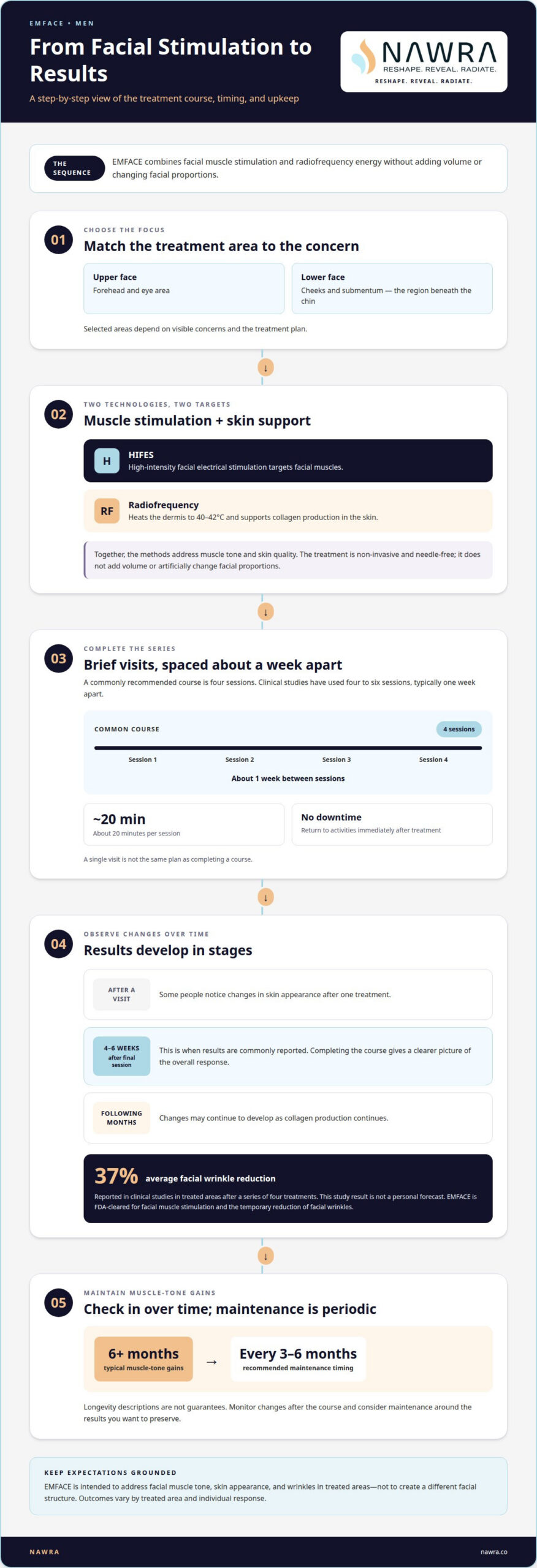
EMFACE treatment areas include the forehead, cheeks, eyes, and submentum, the region beneath the chin. A plan can target specific visible features and underlying muscles. For example, forehead and eye-area applications focus on the upper face, while cheek and submentum applications address lower facial features. The areas selected depend on your concerns and treatment plan.
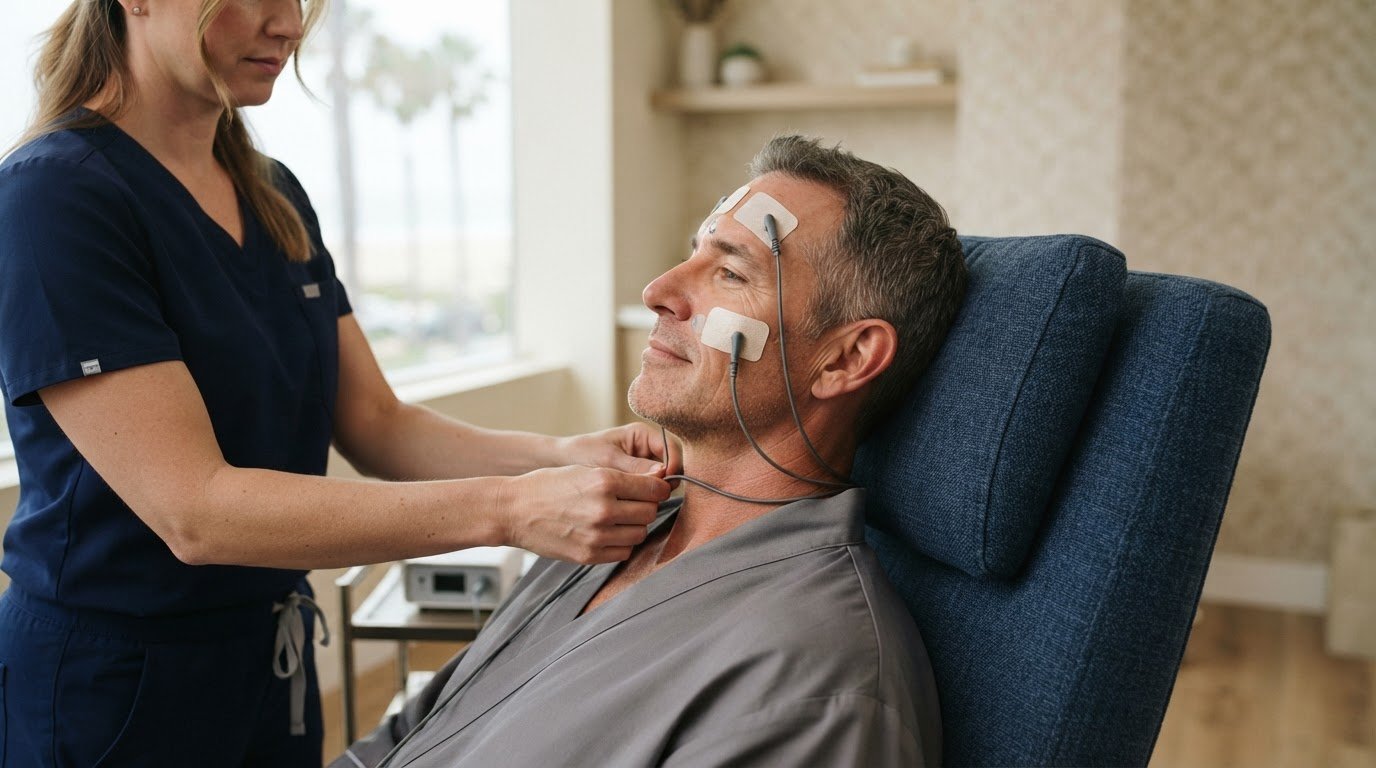
EMFACE combines HIFES, high-intensity facial electrical stimulation, with radiofrequency energy. HIFES stimulates facial muscles, while radiofrequency supports collagen production in the skin. Together, these technologies target muscle tone and skin quality without adding volume or changing facial proportions. EMFACE is non-invasive and needle-free, unlike treatments that use injections or surgery.
A single session takes about 20 minutes. A typical recommended course is four sessions, spaced about a week apart. Clinical studies have used four to six sessions, typically spaced one week apart. This series approach matters: one visit is not the same treatment plan as a completed course. Sessions are brief, and EMFACE requires no recovery or downtime after treatment, so people can return to activities immediately.
Treatment pricing depends on the planned treatment areas and session course, and is provided after a quote request. For budgeting, base decisions on the treatment-specific quote rather than assuming a package or financing structure. The planned areas and number of sessions are practical factors to clarify when reviewing the quote. Those details help explain what the proposed course includes without relying on a generic price estimate.
EMFACE may be considered alongside other cosmetic treatments. Having injectables does not automatically rule out EMFACE, but the methods differ: EMFACE uses muscle stimulation and radiofrequency, while injectables are delivered with needles. Consider how each approach aligns with the change you want. A treatment plan should distinguish goals for muscle tone and skin quality from those that call for a different method.
For men comparing EMFACE with Botox, fillers, or a facelift, the key difference is the method: EMFACE is needle-free, non-surgical, and does not add volume. It may suit someone seeking facial muscle stimulation and improved skin quality without changing facial proportions. It does not replace every injectable or surgical option. In Huntington Beach, start by identifying whether the forehead, cheeks, eyes, or submentum matches your concern.
What results are typical with EMFACE?
EMFACE results develop over time rather than appearing all at once. Useful benchmarks include when changes emerge, how they affect your appearance, and how long muscle-tone gains last.
Expected Results and Timing
Some people notice changes in skin appearance after one treatment, but completing a course gives a clearer picture of the overall response. Results are commonly reported four to six weeks after the final session. Changes may continue to develop over the following months as collagen production continues.
These timelines describe different stages, not promises. The earlier window is when people commonly report visible results; the broader period allows for ongoing skin changes. For example, after your final session, you can assess early changes weeks later and observe how your appearance develops over the following months.
Natural-Looking Masculine Results
EMFACE is designed to enhance existing masculine facial features rather than soften them. It combines muscle stimulation with support for skin quality, without adding volume or artificially changing facial proportions. If you’re seeking a more defined appearance, this distinction helps clarify what the treatment is intended to address.
Expected changes relate to facial tone, skin appearance, and wrinkles in treated areas. They don’t mean a different face or a new facial structure. Think of the aim as rejuvenating your appearance while working with your existing features. The treatment areas and your starting point shape which changes are most relevant to assess.
Result Longevity and Maintenance
Muscle-tone gains typically last six months or longer. Maintenance sessions are recommended every three to six months to support those gains. This timing reflects the goal of maintaining facial muscle tone over time, rather than treating one session as a permanent change.
Some descriptions say EMFACE improvements can last up to a year or longer, while guidance on muscle tone gives a more specific baseline of six months or longer. These are different descriptions of longevity, not guarantees. A practical approach is to monitor changes after the course and plan maintenance around the results you want to maintain.
For men in Huntington Beach, the outcome to evaluate is the fit between treatment goals and the changes EMFACE is designed to address. A focus on wrinkles, skin appearance, or facial muscle tone gives the assessment a concrete direction. An EMFACE treatment assessment can help align those goals with a treatment plan and maintenance approach.
Needle-free facial muscle toning and skin tightening
EMFACE combines facial muscle stimulation with radiofrequency to address muscle tone and skin quality. Its needle-free method targets two distinct features without adding volume.
Skin Tightening and Wrinkle Reduction
Radiofrequency energy heats the dermis to 40-42 degrees Celsius, supporting collagen production. Collagen helps explain the skin-focused part of the treatment; muscle stimulation addresses a separate layer. EMFACE is FDA-cleared for facial muscle stimulation and the temporary reduction of facial wrinkles. The word “temporary” matters: wrinkle reduction is not a permanent change, and outcomes vary by treated area and response.
Clinical studies reported an average 37% reduction of facial wrinkles in treated areas after a series of four treatments. That figure describes study results, not a personal forecast. For example, someone focused on forehead lines should distinguish wrinkle changes from increased muscle tone. The device addresses both mechanisms, but each contributes differently to the overall appearance.
Lifting, Collagen, and Male Facial Structure
EMFACE uses electromagnetic stimulation to strengthen underlying facial muscles, while radiofrequency supports collagen production in the skin. These effects may contribute to a firmer, more lifted appearance without needles or added volume. For men, the treatment is designed to enhance existing masculine features rather than soften them. Preserving facial proportions can therefore be an important goal.
Muscle tone and skin quality are related but separate considerations. If you’re seeking more definition, you may be focused on underlying muscles; if visible wrinkles concern you, skin changes may matter more. EMFACE addresses both through its combined technologies, but it doesn’t reshape facial bones or create filler-like volume. Its purpose is facial rejuvenation within your existing features.
Consider the change you want before assessing the method. If your priority is facial muscle stimulation and temporary wrinkle reduction, EMFACE’s two-part approach may fit that goal. If you want added volume or different facial proportions, this device does not provide that change. Its needle-free format distinguishes it from injectables, while its non-surgical method differs from a facelift.
Assess the treatment area, your concern, and the intended improvement together. For example, a goal involving both skin quality and muscle tone corresponds to EMFACE’s two mechanisms. A goal limited to one feature may call for a more specific plan. Keeping these distinctions clear helps set realistic expectations for toning and tightening.
Candidate suitability and contraindications
EMFACE may suit men seeking facial muscle stimulation and improved skin quality without surgery. Suitability depends on your goals, the treatment area, and contraindications such as electronic or metal implants.
Ideal Male Candidates
An ideal candidate is a man seeking changes in facial muscle tone, skin appearance, or wrinkles without surgery. EMFACE is designed to enhance existing masculine features rather than soften them. For example, a man seeking a more refreshed appearance while keeping his facial proportions may find this approach aligns with his goals.
Start by matching your goal to the treatment method. EMFACE combines radiofrequency with muscle stimulation; it doesn’t add volume or reshape facial proportions. Men seeking filler-like volume or surgical changes have different goals. Distinguishing skin quality, muscle tone, and added volume helps you decide whether EMFACE’s approach fits.
Suitability and Skin Types
EMFACE is described as suitable for all skin types and tones, so skin tone alone doesn’t exclude someone from consideration. Its radiofrequency and muscle-stimulation approach targets skin and facial muscles without needles, unlike microneedling, which uses needles to treat the skin.
Skin type isn’t the only factor. The treatment area matters too: EMFACE shouldn’t be applied over hair or scar tissue. For example, facial hair or a scar in the planned area can affect where the device is applied. Suitability depends on the intended area as well as your skin type.
Specific contraindications also matter. EMFACE shouldn’t be used if you have electronic or metal implants. This differs from having injectables: previous injectable treatments don’t automatically rule you out. The relevant distinction is between injectable history and an implant that may conflict with the device.
A practical suitability review follows a few clear checks:
- Define the goal: identify whether the priority is muscle tone, wrinkles, or skin appearance.
- Identify the area: note whether hair or scar tissue lies over the planned treatment site.
- Review implants: establish whether electronic or metal implants are present.
- Clarify prior treatment: distinguish injectables from implants, since injectables alone don’t rule out treatment.
These considerations distinguish skin-type suitability from area-specific and implant-related restrictions. Any skin tone may be suitable, while the planned treatment area can still raise concerns. A history of injectables is different from the listed implant contraindication. Considering each factor separately makes the decision more precise than relying on age, gender, or skin tone alone.
EMFACE for men in the Huntington Beach area
For men in Huntington Beach, a useful decision starts with matching the treatment method to the change you want. Consider what you want to improve, which areas are relevant, and whether a non-invasive approach fits your goals.
To verify credentials and device availability, review the practitioner’s stated qualifications and role, then confirm that the appointment plan identifies the EMFACE device. Use the consultation to clarify who performs the treatment, which areas are planned, and how suitability is assessed.
Finding EMFACE in Huntington Beach
Availability is specific to each practice, so distinguish EMFACE from other facial treatments using radiofrequency or muscle stimulation. Check that the treatment description names EMFACE and explains its facial applications. For a man focused on forehead lines or submentum definition, the relevant detail is whether those areas match the proposed plan.
Local relevance also means understanding the course before arranging visits. A typical series includes four sessions, spaced about a week apart, with each session taking about 20 minutes. That schedule helps Huntington Beach patients consider travel, appointments, and time away from other activities without assuming every practice follows an identical plan.
Verifying Provider Credentials and Device Availability
Keep practitioner qualifications and device identification distinct. Review the practitioner’s profile for their name, role, and stated qualifications. Then confirm that the treatment information refers specifically to EMFACE rather than a generic facial device. The technology and treatment areas should match the service being discussed.
During your consultation, clarify the planned areas and how suitability is assessed. A clear plan should identify EMFACE, explain the intended facial targets, and account for concerns such as hair or scar tissue in those areas. This keeps the discussion specific rather than relying on broad promises about lifting or skin rejuvenation.
If you’re concerned about sagging, wrinkles, or skin appearance, clarify what the treatment is designed to address. EMFACE combines muscle stimulation with radiofrequency, without needles or surgery. Radiofrequency supports collagen production, while muscle stimulation targets facial muscles. These mechanisms describe the treatment, not a guaranteed result.
Use a simple decision sequence: identify the concern, match it to a treatment area, then review the proposed series and practitioner information. For example, a goal involving forehead wrinkles differs from a goal focused beneath the chin. A precise consultation connects the desired appearance with the areas and technology in the plan. Book an EMFACE consultation to discuss treatment goals and suitability.
NAWRA
NAWRA starts every protocol with a clinical assessment, then measures again after treatment. If you’re considering facial rejuvenation alongside other health or wellness goals, identify your main concern and the support that fits it. Advanced body composition analysis provides detailed physical metrics, while ExoPod Full-Body Therapy and BOA Lymphatic Drainage address different wellness goals. These services aren’t substitutes for facial treatment, but may be relevant if your goals extend beyond facial appearance. NAWRA is a precision wellness studio in Los Alamitos serving men from Huntington Beach and nearby communities, including Cypress, Cerritos, Long Beach, Seal Beach, La Palma, Buena Park, Lakewood, Anaheim, Norwalk, Irvine, Laguna Niguel, Newport Beach, Bellflower, Tustin, Fullerton, and Yorba Linda. Call or text NAWRA to discuss your goals and request a free protocol plan.
Choose a Clear Next Step
For men considering EMFACE in Huntington Beach, the next step is to connect your goals with a plan that respects your facial features and priorities. A focused conversation can clarify what you want to address, which areas matter most, and whether this approach aligns with your expectations. It can also distinguish facial goals from broader wellness interests.
NAWRA offers services for different goals, including Emsculpt NEO, DEXA Body Composition, and ExoPod Full-Body Therapy. These are separate offerings, not substitutes for facial treatment. If your priorities extend beyond your face, that wider context can help guide the conversation.
You don’t need to arrive with every decision settled. Start with the change you’re seeking and the questions that matter to you. Contact NAWRA to discuss Emface and take a considered next step toward your goals.
Frequently Asked Questions
How does EMFACE work?
EMFACE uses synchronized radiofrequency and HIFES energy to target facial skin and underlying muscles. Radiofrequency supports collagen production, while HIFES stimulates facial muscles. These mechanisms address different tissue layers in one treatment. For example, a plan may focus on forehead lines while also targeting muscle tone. EMFACE is non-invasive and needle-free, but it doesn’t add facial volume or change facial proportions.
Can I have EMFACE therapy if I have injectables?
Having injectables doesn’t automatically rule you out of EMFACE. Injectable history differs from having an electronic or metal implant, which is a contraindication. Before treatment, share your injectable history and identify any implants so the plan can account for relevant factors. The planned area matters too: EMFACE shouldn’t be applied over hair or scar tissue. This helps distinguish eligibility concerns from the treatment goal itself.
How do I get started?
Start with a consultation to discuss your goals, treatment areas, and relevant health factors. No referral is required to book an assessment or treatment. At NAWRA, every protocol starts with a clinical scan, such as DEXA, RMR, or VO2 Max, before treatment. The scan type depends on the protocol. These services have not been evaluated by the FDA and are not intended to diagnose, treat, cure, or prevent any disease.
How fast will I see results?
Some people notice changes in skin appearance after one treatment, while results are commonly reported four to six weeks after the final session. Changes may continue developing over the following months as collagen production continues. For a practical comparison, note your main concern before starting, then assess the same facial area after treatment. This gives you a consistent way to track changes rather than relying on memory alone.
How many sessions will I need?
A typical EMFACE course includes four sessions, generally spaced about a week apart. Clinical studies have used four to six sessions, typically spaced one week apart. The appropriate plan depends on your treatment areas and goals, rather than a universal number for everyone. When planning, clarify which areas the course covers and how progress will be assessed afterward.
Is EMFACE painful?
EMFACE is generally described as feeling like a facial muscle massage, with warmth in the treated area. The sensation comes from muscle stimulation and radiofrequency rather than needles. Comfort can vary by treatment area, so describe any discomfort during the session. That feedback helps the practitioner respond to your experience while keeping the planned areas clear.
What is EMFACE and how does it work for men?
EMFACE is a non-invasive facial treatment that combines radiofrequency with HIFES muscle stimulation. For men, it is intended to enhance existing facial features rather than soften them or add volume. It may be considered when your goals involve skin quality, wrinkles, or muscle tone while preserving facial proportions. Individual results vary and are not guaranteed, so focus on the changes the method is designed to address.
What facial concerns can EMFACE treat in men?
EMFACE treatment areas include the forehead, cheeks, eyes, and submentum beneath the chin. It is designed to address facial wrinkles and support muscle tone and skin quality in treated areas. For example, someone concerned about forehead lines may have different priorities from someone focused on the area beneath the chin. Men seeking EMFACE for men in Huntington Beach can use their main concern to guide a discussion about treatment areas.