
Jowls aren’t always caused by excess fat. If you’re looking to reduce jowls without surgery in Newport Beach, first identify whether the change comes from skin laxity, facial volume loss, or fullness beneath the chin. Non-surgical treatments may support collagen or refine contour, but they can’t reposition a heavy, descended jowl.
If your jawline looks less defined, it’s reasonable to wonder whether aging, weight changes, or a double chin is the main cause. These concerns can look similar, but involve different tissues and may call for different approaches.
This guide explains what contributes to jowls, how to distinguish them from under-chin fullness, and which non-surgical options may help. You’ll also learn what these treatments can realistically change, where their limits are, and how to approach your next step without guesswork.
Key Takeaways
- Jowls and a double chin can look similar, but the tissue behind each concern differs, which affects the approach to jawline definition.
- Skin laxity, facial volume changes, genetics, and weight fluctuations can all contribute to jowling.
- Non-surgical options may support collagen or improve contour, but they have limits when tissue has descended significantly.
- Learn which factors shape treatment choice, what side effects and recovery may involve, and when a non-surgical approach may not address the underlying concern.
- Explore how NAWRA’s body-contouring and wellness offerings may fit into a broader, data-informed approach to your goals.
Are Jowls the Same as a Double Chin?
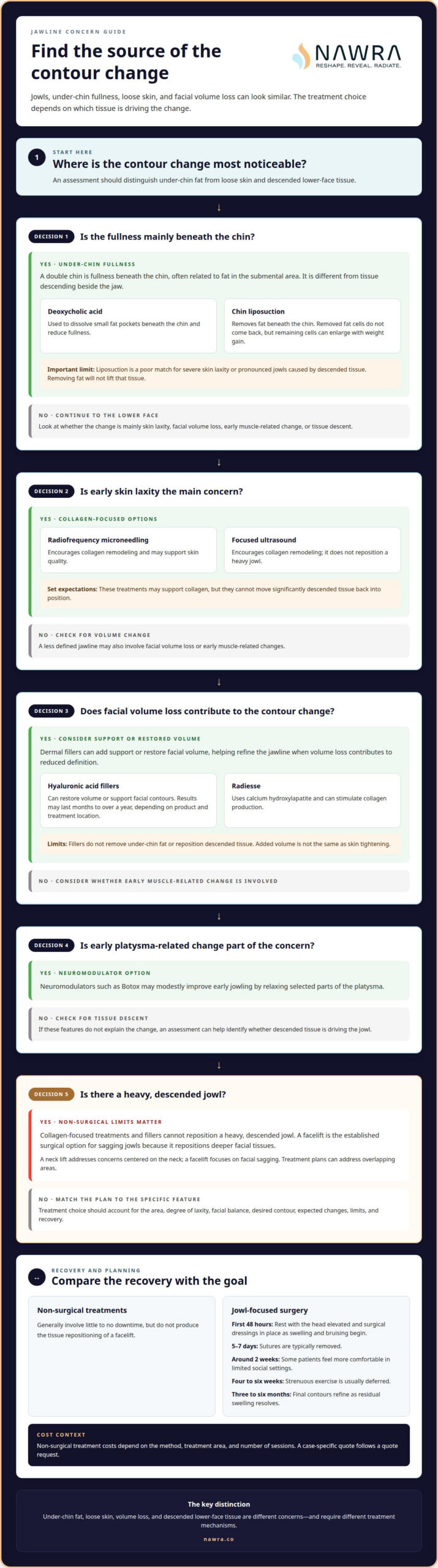
No. Jowls form along the lower face, where tissue descends beside the jawline. A double chin is fullness beneath the chin, often related to fat in the submental area. The two concerns can overlap, but occur in different locations. For example, someone can have under-chin fullness without loose tissue at the edges of the jaw. Identifying the main source of the contour change helps narrow down which treatments might address it.
Neck tightening and double-chin reduction target different features. Deoxycholic acid is used to dissolve small fat pockets beneath the chin and reduce fullness. Radiofrequency microneedling and focused ultrasound encourage collagen remodeling, but can’t reposition a heavy jowl. An assessment should distinguish fat from loose skin and descended tissue. This clarifies whether the goal is a sharper transition beneath the chin, firmer-looking skin, or better support along the jaw.
Chin liposuction removes fat beneath the chin. The removed fat cells don’t come back, but remaining cells can enlarge with weight gain. Liposuction is a poor match for severe skin laxity or pronounced jowls caused by descended tissue. Removing fat in that situation won’t lift the tissue creating the jowl. The key is matching treatment to the anatomy: under-chin fat, loose skin, and lower-face descent are distinct concerns.
Fillers can add support or restore facial volume, helping refine the jawline when volume loss contributes to a less defined contour. They don’t remove under-chin fat or reposition descended tissue. Dermal filler results may last months to over a year, depending on the product and treatment location. A plan should account for the area being treated and the desired contour. This distinction matters when seeking definition without mistaking added volume for skin tightening.
A facelift is the established surgical option for sagging jowls because it repositions deeper facial tissues. A neck lift addresses concerns centered on the neck, while a facelift focuses on facial sagging; treatment plans can address overlapping areas. Surgery involves recovery. After jowl-focused surgery, sutures are typically removed 5-7 days after the procedure. Some patients feel more comfortable in limited social settings around 2 weeks afterward, while strenuous exercise is usually deferred for four to six weeks.
During the first 48 hours after jowl-focused surgery, rest with the head elevated and surgical dressings in place as swelling and bruising begin. Final contours refine over Three to Six months as residual swelling resolves. Non-surgical treatments generally involve little to no downtime, but they don’t produce the tissue repositioning of a facelift. The practical decision is to identify whether fat, skin laxity, or descended tissue drives the concern, then choose an approach with recovery and expected contour changes that fit that goal.
What Causes Sagging Jowls?
Jowls develop as collagen and elastin fibers weaken with age. Gravity, facial muscle weakening, weight fluctuations, and genetic predisposition can add to the change. UV exposure, hormonal changes, and facial volume loss also contribute to lower-face laxity. Jowls often become more noticeable in a person’s 40s or 50s, though there’s no set age for their development. These factors can combine, so the visible contour alone doesn’t reveal the cause.
Non-surgical treatments address specific parts of the picture. Radiofrequency microneedling and focused ultrasound encourage collagen remodeling, which may support skin quality. They can’t reposition a heavy jowl formed by descended tissue. A treatment that supports collagen isn’t a substitute for lifting tissue. For early laxity, the goal may be subtle definition; pronounced descent calls for a different discussion.
Injectables also work through distinct mechanisms. Neuromodulators such as Botox may modestly improve early jowling by relaxing selected parts of the platysma. Hyaluronic acid occurs naturally in youthful skin, and hyaluronic acid fillers can restore volume or support facial contours. Radiesse uses calcium hydroxylapatite, a mineral found in bones and teeth, and can stimulate collagen production. Filler results can last months to over a year, depending on the product and location.
Natural-looking jawline rejuvenation starts by matching the method to the feature being treated. A small volume deficit along the chin may call for a different plan than lax skin at the jaw’s edge. Added volume can’t correct descended tissue, and collagen-focused treatments can’t move a heavy jowl. A considered plan accounts for facial balance, treatment area, and degree of laxity before aiming to sharpen definition.
When comparing Newport Beach providers for jowl treatments, compare the proposed method with the specific concern it addresses: fat, volume loss, early muscle-related changes, or tissue descent. Also consider how clearly the plan explains expected contour changes, limits, and recovery for that treatment.
Non-surgical jowl treatment costs in Newport Beach depend on the method, treatment area, and number of sessions. A case-specific quote follows a quote request.
At home, use broad-spectrum sunscreen with SPF 30 or higher to help protect skin from sun damage. Facial exercises have little proof of making a substantial difference to existing jowls. Skincare can support the skin’s surface, but products can’t tighten loose facial ligaments or move descended tissue back into position. Consistent sun protection supports prevention, while choosing a treatment depends on what is driving the contour change.
For a broader, measurement-led wellness perspective, explore a structured wellness approach.
How Can I Get a Defined Jawline?
If you’re looking to reduce jowls without surgery in Newport Beach, start by identifying the change you want to address: fullness, skin laxity, or tissue descent. Each points to a different treatment mechanism and recovery experience. Collagen-focused treatments support skin remodeling; fillers can add contour support. Neither repositions heavy, descended tissue. A defined aesthetic depends on matching the approach to the anatomy, not simply combining procedures.
Non-invasive treatments aim to help restore a more youthful jawline with little to no downtime. Recovery still depends on the method and treated area. Mild swelling, bruising, and tenderness after a jowl lift typically subside within a few days. Care for the tissue for at least a week after treatment. Plan for that healing period and follow the specific aftercare instructions for the procedure performed.
Safety begins with understanding a treatment’s target and limits. Radiofrequency microneedling and focused ultrasound encourage collagen remodeling, but can’t reposition a heavy jowl. Fillers add volume; they don’t remove fat. A combined approach may address separate concerns, such as volume loss and skin laxity, but combining treatments doesn’t make every concern suitable for non-surgical care. Before proceeding, clarify which feature each treatment targets and what changes it can reasonably produce.
Surgical and non-surgical recovery differ. After jowl-focused surgery, swelling and bruising occur during the initial healing period, and the contour continues to refine as residual swelling resolves. Non-surgical recovery is generally more limited, but the treated tissue still needs care. Consider healing needs alongside the expected lifting and definition. This helps you plan work, exercise, and social activities around the procedure instead of assuming every approach has the same recovery timeline.
A practical decision sequence keeps the goal specific. Identify whether fat, skin laxity, or tissue descent drives the concern, then match the treatment mechanism to that feature. Consider aftercare, possible swelling or tenderness, and time for healing. If you want to reduce jowls without surgery in Newport Beach, a non-surgical option may suit a goal of gradual contour support. Pronounced tissue descent is a different structural concern and calls for a realistic discussion of what non-surgical treatment can achieve.
Aging, skin elasticity, and facial support
Collagen and elastin fibers weaken with age, reducing the skin’s ability to maintain firm support. UV exposure, hormonal changes, and facial volume loss can add to lower-face laxity. These changes affect people differently. One person may notice a softer jawline after volume loss, while another develops looseness as support declines. The cause matters because tightening skin and restoring volume address different features.
Energy-based options include radiofrequency microneedling and focused ultrasound. Both encourage collagen remodeling, which may support skin quality and mild tightening. Neither can reposition a heavy jowl formed by descended tissue. Skin texture and laxity are not the same as deeper facial support. If you’re seeking a more youthful contour, understand that energy-based treatment can’t replace tissue repositioning.
There isn’t one category-wide answer to whether non-surgical jowl treatments are FDA-cleared for facial lifting. The specific device and its stated intended use matter; the phrase “non-surgical lifting” alone doesn’t establish clearance. Collagen remodeling also shouldn’t be described as surgical lifting. It encourages changes in skin support, while a facelift repositions deeper facial tissue.
A good candidate for non-surgical jowl reduction generally has mild laxity or an early contour change, rather than a heavy, descended jowl. Skin quality, the amount of volume loss, and whether fullness comes from fat or loose tissue all shape the treatment choice. For example, collagen-focused treatment may suit a skin-quality goal, while a volume deficit calls for a different approach. Expected changes should match the treatment’s mechanism.
Facelift candidacy involves a different level of correction. A facelift is considered the gold-standard treatment for established sagging jowls because it repositions deeper facial tissues. Candidates for jowl surgery should be non-smokers or willing to stop nicotine before surgery. Deeper facelift techniques that restore structural support can maintain noticeable improvement for many years, although longevity varies by patient. Skin quality is one part of planning, alongside tissue descent and the desired contour.
Use a simple decision sequence: identify whether the main issue is skin laxity, volume loss, or descended tissue; match the treatment to that feature; then set expectations for the degree of change. If the concern is substantial tissue descent, energy-based tightening has a clear limit. If the goal is modest support for early laxity, a non-surgical approach may better match the desired correction.
Causes of jowls and facial aging
A jowl is a contour change, not a condition with a single cause. Aging weakens collagen and elastin fibers, so skin gradually loses support along the lower face. Gravity acts on that tissue over time. Facial volume loss can also reduce structural support, making the jawline appear less distinct. These processes may happen together, but one may be more visible than another. That’s why similar facial appearances can have different underlying causes.
Consider two examples. One person has a softer jawline after losing facial volume, while another has lax skin and descended tissue. A third has both changes, with weight fluctuations adding fullness around the lower face. Genetics also influence how facial features change with age. Hormonal changes and UV exposure contribute to lower-face laxity. The visible contour reflects interacting factors, so it can’t reliably identify one cause on its own.
Collagen is part of the skin’s support structure. As its fibers weaken, skin becomes less able to maintain its former firmness. Elastin fibers also weaken with age, reducing the skin’s ability to spring back. UV exposure adds to lower-face skin laxity. These changes help explain why surface appearance and deeper support are different issues. A cream may improve the skin’s surface, but it can’t tighten loose facial ligaments or move descended tissue back into position.
Facial volume changes affect contour in a different way. When support diminishes, the lower face may look less defined, even without a distinct pocket of excess fat. Weight fluctuations can alter fullness and make an existing change more noticeable. Muscle weakening and gravity add to the combined effect. For example, under-chin fullness and laxity beside the jawline may appear together, but they don’t point to the same treatment target. The key is distinguishing volume, skin laxity, and tissue descent.
This distinction sets a practical limit on non-surgical care. Skincare can help protect the skin’s surface, but it can’t remove descended tissue or restore deeper support. An immediate effect shouldn’t be confused with long-term structural change. The useful question is whether the goal involves skin quality, volume, or a lifted contour, because each describes a different change.
Takeaway: jowls reflect overlapping changes in skin support, facial volume, gravity, and tissue position. Identify which feature dominates before weighing a treatment. That approach keeps the goal precise: improve skin quality, address volume, or consider whether descended tissue needs structural lifting. For a broader view of facial wellness options, explore facial care options.
NAWRA
NAWRA offers a data-informed wellness setting for people whose aesthetic goals connect with broader health and body-composition questions. Its services include DEXA Body Composition, EMSCULPT NEO, ExoPod Full-Body Therapy, and BOA Lymphatic Drainage. These services don’t reposition facial tissue or serve as jowl-lifting treatments. They may be relevant if your goals also include understanding body composition or exploring non-invasive body wellness options.
Consider NAWRA if you want to discuss how its wellness offerings fit alongside your broader goals, while keeping facial jowl concerns distinct from body-focused services. This distinction helps you choose the right direction without expecting one treatment category to address a different concern. Contact NAWRA to discuss your wellness goals and available offerings.
Choose Your Next Step With Clarity
If you’re considering ways to reduce jowls without surgery in Newport Beach, begin by defining the change you want to address: facial contour, skin quality, or a broader wellness goal. That distinction keeps your next decision focused and helps separate facial concerns from body-focused services, so expectations stay aligned with what each option addresses.
NAWRA’s offerings support body-contouring and wellness goals, not facial tissue lifting. If those broader goals are part of your plan, a conversation can help you understand where its services fit. If your priority is facial jowl correction, focus on options designed for facial anatomy and the degree of tissue change involved.
Contact NAWRA to discuss how its wellness offerings may fit your goals. A precise next step starts with the outcome you want and a clear understanding of what can address it.
Frequently Asked Questions
What should I expect?
Expect a focused discussion of the change you notice and the result you want. At a consultation, describe whether the concern appears beneath the chin, beside the jaw, or in both areas. A side-profile view can help clarify where fullness or looseness is most visible. You’ll also discuss treatment limits, expected changes, and recovery needs before choosing an approach. A precise goal makes the next decision more practical.
Can You Improve Jowls Without Surgery?
Yes, non-surgical treatments can improve some early jawline changes, especially when the goal is modest contour support or better skin quality. Collagen-focused treatments encourage remodeling, while fillers may support volume and definition. These methods don’t reposition heavy, descended tissue. The distinction is practical: a subtle change in skin firmness differs from lifting established sagging. The treatment mechanism should match the feature you want to address.
How long do results last?
Duration depends on the treatment and area addressed. Dermal filler results can last months to over a year, depending on the product and location. That timeframe doesn’t apply to every method. Collagen remodeling works through tissue changes rather than adding contour immediately, so its visible effects follow a different pattern. The treatment type, placement, and concern being addressed all shape how long an improvement remains noticeable.
What non-surgical treatments reduce jowls?
Options include collagen-focused radiofrequency microneedling or focused ultrasound, fillers for contour support, and neuromodulators for selected early muscle-related changes. Deoxycholic acid targets small fat pockets beneath the chin, not descended jowl tissue. Each method has a different target. For example, an injectable that addresses under-chin fullness won’t tighten loose skin. The useful first step is identifying whether the main issue is skin quality, volume, muscle activity, or localized fat.
How many treatment sessions are needed, and how long do results last?
Session needs depend on the chosen method, treatment area, and degree of change being addressed. Duration also varies by modality. Dermal filler results can last months to over a year, depending on the product and location. That estimate doesn’t describe energy-based treatments or neuromodulators. Ask how the plan defines progress, when results are assessed, and what factors could prompt maintenance. Those details make session planning more specific to the method.
What are the risks and side effects of non-surgical jowl treatments?
Side effects depend on the treatment performed. Mild swelling, bruising, and tenderness after a jowl lift typically subside within a few days. Recovery instructions also vary by method, so the treated area and procedure guide aftercare. Before treatment, discuss relevant health history, medications, and previous procedures during the consultation. Clear expectations about temporary effects and healing help you plan work, social activities, and exercise without assuming every treatment has the same recovery pattern.