

Bladder leakage is involuntary urine loss, and treatment depends on the pattern behind it. For bladder leakage treatment in Anaheim, an important first distinction is between stress incontinence, where pressure from coughing, sneezing, or exercise triggers leakage, and urge incontinence, where a sudden need to urinate arrives before you can reach a bathroom. Identifying the pattern helps guide the next steps.
Leaks can disrupt daily routines and make everyday activities feel less predictable. Understanding what may be contributing to them can help replace guesswork with a clearer plan.
This article explains common causes of urinary incontinence and how pelvic floor exercises, bladder habits, lifestyle adjustments, and conservative treatments may help manage symptoms. You’ll also learn why the right approach depends on the type of leakage and how it affects you.
Key Takeaways
- Recognize whether leakage follows pressure, a sudden urge, or incomplete bladder emptying; the pattern helps clarify what may be contributing.
- Pelvic floor exercises depend on using the right muscles and technique, not simply repeating contractions.
- A bladder diary and scheduled bathroom breaks can help reveal patterns and support more structured bladder habits.
- Review possible food, drink, medication, and lifestyle triggers to identify practical changes that may ease symptoms.
- Conservative options vary by the type of leakage and personal needs, so understanding the available approaches can help guide your next steps.
What Causes Bladder Leak?
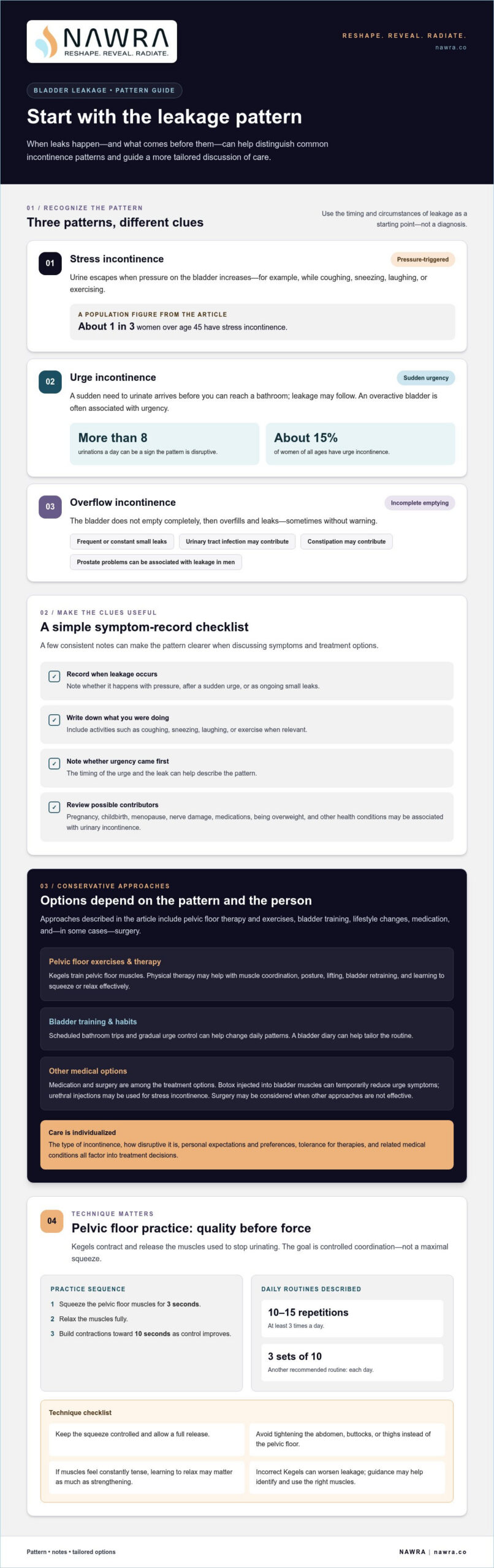
Urinary incontinence is involuntary urine leakage, also called loss of bladder control. The pattern matters because stress, urge, and overflow incontinence have different triggers. Leakage during a cough points to a different pattern than a sudden urge or ongoing dribbling. Noting when leaks happen gives you a clearer starting point for discussing symptoms and treatment options.
Stress urinary incontinence occurs when pressure on the bladder causes urine to escape. Coughing, sneezing, laughing, and exercise are common examples. Pelvic floor muscles support the bladder and uterus while helping control urination. Pregnancy, childbirth, and aging can leave these muscles weak, stretched, or uncoordinated. About 1 in 3 women over age 45 have stress incontinence. The figure describes a common pattern, not the cause of every individual leak.
Urge incontinence involves a sudden or abrupt need to empty the bladder. The urge may arrive before a person can reach a bathroom, and leakage may follow. An overactive bladder is often associated with urgency, but urge incontinence describes leakage connected with that sudden need. Needing to urinate more than eight times a day or leaking before reaching the bathroom are signs that the pattern may be disruptive. About 15% of women of all ages have urge incontinence.
Overflow incontinence occurs when the bladder doesn’t empty completely, then overfills and leaks, sometimes without warning. Frequent or constant small leaks may fit this pattern. Urinary tract infections and constipation can also contribute. Men may experience leakage, particularly with prostate problems. The amount, timing, and circumstances of leakage can help distinguish one pattern from another.
Pelvic floor function is one part of the picture, but not the only one. In women, pregnancy, childbirth, menopause, nerve damage, medications, or being overweight may be associated with urinary incontinence. Bladder symptoms can also relate to other health conditions. Record when leakage occurs, what you were doing, and whether urgency came first. These details help you describe the pattern clearly during an evaluation.
Treatment options include pelvic floor therapy and exercises, bladder training, lifestyle changes, medication, and surgery. Botox injected into bladder muscles can temporarily reduce urge symptoms by helping the bladder hold more urine. Urethral injections may be used for stress incontinence, while surgery may be considered when other approaches are not effective.
Treatment depends on the type of incontinence, how disruptive it is, your expectations and preferences, tolerance for therapies, and any related medical conditions. Leakage during exercise and sudden urgency, for example, may call for different approaches. A physical therapist may use urodynamic testing, diagnostic ultrasound, or MRI when evaluating urinary incontinence. Matching care to the pattern avoids treating every bladder-control problem as though it has the same cause.
Kegel exercises and pelvic floor strengthening
Pelvic floor exercises train muscles that support bladder control. Technique matters because incorrect contractions may worsen leakage.
Pelvic Floor Muscle Exercises
Kegel exercises contract and release the pelvic floor muscles used to stop urinating. To practice, squeeze those muscles for 3 seconds, then relax; build contractions toward 10 seconds as control improves. A recommended set includes 10 to 15 repetitions, performed at least 3 times a day. Another recommended routine is at least three sets of 10 repetitions each day. Regular daily practice can improve or potentially cure urinary incontinence.
Physical Therapy for Pelvic Floor Strengthening
Pelvic floor physical therapy teaches people to coordinate and use these muscles effectively. A therapist may teach you to squeeze before coughing or relax muscles that are too tight. Sessions can also address posture, lifting, and bladder retraining. Guidance is especially useful when it’s difficult to identify the right muscles or repeated Kegels aren’t improving control.
Pelvic Floor Muscle Stimulation
Electrical stimulation may be included in physical therapy for urinary incontinence. A device stimulates pelvic floor muscles as part of a broader rehabilitation approach. A trained professional may combine stimulation with Kegels, strengthening exercises, or biofeedback. The goal is to support muscle training, not replace learning to contract and relax the muscles with control.
Technique is the foundation. If a Kegel tightens your abdomen, buttocks, or thighs instead of the pelvic floor, the intended muscles may not be working. Incorrect Kegels can worsen leakage, so quality matters more than force. Focus on a controlled squeeze and a full release. If your muscles feel constantly tense, learning to relax them may be as important as strengthening them.
Consistency gives the muscles repeated opportunities to practice. Use a daily routine with a comfortable position, such as lying down or sitting, and keep each contraction controlled. As strength develops, pelvic floor contractions can be worked up to 10 seconds at a time. The aim is coordinated support during everyday actions, not a maximal squeeze that creates extra tension.
Pelvic floor muscle treatment can combine home exercises with guided rehabilitation. Physical therapy may include Kegels, biofeedback, strengthening exercises, or electrical stimulation. A therapist can tailor the approach to muscle coordination and leakage patterns. For example, stress leakage may call for practicing a squeeze before exertion, while overly tight muscles may need relaxation work.
Behavioral therapies and bladder habits
Bladder training uses scheduled bathroom trips and gradual urge control to change daily patterns. A diary can help tailor the routine.
In Anaheim, a physician can evaluate urinary leakage, while a pelvic floor physical therapist can teach muscle coordination and bladder retraining. The appropriate care depends on the leakage pattern, its impact, your preferences, and related medical conditions.
A bladder diary records bathroom visits, leakage episodes, urgency, and possible triggers. Reviewing the entries can show whether leaks follow pressure, such as coughing, or a sudden urge. This pattern can help set practical intervals between bathroom trips instead of relying on guesswork. A diary can also show whether scheduled breaks fit your daily routine.
Bladder training builds gradually. When an urge occurs, a person can initially try delaying urination for 10 minutes. Over time, the goal is to lengthen the space between bathroom trips until urination occurs every 2.5 to 3.5 hours. Timed voiding follows a related approach: schedule bathroom breaks, then gradually extend the interval. The diary helps track progress and identify a workable schedule.
Simple habits can support the plan. Sit long enough to empty your bladder fully, and follow the planned schedule rather than making repeated precautionary trips. Correctly performed Kegel exercises may also help manage leakage. When urgency strikes, pausing, relaxing, and using a practiced pelvic floor contraction may help make the next bathroom trip more controlled.
Pelvic floor therapy can address coordination as well as strength. A therapist may teach you to squeeze before coughing, relax overly tight muscles, and adjust posture or lifting habits. Pregnancy and childbirth can affect pelvic floor function, making these skills relevant when leakage occurs during exertion. Therapy may also include bladder retraining, linking muscle control with a planned bathroom routine.
For someone receiving pelvic floor physical therapy at home in Anaheim, the same principles can be practiced in familiar settings. A therapist might work on posture while lifting a household item or plan bathroom access around daily routines. The benefit comes from guided assessment and practice, not simply being at home. Visits focus on your symptoms and the specific actions that trigger leakage.
Interventional therapies may be considered when behavioral approaches don’t sufficiently address symptoms. Botox injected into bladder muscles can temporarily reduce urge symptoms by allowing the bladder to hold more urine. Nerve stimulation delivers small electrical pulses through a needle placed near a nerve and can temporarily reduce urge symptoms. Sacral nerve stimulation involves surgically implanting a device near the spine and a battery in the buttocks area. It is described as a last-line option for urge incontinence.
These approaches act on the bladder muscles and nerves in different ways. A bladder diary, symptom pattern, treatment expectations, and personal preferences help determine which options may fit. Behavioral therapy focuses on habits and coordination; stimulation and surgery are distinct medical interventions, not extensions of a bathroom schedule.
Lifestyle changes and conservative medical treatment
Conservative care combines practical habit changes with medical options suited to the leakage pattern. In California, a doctor may consider your symptoms, preferences, and related conditions when discussing treatment.
Start by tracking possible triggers. Caffeine, carbonated drinks, citrus, tobacco, alcohol, and artificial sweeteners may worsen urge incontinence for some people. Alcohol, caffeine, and acidic or spicy foods can also increase urine volume. A diary can help connect a drink or meal with urgency, leakage, and bathroom visits. Adjusting one suspected trigger at a time makes it easier to notice its effect.
Other changes can reduce pressure on the bladder. Losing weight may help reduce that pressure. Scheduled bathroom breaks, fully emptying the bladder, and pelvic floor exercises can also support symptom management. If you think a medication may contribute to leakage, talk with a doctor before changing or stopping it. Have the medication name and dose available for the discussion.
A pessary is a nonsurgical device placed inside the vagina to support tissue displaced by pelvic organ prolapse. Supporting that tissue can reduce pressure-related stress incontinence symptoms. Incontinence pessaries may be reusable or disposable. This option may be relevant when prolapse and pressure-related leakage are part of the picture, rather than a general solution for every bladder symptom.
Prepare for a medical appointment with a bladder diary, medication list, and examples of when leakage occurs. Note whether it follows coughing, exercise, or a sudden urge. Include how symptoms affect daily activities and which changes you’ve already tried. These details help a doctor discuss the type of incontinence, your goals and preferences, and any related medical conditions.
To find a board-certified urologist or urogynecologist in Anaheim, search medical directories by specialty, then confirm the physician’s board certification and focus on urinary incontinence. A primary care doctor can also help identify the appropriate specialty based on your symptoms and medical history.
There is no single out-of-pocket cost for every bladder leakage treatment in Anaheim. The amount depends on the treatment, evaluation, and insurance benefits. Review those factors with the relevant medical office and your plan before care.
Insurance and Medicare coverage depend on the treatment and your plan. Ask separately about evaluation, prescribed treatment, and devices such as pessaries, then review the applicable coverage terms and any patient costs.
A doctor should assess leakage that is new, persistent, worsening, or disrupting daily activities. Seek urgent medical attention for severe or rapidly worsening symptoms rather than waiting for a routine appointment.
Kegel exercises and biofeedback
Kegel exercises train pelvic floor muscles through controlled contractions and releases. Biofeedback provides information about muscle activity, helping make practice more precise.
Start with a gentle squeeze of the muscles used to stop urinating, then release fully. A common practice target is holding the contraction for 3 seconds. One recommended set includes 10 to 15 repetitions, performed at least 3 times a day. Another routine is at least three sets of 10 repetitions each day. Pelvic floor contractions can be worked up to 10 seconds at a time.
These exercises may help with stress incontinence, when coughing or other pressure triggers leakage. Pregnancy and childbirth can affect pelvic floor muscles, making coordination and strength relevant to rehabilitation. Regular practice may improve urinary incontinence and, in some cases, potentially cure it. The goal is controlled support during everyday actions, not forceful squeezing throughout the day.
Biofeedback helps you observe how pelvic floor muscles respond during an exercise. In physical therapy, it can help distinguish an effective contraction from tightening the abdomen, thighs, or buttocks. That distinction matters because incorrect Kegels may worsen bladder leakage. A trained professional can guide your technique and adjust practice if it’s difficult to engage the intended muscles.
A focused practice sequence can make home exercises easier to assess:
- Choose a comfortable position, such as sitting or lying down.
- Squeeze the pelvic floor muscles without holding your breath or tightening nearby muscles.
- Hold for 3 seconds, then relax completely before the next repetition.
- Track the repetitions and note whether the squeeze and release feel controlled.
Physical therapy may combine Kegels with biofeedback, other strengthening exercises, or electrical stimulation. It can also address coordination, such as squeezing before a cough and relaxing muscles that are too tight. This is more targeted than simply increasing repetitions. If you have persistent difficulty identifying or releasing pelvic floor muscles, professional guidance can help you focus on technique.
These methods are nonsurgical, but progress depends on consistently using the right muscles. More repetitions aren’t automatically better if each contraction recruits the wrong muscles or lacks a full release. A diary of exercise practice and leakage episodes can help show whether your routine is changing day-to-day control. If coughing continues to trigger leaks, note whether a well-timed pelvic floor squeeze changes the pattern.
For a structured next step, explore pelvic-floor wellness support and consider how guided muscle-focused care may fit alongside exercise practice.
NAWRA: EMSCULPT NEO
NAWRA offers EMSCULPT NEO for non-invasive body sculpting and muscle stimulation. It is distinct from treatments that specifically address bladder leakage, so it is not a substitute for pelvic floor care or medical evaluation. For ongoing urinary symptoms, use your leakage pattern and treatment goals to guide a discussion with a qualified healthcare professional.
If your goals also include non-invasive body sculpting, EMSCULPT NEO may be relevant as a separate wellness service. NAWRA also offers DEXA Body Composition, ExoPod Full-Body Therapy, and BOA Lymphatic Drainage. These services address different wellness goals, not bladder incontinence.
To learn more about NAWRA’s offerings, visit nawra.co.
Choose a Clear Next Step for Better Control
Choose your next step based on your goal. For bladder leakage treatment in Anaheim, discuss persistent symptoms with a healthcare professional and use their assessment to guide care decisions. NAWRA offers EMSELLA, a non-invasive pelvic-floor stimulation service for urinary incontinence or pelvic-floor weakness. Its role is distinct from services aimed at other wellness goals.
NAWRA also offers EMSCULPT NEO, DEXA Body Composition, and ExoPod Full-Body Therapy. These are separate services, so choose based on the outcome you’re seeking rather than treating them as substitutes for incontinence care. A clear understanding of your priorities can help you decide on a suitable next step.
Contact NAWRA to discuss your options, including whether Emsella aligns with your goals. Take the next step with a focused plan and the right guidance.
Frequently Asked Questions
What is urinary incontinence?
Urinary incontinence is involuntary urine loss, rather than urine passed intentionally. It can range from a small leak that dampens clothing to a larger loss that interrupts an activity. Timing offers useful information: leakage during movement differs from leakage after a sudden urge. Describing what happened, what you were doing, and whether urgency came first helps you communicate the symptom clearly.
What causes bladder leakage and what types of urinary incontinence are there?
Bladder leakage can be associated with stress, urge, or overflow incontinence. Stress leakage follows pressure, while urge leakage accompanies a sudden need to urinate. Overflow involves incomplete emptying and frequent or constant small leaks. Other possible contributors include urinary tract infections, constipation, medications, nerve damage, and prostate problems. More than one factor may be relevant, so note health or medication changes alongside leakage patterns.
What bladder leakage treatments are covered by Medicare and California health insurance plans?
Coverage depends on your specific plan, the service, and how the plan classifies that care. Review evaluation, pelvic floor therapy, medication, medical devices, injections, and surgery as separate benefits. Your plan’s terms determine whether a service is covered and what patient costs apply. Don’t assume that coverage for one treatment applies to another, or that a wellness service is treated like medical care.
What should I expect at a bladder leakage evaluation and diagnosis appointment?
Be ready to describe when leaks happen, whether you feel urgency beforehand, and any relevant health conditions or medications. A physical therapist may use urodynamic testing, diagnostic ultrasound, or MRI as part of an evaluation. Bring symptom notes and questions about daily activities. Anaheim residents and people in nearby communities, including Los Alamitos, Cypress, Cerritos, Long Beach, Seal Beach, La Palma, Buena Park, Lakewood, Norwalk, Irvine, Laguna Niguel, Newport Beach, Huntington Beach, Bellflower, Tustin, Fullerton, and Yorba Linda, can use these details to prepare.
What are the benefits, risks, and recovery times of bladder leakage procedures such as sling surgery or Botox?
A sling supports the urethra and is a surgical option for stress incontinence; Botox can temporarily reduce urge symptoms by helping the bladder hold more urine. Mesh sling complications can include vaginal mesh exposure, pain, or displacement. A sling made from a patient’s own tissue avoids mesh-specific complications, but takes longer to recover from and carries a higher likelihood of postsurgical difficulty urinating. Recovery depends on the procedure.
What lifestyle changes and at-home exercises can reduce bladder leakage?
Try identifying personal triggers, such as coffee, tea, alcohol, or acidic foods, and adjust one at a time. Kegels may help, but incorrect technique may worsen leakage; focus on controlled contractions and full relaxation. For functional incontinence, practical changes such as a bedside commode or elevated toilet seat can make bathroom access easier. EMSELLA is a non-invasive pelvic-floor stimulation service. These services have not been evaluated by the FDA and are not intended to diagnose, treat, cure, or prevent any disease.
Which doctors and clinics treat bladder leakage in Anaheim, California?
A physician can evaluate urinary leakage in Anaheim, and a pelvic floor physical therapist can teach muscle coordination and bladder retraining.