Measurement: resting metabolic rate test · Reviewed by the DexaFit Los Alamitos clinical team · Updated August 2026
The short answer: Online calorie calculators estimate your metabolism from height, weight, age, and sex — population averages that can miss an individual by hundreds of calories in either direction. An RMR test measures the calories you actually burn at rest by analyzing your breath, giving you a real number to build from instead of a guess.
Every online calorie calculator does the same thing: it takes your height, weight, age, and sex, runs them through an equation built from population averages, and hands you a number. For a large share of people that estimate lands reasonably close. For a meaningful minority it is off by hundreds of calories in one direction or the other.
If you have been eating carefully for months with nothing to show for it, there is a reasonable chance you are working from a number that was never right for your body. An RMR test replaces the estimate with a measurement.
Why calculators miss
Predictive equations — Mifflin-St Jeor, Harris-Benedict, Katch-McArdle — were developed by measuring large groups of people and fitting a formula to the average. They are genuinely useful as a starting point. They are also, by design, blind to everything that makes you an individual.
Several things move your actual metabolic rate away from the predicted one:
Lean mass. Muscle tissue is more metabolically demanding at rest than fat tissue. Two people at identical height, weight, age, and sex can have substantially different lean mass — and substantially different resting energy expenditure. Standard equations don’t ask.
Dieting history. Extended periods of restriction produce measurable downward shifts in resting energy expenditure, beyond what the loss of body mass alone would predict.
Thyroid function and medication. Thyroid status has a direct effect on metabolic rate, and a number of common medications influence it as well.
Age and hormonal changes. Resting metabolic rate tends to decline with age, largely — though not entirely — tracking losses in lean mass.
RMR, BMR, and TDEE — the difference
These three terms get used interchangeably online, which causes real confusion.
BMR (basal metabolic rate) is the energy your body uses at complete rest to run basic functions — breathing, circulation, cell repair, brain activity. Measuring true BMR requires overnight fasting in a controlled clinical setting.
RMR (resting metabolic rate) is the practical, measurable version of the same thing. It runs slightly higher than BMR and is what testing facilities actually measure. In everyday use, the two terms are often treated as interchangeable.
TDEE (total daily energy expenditure) is everything: your RMR plus the energy cost of digesting food, plus deliberate exercise, plus all the incidental movement of daily life. TDEE is what determines whether you gain or lose over time.
RMR is typically the largest single component of TDEE for most people. Get it wrong and everything built on top of it is wrong too.
What metabolic adaptation actually is
“I’ve damaged my metabolism” is one of the most common things people say after a long stretch of dieting. The honest answer is that the phrase overstates what happens — but it is not describing nothing.
When energy intake stays low for an extended period, the body responds. Resting energy expenditure falls. Spontaneous movement — fidgeting, pacing, gesturing, the incidental activity you don’t schedule — tends to decrease, sometimes substantially and usually without you noticing. Hormonal signals related to hunger and satiety shift. The combined effect is that maintenance requires fewer calories than the math predicted.
The important part: this is largely adaptive rather than permanent. It is a response to a sustained energy deficit, and it responds in turn to restoring intake, rebuilding lean mass, and time. Framing it as damage suggests something broken and irreversible, which is both inaccurate and demoralizing.
What a measured RMR gives you is the ability to see where you actually stand right now, instead of arguing with a calculator.
How the test works
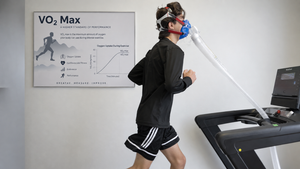
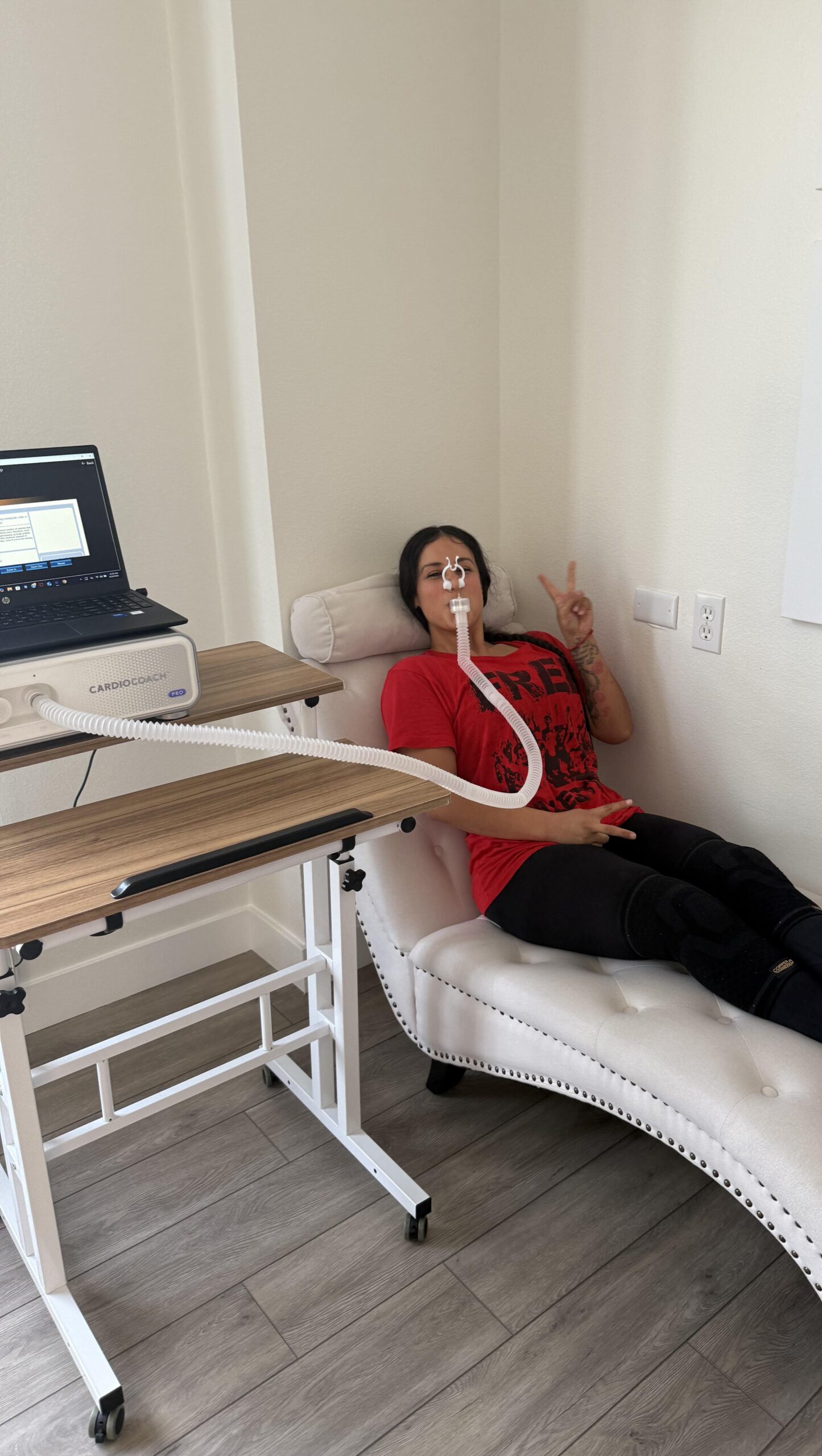
RMR testing uses indirect calorimetry. The principle is straightforward: producing energy consumes oxygen and generates carbon dioxide in predictable proportions. Measure the gas exchange in your breath, and you can calculate energy expenditure without measuring heat directly.
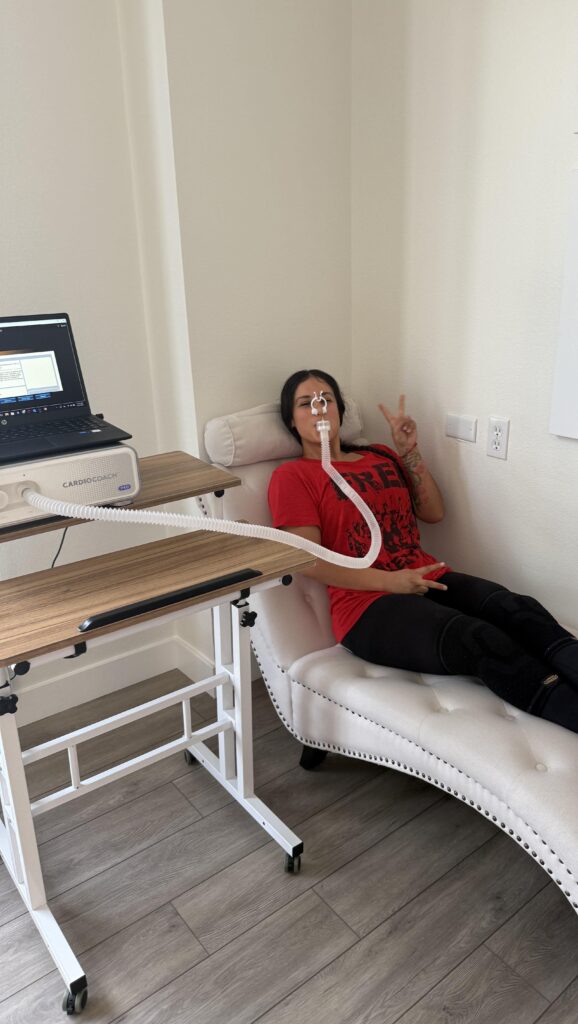
In practice, you sit or recline comfortably in a quiet room. A lightweight mask or mouthpiece collects your exhaled breath, and the analyzer measures oxygen consumed against carbon dioxide produced. The test runs about 10 to 15 minutes.
There is nothing strenuous about it. The main requirement is stillness — you are being measured at rest, so resting is the entire job.
Preparation matters and affects accuracy:
- Fast for at least 4 hours (morning appointments before breakfast are ideal)
- No caffeine or nicotine that morning
- No exercise for at least 12 hours beforehand
- Arrive with time to sit quietly for a few minutes before starting
- Normal hydration — no loading or restricting
Reading your results
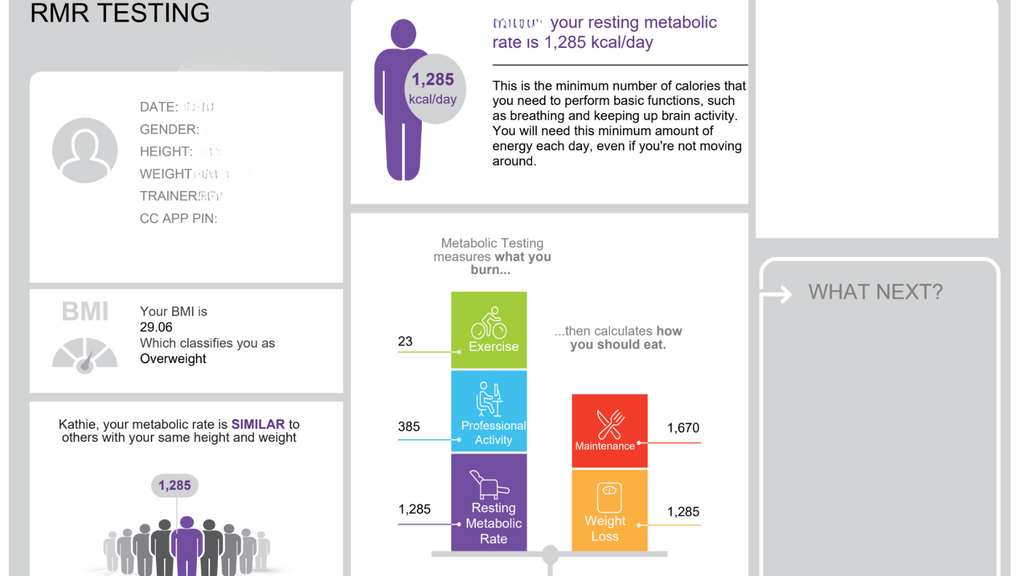
The headline number is your measured resting metabolic rate in calories per day. The more informative figure is how it compares to your predicted rate.
Measured close to predicted means the standard equations describe you well, and generic guidance is likely to work as advertised.
Measured meaningfully below predicted is common in people with a long history of restriction or with relatively low lean mass. It suggests that building lean mass and, sometimes, spending a period eating at maintenance may be more productive than cutting further.
Measured meaningfully above predicted happens too — often in people carrying more muscle than their weight suggests. It usually means there is more room in the plan than they thought.
The RQ number most facilities don’t discuss
Indirect calorimetry also produces a respiratory quotient (RQ) — the ratio of carbon dioxide produced to oxygen consumed. Because fat and carbohydrate oxidize at different ratios, RQ indicates which fuel your body is drawing on predominantly at rest.
An RQ nearer the lower end of the physiological range suggests greater reliance on fat oxidation. An RQ nearer the upper end suggests carbohydrate predominance. It shifts with recent food intake, which is precisely why the fasting requirement matters.
It is a snapshot rather than a verdict, but it is useful context — and it is a number most people have never seen.
Turning a measurement into a plan
A resting metabolic rate is a foundation, not a prescription. Building it into something usable involves:
- Estimating total daily expenditure by applying an activity factor that reflects your actual week — not the week you intend to have
- Setting a deficit or surplus sized to your goal and, importantly, to how long you’re willing to sustain it
- Setting protein intake relative to body weight and lean mass, to protect muscle during a deficit
- Reassessing periodically, because the number moves as your body composition and habits change
Aggressive deficits are where most plans fail. Larger deficits produce faster initial change and also drive greater lean mass loss, stronger hunger signals, and more pronounced adaptive slowing — which is why they so often end in a plateau followed by regain.
We work through your specific targets during your results consultation rather than publishing numbers here, because appropriate intake depends on your body composition, medical history, medications, and goals. If you have a history of disordered eating, or a current eating disorder diagnosis, please bring that up — it changes how this information should be used, and it’s worth having your physician or treatment team involved in the conversation.
Why RMR and DEXA belong together
Lean mass is the single largest driver of resting metabolic rate. Measuring one without the other leaves the most useful interpretation on the table.
Together they answer the question directly: is your metabolic rate what it should be for the amount of muscle you’re carrying? A rate that looks low in isolation may be entirely appropriate for your lean mass — in which case the productive lever is building muscle, not cutting calories further. That is a completely different plan from the one most people arrive with.
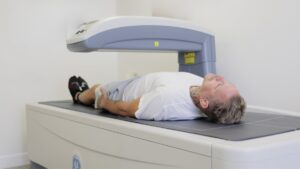
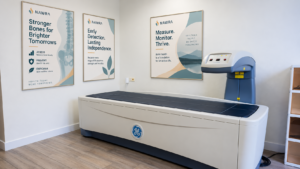
Both tests are available at DexaFit Los Alamitos on Katella Ave., and can be scheduled in the same visit.
Frequently asked questions
How is RMR different from BMR?
BMR is measured under strict overnight-fasted clinical conditions; RMR is the practical equivalent measured in a rested state and runs slightly higher. The terms are often used interchangeably in everyday contexts.
How accurate is an RMR test?
Indirect calorimetry is considerably more accurate than predictive equations for an individual, provided preparation guidelines are followed. Eating, caffeine, or exercise before the test will distort the result.
Can I actually raise my metabolism?
The most reliable lever is increasing lean mass through resistance training and adequate protein. Total daily expenditure also responds meaningfully to increased daily movement. Claims about foods, supplements, or specific timing strategies producing large metabolic increases are generally not well supported.
Do I have to fast?
Yes — at least 4 hours, with no caffeine that morning and no exercise for 12 hours prior. Digestion itself raises metabolic rate and will inflate the reading.
How often should I retest?
Every 3 to 6 months is reasonable, or after a significant change in body composition, training, or medication.
Does the test hurt?
No. You breathe normally through a mask or mouthpiece while sitting still. Some people find the mask mildly claustrophobic at first; it can be adjusted.
Why is my RMR lower than the calculator predicted?
Common contributors include lower lean mass than the equation assumes, an extended history of caloric restriction, age, and thyroid or medication effects. The measurement tells you the gap exists; interpreting the cause is a conversation to have with your physician.
How long does the appointment take?
The measurement runs 10 to 15 minutes. Allow about 30 minutes including setup and review of results.
This article is educational and not medical or nutritional advice. Metabolic testing results should be interpreted with a qualified professional, particularly if you have a medical condition, take medication affecting metabolism, or have a history of disordered eating.