Measurement: VO2 max test · Reviewed by the DexaFit Los Alamitos clinical team · Updated August 2026
The short answer: VO₂ max is the maximum volume of oxygen your body can take in, deliver, and use during intense exercise. It is expressed in milliliters of oxygen per kilogram of body weight per minute, and it is the single best available measure of cardiorespiratory fitness.
It is also one of the strongest predictors of long-term health outcomes that exists — stronger than most of the risk factors people track far more closely.
Your watch gives you a number for it. That number is an inference, not a measurement.
What VO₂ max actually represents
Think of it as engine displacement for your aerobic system. Oxygen has to travel a full chain to be useful: into the lungs, across into the blood, pumped by the heart, delivered through the vasculature, and finally consumed inside muscle cells by the mitochondria. VO₂ max reflects the capacity of that entire chain, limited by whichever link is weakest.
This is why it captures something that no single metric — resting heart rate, blood pressure, weekly mileage — quite does. It is an integrated measure of how well the whole system works under demand.
It is also why the everyday experience of being winded on a flight of stairs is genuinely informative. That feeling is your aerobic system running out of headroom during an activity that should sit comfortably within it.
The longevity evidence
A large retrospective cohort study of exercise treadmill testing published in JAMA Network Open in 2018 (Mandsager et al., Cleveland Clinic) examined the relationship between cardiorespiratory fitness and long-term mortality across more than 120,000 patients.
The findings were striking on two counts. First, the relationship between fitness and survival was graded and continuous — higher fitness was associated with lower mortality across the entire range, with no plateau at which additional fitness stopped conferring benefit. Second, the association between very low fitness and mortality risk was comparable in magnitude to that of major traditional risk factors including smoking, diabetes, and hypertension.
That is worth sitting with. Low cardiorespiratory fitness is not a minor lifestyle variable. It sits alongside the risk factors physicians treat aggressively.
The encouraging implication is that VO₂ max is highly trainable. Unlike age or genetics, it responds to what you do.
VO₂ max reference ranges by age
The table below gives approximate reference ranges in ml/kg/min for the general adult population. Individual results should be interpreted in context — training history, testing protocol, and body composition all affect where a given number sits.
Men
| Age | Poor | Fair | Good | Excellent | Superior |
|---|---|---|---|---|---|
| 20–29 | <38 | 38–43 | 44–51 | 52–56 | 57+ |
| 30–39 | <34 | 34–39 | 40–47 | 48–51 | 52+ |
| 40–49 | <30 | 30–35 | 36–43 | 44–47 | 48+ |
| 50–59 | <25 | 25–31 | 32–39 | 40–43 | 44+ |
| 60–69 | <21 | 21–26 | 27–35 | 36–39 | 40+ |
| 70+ | <18 | 18–23 | 24–31 | 32–35 | 36+ |
Women
| Age | Poor | Fair | Good | Excellent | Superior |
|---|---|---|---|---|---|
| 20–29 | <28 | 28–33 | 34–41 | 42–46 | 47+ |
| 30–39 | <27 | 27–32 | 33–39 | 40–44 | 45+ |
| 40–49 | <25 | 25–29 | 30–36 | 37–41 | 42+ |
| 50–59 | <21 | 21–24 | 25–31 | 32–36 | 37+ |
| 60–69 | <19 | 19–23 | 24–29 | 30–33 | 34+ |
| 70+ | <17 | 17–20 | 21–27 | 28–31 | 32+ |
Two observations most people take from this table. The decline with age is real but gradual — and a well-trained 55-year-old routinely outperforms an untrained 30-year-old. And moving from “poor” to “fair” is where the steepest health returns appear to sit. You do not need to be an athlete to capture most of the benefit.
Why your watch’s number is off
Wearables estimate VO₂ max rather than measuring it. The typical approach infers the relationship between your heart rate and your pace or power during outdoor activity, then models where that relationship would extrapolate at maximum effort.
That inference degrades in a number of ordinary situations:
- Wrist-based heart rate error, particularly during interval work, in cold weather, or with a loose band
- Terrain and conditions — hills, wind, heat, and altitude all break the pace-to-effort relationship the model assumes
- Individual variation in maximum heart rate, which many devices estimate from age using formulas with wide error margins
- Activity type — most algorithms are calibrated primarily on running and are less reliable for cycling, rowing, or mixed training
- No actual maximal effort — the device is extrapolating past anything you’ve actually done
Reported error rates vary by device and study, but differences of 10–15% against laboratory measurement are common, and larger gaps occur.
The watch number is a reasonable trend indicator over months. It is not a baseline you should make decisions from.
What a lab test involves
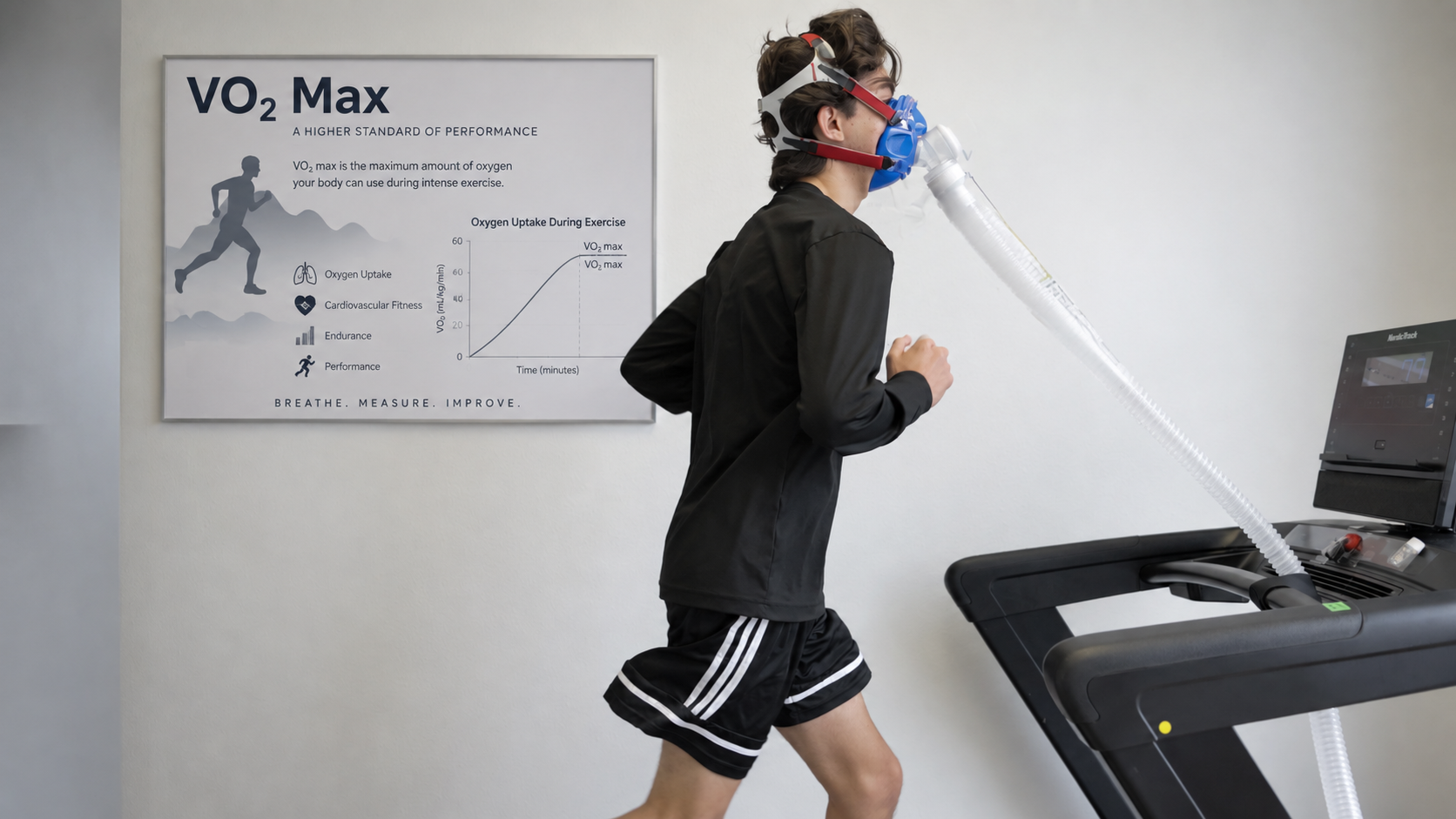
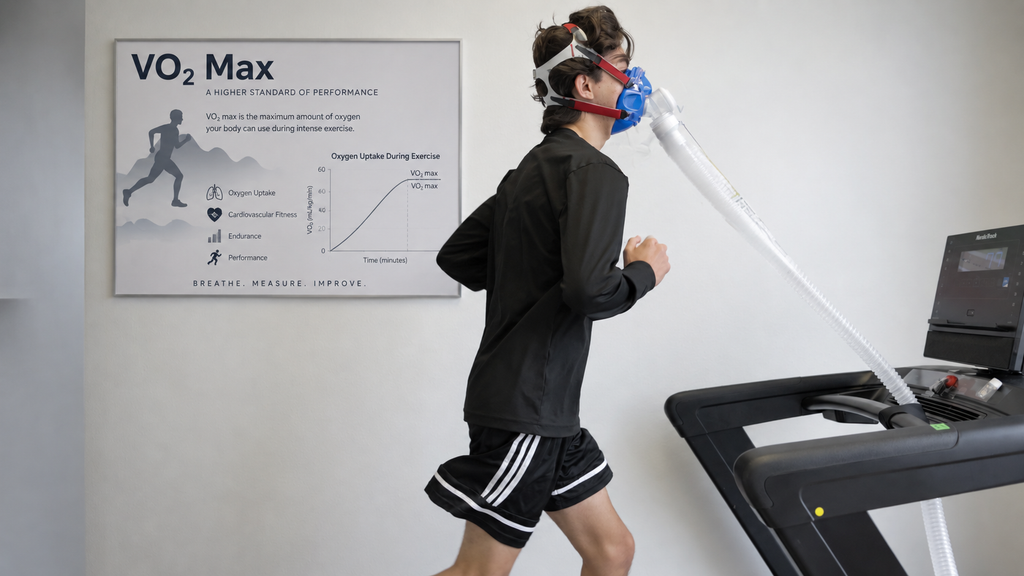
A graded exercise test on a treadmill or cycle ergometer, wearing a mask that captures every breath. The workload increases in stages — speed, incline, or resistance — while the analyzer measures oxygen consumption and carbon dioxide production continuously.
You continue until you reach volitional exhaustion, typically 10 to 15 minutes in. The final stages are genuinely hard; that is the point. VO₂ max is defined at maximal effort, and reaching it requires going there.
You are monitored throughout and can stop at any moment.
What you receive:
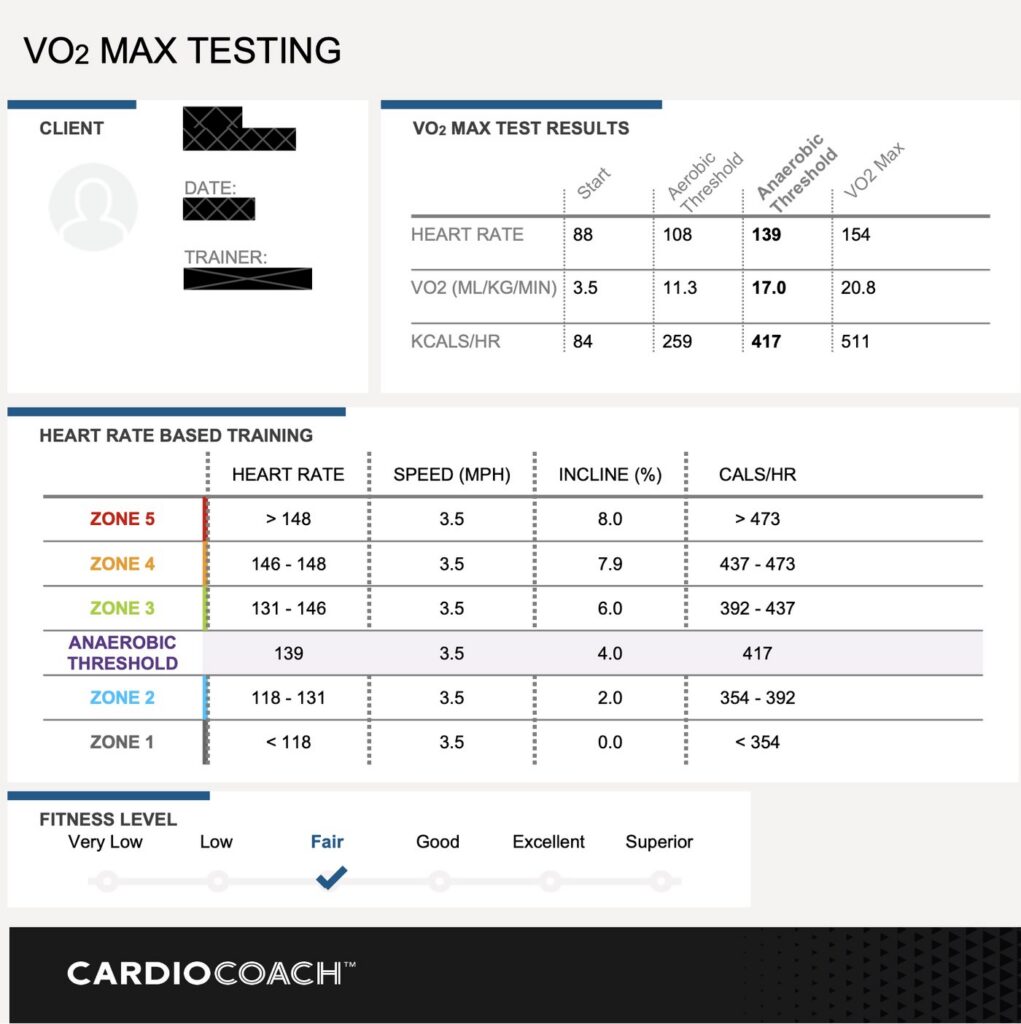
- Your measured VO₂ max, with percentile ranking for your age and sex
- Ventilatory thresholds — the intensities at which your body’s fuel use and breathing pattern shift, marking the boundaries of your training zones
- Heart rate training zones derived from your actual physiology, rather than from an age-based formula
- Peak heart rate, measured rather than estimated
- Substrate utilization across intensities — where you transition from predominantly fat to predominantly carbohydrate
Finding your actual Zone 2
Zone 2 training has become widely discussed, and most people are guessing at where their Zone 2 sits.
The common approach — a percentage of an age-estimated maximum heart rate — inherits every error in that estimate. Real maximum heart rate varies substantially between individuals of the same age, and the formulas carry error margins wide enough to place your target zone well off from where it should be.
Ventilatory threshold testing identifies the boundary directly, from your breathing and gas exchange. The practical consequence is significant: training above your true aerobic threshold while believing you’re below it means you accumulate fatigue without the specific adaptations you’re training for. It’s the most common reason people follow a polarized training plan diligently and see less than expected.
Who should test
- Anyone over 40 establishing a health baseline — this is arguably the most valuable use case
- Endurance athletes setting training zones from physiology rather than formula
- People returning to exercise after a long gap, who want a real starting point
- Anyone whose watch number seems implausible in either direction
- People tracking a training block, retesting at the end to measure the response
Safety and screening
A maximal exercise test is a genuine cardiovascular stress. We screen everyone beforehand.
If you have known or suspected cardiovascular disease, uncontrolled hypertension, a history of chest pain or unexplained shortness of breath, arrhythmia, recent cardiac events, or significant respiratory conditions, obtain clearance from your physician before scheduling. If you develop chest pain, dizziness, or unusual shortness of breath during ordinary activity, see a physician before pursuing a maximal test.
Submaximal testing protocols are available where a maximal test isn’t appropriate.
Testing in Los Alamitos
VO₂ max testing is available at DexaFit Los Alamitos, 5122 Katella Ave., Suite 201, serving Orange County, Long Beach, and the surrounding area. Results are reviewed with you in person, including how to apply your training zones.
Many clients pair VO₂ max with DEXA body composition and RMR testing. Because VO₂ max is expressed relative to body weight, understanding your body composition changes how the number should be interpreted — a point that gets missed surprisingly often.
Frequently asked questions
What is a good VO₂ max for my age?
See the reference tables above. Broadly, reaching the “good” band for your age and sex places you in a favorable position, and the largest health returns appear when moving out of the lowest categories.
How accurate is my Apple Watch or Garmin VO₂ max?
These are estimates derived from heart rate and pace, not measurements. Differences of 10–15% versus laboratory testing are common. Useful for tracking trends; not reliable as an absolute baseline.
How do I improve my VO₂ max?
A combination of higher-volume low-intensity aerobic work and a smaller amount of high-intensity interval work is the most consistently supported approach. Meaningful improvement typically appears over 8 to 12 weeks of consistent training.
How long does the test take?
The test itself runs about 10 to 15 minutes. Allow 45 to 60 minutes for the full appointment including setup, screening, and results review.
Is VO₂ max testing dangerous?
For screened, healthy individuals the risk is low. Because it’s a maximal effort, we screen for cardiovascular risk factors and may require physician clearance.
What should I wear and eat beforehand?
Athletic clothing and running shoes. Avoid a large meal within 3 hours, skip caffeine that day, and avoid hard training for 24 hours prior.
How often should I retest?
Every 3 to 6 months, or at the end of a defined training block.
Can I do this if I’m not an athlete?
Yes — and untrained individuals often gain the most from it, because it establishes a baseline and produces training zones calibrated to their actual physiology rather than to assumptions.
This article is educational and not medical advice. Maximal exercise testing carries cardiovascular risk and requires appropriate screening. Consult your physician before beginning a new exercise program or undergoing maximal exercise testing.