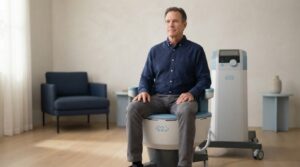
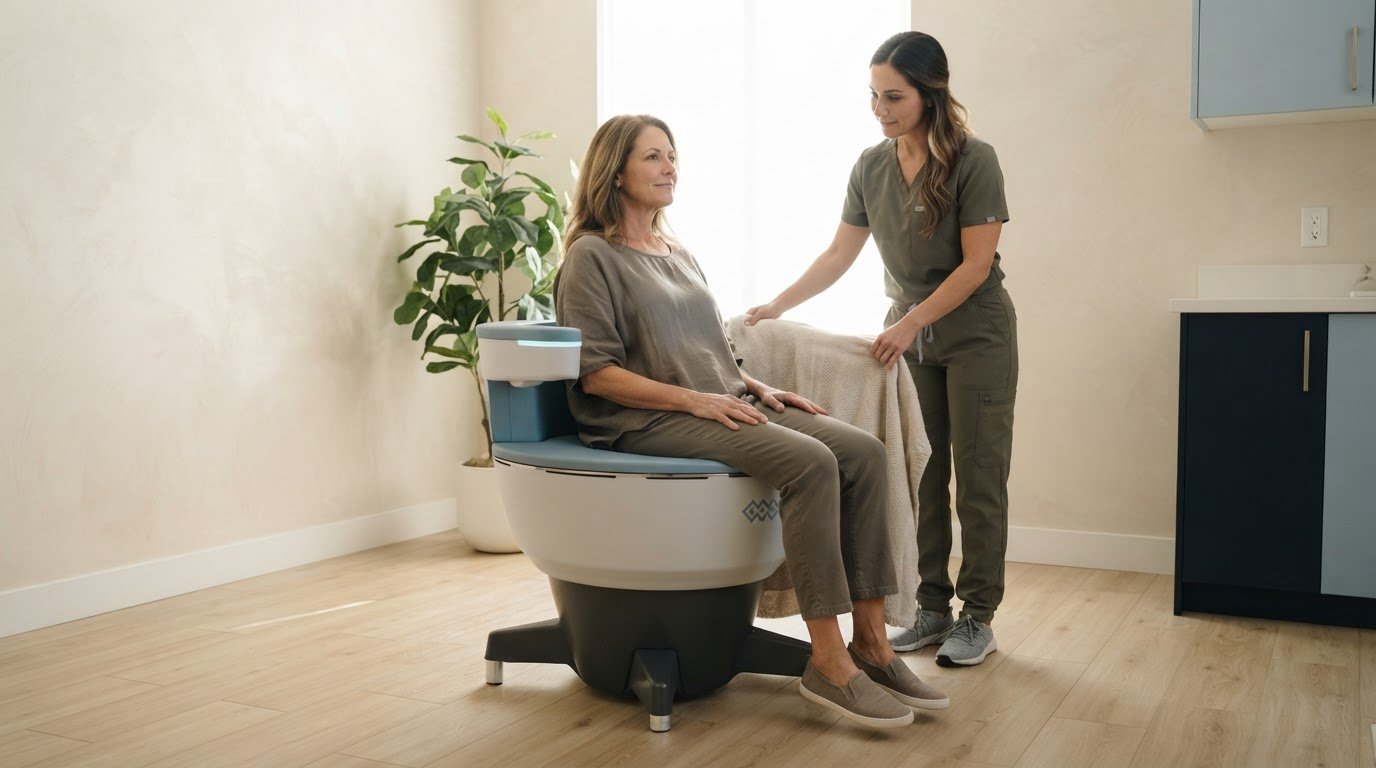
The Emsella chair cost in Los Alamitos depends on the treatment plan, number of sessions, and whether maintenance is part of the plan. Pricing is provided after a quote request, so a single figure won’t reflect every person’s needs. The key is to understand what the total may include before deciding whether treatment fits your goals and budget.
It’s reasonable to look beyond the price of one appointment. An initial series and later maintenance can affect the overall cost, while the treatment itself uses electromagnetic energy to stimulate pelvic floor muscle contractions. Emsella may be considered for pelvic floor strengthening, but the right plan depends on your needs and suitability for treatment.
This guide explains what to consider when planning for Emsella treatment, how the chair works, and what to clarify about payment. You’ll also learn how to assess a treatment plan and how NAWRA’s Emsella service may fit your pelvic floor goals. The aim is to help you understand the process and take a practical next step.
Key Takeaways
- Estimate the full treatment commitment by considering the initial series and possible maintenance, rather than focusing only on a single session.
- A typical starting plan involves six sessions scheduled twice a week over three weeks.
- Emsella uses electromagnetic energy to stimulate pelvic floor muscle contractions, supporting a structured approach to pelvic floor strengthening.
- Insurance coverage is generally unavailable; HSA or FSA eligibility depends on the terms of the individual plan.
- NAWRA offers Emsella for people exploring non-invasive pelvic floor care.
BTL Emsella chair: Does it help for incontinence?
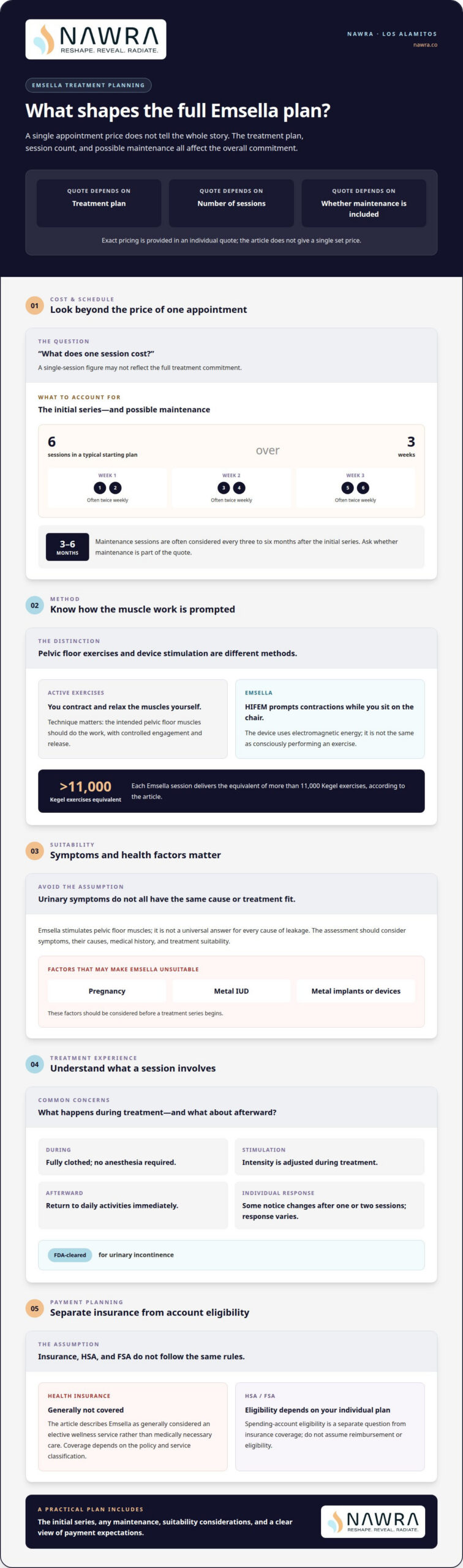
Emsella is designed to stimulate pelvic floor muscles, which support bladder control and urinary continence. The device uses high-intensity focused electromagnetic technology to trigger repeated contractions while the patient sits on the chair. A typical initial plan consists of six sessions across three weeks, often scheduled twice weekly. Each session delivers the equivalent of more than 11,000 Kegel exercises. This may suit people seeking a non-surgical approach to pelvic floor strengthening, including those experiencing urinary incontinence. It doesn’t replace an assessment of symptoms, causes, or treatment suitability.
The treatment experience is structured and non-invasive. Patients remain fully clothed during sessions, and the treatment requires no anesthesia. The electromagnetic stimulation produces pelvic floor contractions; intensity is adjusted during treatment to support an appropriate experience. Some people notice changes after one or two sessions, but response varies. Emsella is FDA-cleared for urinary incontinence, and patients can return to daily activities immediately afterward. A complete series matters when evaluating the approach, since one session isn’t equivalent to the usual treatment plan.
Suitability also matters. Pregnancy, a metal IUD, or metal implants or devices may make Emsella unsuitable. These factors can affect whether electromagnetic stimulation is appropriate, so they belong in the treatment assessment before a series begins. Emsella addresses pelvic floor muscle stimulation; it isn’t a universal answer for every cause of leakage. The type of incontinence, relevant medical history, and presence of implanted metal devices all shape the decision. A plan should account for those criteria rather than treating every urinary symptom as the same problem.
For readers considering Emsella chair costs in Los Alamitos, the exact price is provided in a quote for the individual case. It depends on the treatment plan, session count, and whether maintenance is included. Maintenance sessions are often considered every three to six months after the initial series. That ongoing schedule can change the total commitment. Emsella also shouldn’t be compared with surgery by price alone: the approaches differ in invasiveness, recovery, and clinical purpose. A quote should make clear which sessions and follow-up care it covers.
For readers in Los Alamitos, the relevant details are the treatment plan and where appointments take place. NAWRA is a precision wellness studio in Los Alamitos, serving nearby communities including Cypress, Cerritos, Long Beach, Seal Beach, La Palma, Buena Park, Lakewood, Anaheim, Norwalk, Irvine, Laguna Niguel, Newport Beach, Huntington Beach, Bellflower, Tustin, Fullerton, and Yorba Linda. Emsella is non-invasive, and suitability depends on your symptoms and health considerations.
Pelvic floor strengthening
Pelvic floor muscles contribute to support and control in the pelvic region. Strengthening involves more than producing a strong contraction; coordination and the ability to relax matter too. For example, someone who experiences urinary leakage while coughing may want to understand how their pelvic muscles respond during that activity. A practical discussion should identify the goal, the muscles being targeted, and how progress will be assessed.
Pelvic floor exercises, including Kegels, rely on a person actively contracting and relaxing the muscles. Technique matters: the intended muscles should do the work, rather than relying on general tension elsewhere in the body. A useful first step is learning to identify the pelvic floor contraction, then practicing controlled engagement and release. Exercises and device-based stimulation use different methods. One is actively performed; the other prompts muscle contractions through external technology.
With Emsella, HIFEM technology stimulates pelvic floor muscle contractions while you sit on the device. This offers a structured approach for people who find repeated voluntary contractions difficult. The methods are not identical: exercises involve conscious control, while the device prompts contractions through electromagnetic energy. Understanding this difference helps clarify what a treatment session involves.
Start with a specific functional goal, such as improving pelvic muscle control during a daily activity. Then track that goal consistently rather than judging progress by a single sensation during treatment. Changes in symptoms, exercise technique, and comfort each provide different information. Because pelvic floor concerns have different causes, the approach should reflect your needs and treatment suitability.
Pelvic floor care is functional, not an aesthetic treatment goal. The priority is muscle strength, coordination, and symptom management. If you’re considering electromagnetic stimulation as part of that approach, explore pelvic floor stimulation care alongside the role of active exercises. A clear plan identifies the method, the target function, and how progress will be evaluated. That structure makes it easier to understand what each part of care is intended to address.
Insurance, HSA, and FSA payment options
Emsella treatment is generally not covered by health insurance because it’s considered an elective wellness service rather than medically necessary care. That classification can leave patients responsible for the treatment cost, even when bladder control concerns affect daily routines. Coverage decisions depend on the policy and how the service is classified, so don’t assume that an insurance plan will reimburse a session or treatment series. This distinction matters before comparing payment methods: insurance coverage and spending-account eligibility are separate questions.
Health savings accounts and flexible spending accounts have their own eligibility rules. Whether Emsella treatment qualifies depends on the terms of the individual HSA or FSA plan. Establish that eligibility before including account funds in a treatment budget. For example, a person may have an available account balance but still need the plan to recognize the service as an eligible expense. The balance alone doesn’t establish that a particular treatment can be paid from the account.
Los Alamitos clinics may handle consultations, promotions, and financing differently; these are clinic-level arrangements, not standard features of the Emsella device. A consultation can help clarify the proposed treatment plan, while a promotion or financing option changes the payment arrangement. Don’t treat any of those as guaranteed or assume they apply to every patient. Keep the distinctions clear: insurance is a coverage decision, HSA or FSA use is plan-dependent, and financing is a separate payment arrangement.
The treatment experience doesn’t determine payment eligibility. Patients remain fully clothed during Emsella treatment, and the session involves pelvic floor muscles rather than an external procedure requiring a change of clothing. Minutes spent in the chair describe the appointment, not whether an insurer or spending account will pay. For practical budgeting, separate the treatment schedule from the payment method and understand which expenses each method could cover.
A useful payment review follows three steps. First, identify whether insurance treats Emsella as covered care or elective wellness. Second, establish whether the specific HSA or FSA plan permits payment for the treatment. Third, review any clinic payment arrangement separately, including what it covers and when payments are due. This sequence helps patients avoid confusing account eligibility with reimbursement or financing. It also makes the total commitment easier to assess alongside the treatment plan for pelvic floor support and bladder control.
Keep records of the plan’s eligibility decision and any payment terms before starting treatment. If account funds aren’t eligible, that doesn’t establish whether insurance will cover Emsella; those decisions follow different rules. A clear written breakdown of the proposed treatment and payment arrangement can help patients plan without assuming reimbursement. The key is to separate clinical suitability, coverage, and payment method, then make a decision using the terms that actually apply to the individual plan.
Emsella chair purchase price
The purchase price of an Emsella chair is a clinic equipment expense, not the price an individual pays for treatment. A clinic buys the device; a patient pays for a treatment plan. The equipment’s purchase cost does not determine a patient’s bill, which depends on the clinic’s pricing and what the plan includes.
For a clinic evaluating the equipment, the purchase quote is the starting point. The final amount depends on the specific equipment configuration and the commercial terms attached to the transaction. Those terms determine what the buyer receives and which expenses belong to the purchase itself. A clinic should therefore assess the complete offer rather than compare a single headline figure. Those purchase considerations are separate from the patient’s treatment schedule.
Equipment ownership and treatment delivery are different matters. Emsella uses electromagnetic energy to stimulate pelvic floor muscles, but the clinic’s equipment purchase does not determine how many sessions you need or what treatment costs. For someone exploring support for bladder control or pelvic floor strength, the relevant figure is the quote for their individual treatment plan.
A practical way to read a purchase quote is to separate the known terms from the assumptions. Identify the exact equipment configuration named in the quote. Then review the commercial terms and distinguish purchase expenses from the clinic’s separate costs of delivering treatment. Avoid treating an equipment acquisition figure as a typical patient price. It addresses a different buyer, a different transaction, and a different purpose.
The distinction also matters when comparing Emsella with other procedures. A clinic’s device purchase is a business expense; a patient compares care options by purpose, suitability, and the proposed plan. Neither the chair’s purchase price nor the word “electromagnetic” shows that Emsella is appropriate for every cause of urinary symptoms. Suitability and budgeting are separate questions.
For patients, the useful next step is to focus on the treatment quote rather than reverse-engineering a clinic’s equipment purchase. The quote should describe the proposed course of care and any included follow-up. For clinics, the useful step is to assess the complete equipment transaction and its terms. Keeping those decisions separate avoids a common pricing error: mistaking the cost of a treatment device for the price of receiving treatment.
Which clinics near Los Alamitos offer Emsella treatments?
For Los Alamitos readers, the important distinction is between a clinic that offers Emsella and a clinic that is simply described as serving the area. Treatment location affects travel planning, appointment logistics, and continuity across a recommended course. A city name alone doesn’t establish where appointments take place. The practical starting point is the location attached to the treatment itself, then the plan’s schedule and follow-up needs.
Location also shapes whether a treatment course feels manageable. Emsella is generally delivered as a series rather than a one-time visit, so the distance to the treatment room matters across repeated appointments. Consider the route from Los Alamitos, typical travel conditions, and how easily appointments fit around work or caregiving. A nearby address can reduce travel demands, but distance is only one part of the decision. The treatment approach and the ability to follow its schedule matter too.
Look for clear, consistent details about what the visit involves. A useful treatment description explains the purpose of pelvic floor stimulation, the session format, and how the plan is structured. For example, someone considering care for urinary leakage needs information about whether the approach targets pelvic floor muscles. Treatment information should also describe who may be unsuitable, including people who are pregnant or have certain metal devices. These points help make a location listing more meaningful than a name or map pin.
Local access is not the same as clinical suitability. Emsella may support pelvic floor strengthening, but it isn’t appropriate for every person or every cause of incontinence. Pregnancy, a metal IUD, and metal implants or devices are relevant contraindications. Those details should be part of a careful treatment assessment, not omitted from a brief promotional description. A suitable plan connects the person’s symptoms, health considerations, and treatment goals.
When searching for Emsella in Los Alamitos, focus on where appointments take place and what the treatment plan involves. NAWRA Wellness is located in Los Alamitos and serves nearby communities including Cypress, Cerritos, Long Beach, Seal Beach, La Palma, Buena Park, Lakewood, Anaheim, Norwalk, Irvine, Laguna Niguel, Newport Beach, Huntington Beach, Bellflower, Tustin, Fullerton, and Yorba Linda. Knowing the location and plan helps you judge whether appointments fit your needs.
If you’re evaluating Emsella for pelvic floor care, review the treatment information and care approach to understand the process and its intended role. A focused review keeps the decision grounded in location, treatment purpose, and personal suitability, rather than a city label alone.
NAWRA: Emsella
NAWRA offers Emsella for people exploring non-invasive support for pelvic floor strength and urinary concerns. The treatment uses electromagnetic stimulation to prompt pelvic floor muscle contractions, making it a distinct option from exercises that rely on voluntary contraction. It may be worth discussing when bladder control symptoms or pelvic floor goals are prompting you to consider a structured treatment plan.
A useful next step is to talk through your goals, relevant health considerations, and the treatment plan. Cost depends on the individual plan and is provided in a quote for your case. This helps connect the decision to the care being considered, rather than equipment purchase prices or general market estimates.
Contact NAWRA to discuss Emsella and your pelvic floor care goals.
Make your next step a considered one
Use your treatment goals to guide the next conversation. Rather than treating the Emsella chair cost in Los Alamitos as an isolated figure, consider how pelvic floor care fits your priorities, health considerations, and preferred approach. A focused discussion can help connect those factors to a plan that makes sense for you.
NAWRA also offers EMSCULPT NEO, DEXA Body Composition, and ExoPod Full-Body Therapy. These services address different wellness goals, so the right starting point depends on what you want to address. For pelvic floor care, focus the conversation on EMSELLA and the questions that matter to your decision.
Contact NAWRA to discuss Emsella and your goals. A clear next step can help you move forward with greater confidence and a plan that reflects your needs.
Frequently Asked Questions
How Much Does Emsella Cost?
The Emsella chair cost in Los Alamitos depends on the treatment plan and what it includes. The total can reflect the number of appointments and any maintenance sessions in the plan. A quote for your case gives the clearest basis for budgeting. Keep the treatment price separate from a clinic’s equipment purchase cost, since those figures belong to different transactions and answer different questions.
How long do Emsella results last?
Emsella results typically last about six months after a completed treatment series. That estimate helps with planning, but it doesn’t define an individual response or establish when maintenance is needed. For example, track changes in bladder control after the initial course and consider how those changes affect daily activities. This creates a more useful basis for discussing ongoing care than relying on a single appointment’s immediate effects.
Does Insurance Cover Emsella Treatment?
Insurance coverage for Emsella is generally unavailable because treatment is considered elective wellness rather than medically necessary care. That classification means patients should plan for self-payment rather than assume their policy will reimburse the service. For example, a plan covering other pelvic health care doesn’t automatically cover Emsella. Review the specific benefit category and distinguish insurance reimbursement from HSA or FSA eligibility, which follows the account’s own terms.
How long does Emsella take to work?
Some patients notice improvement after one or two sessions, while the usual course is completed over several appointments. An early change is not the same as completing treatment or knowing how long results will last. For a practical progress check, note the symptom being addressed, such as leakage during exercise, and whether it changes as sessions continue. That gives a concrete point to discuss during care.
How Many Treatments Do I Need?
A typical initial Emsella plan consists of six treatments scheduled twice a week over three weeks. The schedule gives the treatment course a defined structure rather than relying on isolated visits. After completing the series, maintenance may be considered every three to six months. The appropriate plan also depends on treatment suitability and the person’s goals, so the initial series and later maintenance should be treated as separate planning decisions.
What is the price per Emsella session at Los Alamitos-area clinics?
There isn’t one session price that applies to every Los Alamitos-area treatment plan. The quoted amount depends on the case and whether the plan covers individual visits, a series, or follow-up care. Compare what the quote includes, not only the per-appointment figure. For example, a plan that includes several sessions should be evaluated separately from a single visit or a maintenance appointment.
How many Emsella sessions are typically recommended, and how long does each session take?
The typical initial course is six sessions over three weeks, with appointments scheduled twice weekly. Session descriptions give a duration of 28 minutes, while other treatment descriptions call it a 30-minute session. These figures refer to the treatment session, not necessarily the entire visit. Planning around the course schedule can help fit appointments into work, travel, and other regular commitments.
Does insurance cover Emsella treatment, or is it usually self-pay?
Emsella is usually self-pay because insurance coverage is generally unavailable for this elective wellness service. HSA or FSA payment depends on the individual plan’s eligibility rules, so an account balance alone doesn’t establish that the treatment qualifies. Keep those payment routes separate: insurance reimbursement, spending-account eligibility, and any clinic payment arrangement are different matters. This distinction helps prevent an assumed benefit from becoming part of the treatment budget.