Treatment: weak core lower back pain · Medically reviewed by Rasiq Ahmed, MD · Updated August 2026
The short answer: Deep core muscles stabilize your spine before you move — a feed-forward mechanism that fires milliseconds ahead of the movement itself. When they weaken or stop firing properly after pregnancy, surgery, injury, or years of sitting, surrounding muscles compensate and the lower back absorbs load it was not built for. Restoring activation is often the missing step.
Your lower back aches by mid-afternoon. It’s worse after sitting, worse after standing too long, worse when you lift something awkwardly. You’ve been told to strengthen your core, so you’ve done planks. Consistently. For months.
It hasn’t helped, and you’ve concluded either that you’re doing it wrong or that this is just how your back is now.
There’s a third possibility that gets discussed far less: the muscles you’re trying to train may not be participating.
What the deep core actually is
“Core” in common usage means abdominals. The functional reality is a coordinated cylinder of four structures that work together:
- Transverse abdominis (TVA) — the deepest abdominal layer, wrapping horizontally around the trunk like a corset. It doesn’t move your spine; it stabilizes it.
- Multifidus — small muscles running along the spine, segment to segment, providing local stability at each vertebral level.
- Pelvic floor — the muscular base of the cylinder.
- Diaphragm — the top of the cylinder. Yes, your breathing muscle is a core stabilizer.
These four coordinate to manage intra-abdominal pressure and stabilize the spine. In healthy function, they activate before you move — a feed-forward mechanism that stiffens the trunk in anticipation of load, milliseconds ahead of the movement itself.
That anticipatory timing is the part that breaks.
How weakness becomes pain
When the deep stabilizers don’t engage properly, the demand doesn’t disappear. Your spine still needs stabilizing. Other structures take it on.
The larger, more superficial muscles — rectus abdominis, obliques, erector spinae, hip flexors — begin doing stabilization work they weren’t designed for. They’re movement muscles, built for larger, shorter-duration efforts, and they fatigue when asked to hold continuously.
The common consequences: chronically tight hip flexors pulling into anterior pelvic tilt, which increases lumbar curvature and the compressive load on the lower back. Erector spinae muscles that are constantly working and constantly tight. Load transferring to passive structures — discs, facet joints, ligaments — rather than being managed by active muscular control.
The result is the pattern most people recognize: back that aches with sustained postures, tightness that stretching relieves temporarily, and a nagging sense that your midsection isn’t doing its job.
The distinction that matters: motor control versus strength
Here’s the insight that changes how this problem should be approached.
A muscle can be strong and still not fire correctly.
Strength is force-producing capacity. Motor control is your nervous system’s ability to recruit the right muscles, at the right time, in the right sequence, for the task at hand.
After pregnancy, surgery, injury, or a long period of guarding or disuse, the nervous system’s recruitment patterns for specific muscles can become inhibited. The muscle is present. The connection is degraded — the signal doesn’t reliably get there, or arrives late, or arrives weaker than needed.
This is why “just do planks” so often fails. A plank is a high-load, whole-body task. If your transverse abdominis isn’t recruiting, your body will complete the plank using everything else. You’ll get better at planks. You will be reinforcing the compensation pattern that’s causing the problem.
You cannot strengthen a muscle you aren’t recruiting. Activation has to come first.
What causes inhibition
Pregnancy and delivery. Nine months of progressive stretching of the abdominal wall and pelvic floor, followed by delivery. The proprioceptive feedback the nervous system relies on to control these muscles is disrupted, and it doesn’t automatically restore itself.
Abdominal surgery. Cesarean delivery, hernia repair, hysterectomy, appendectomy. Incisions through or near abdominal musculature affect both the tissue and the neural pathways.
Prolonged sitting. Extended sitting places the deep core in a shortened, unloaded position for hours daily. The nervous system optimizes for what you actually do.
Injury and guarding. After a back injury, the body reflexively splints the area. This is protective in the short term. Sustained, it becomes a pattern that outlasts the injury — a well-documented phenomenon in back pain research.
Age and inactivity. Recruitment patterns, like anything else, degrade without use.
Diastasis recti
Diastasis recti abdominis is a widening of the linea alba — the connective tissue running down the midline between the two halves of the rectus abdominis. It occurs commonly during pregnancy as the abdominal wall accommodates the growing uterus.
Assessment is typically done by palpating the midline gap in fingers’ width and, importantly, by assessing the tension of the connective tissue rather than gap width alone. Current thinking places more emphasis on whether the tissue can generate tension and transfer load than on the measured separation.
What can improve: load transfer through the midline, the ability to generate tension, functional symptoms including back pain, and often the appearance of doming or coning during effort.
What may not fully resolve: the connective tissue does not necessarily return to its pre-pregnancy width. Some separation may remain, and that can be entirely compatible with a functional, symptom-free abdominal wall.
What makes it worse: exercises that increase intra-abdominal pressure without adequate deep core control — traditional crunches, sit-ups, and certain loaded movements — can worsen doming.
If you have diastasis recti, please work with a pelvic floor physical therapist. That’s the appropriate clinical pathway, and anything we offer should sit alongside it rather than in place of it.
Where supramaximal contraction fits
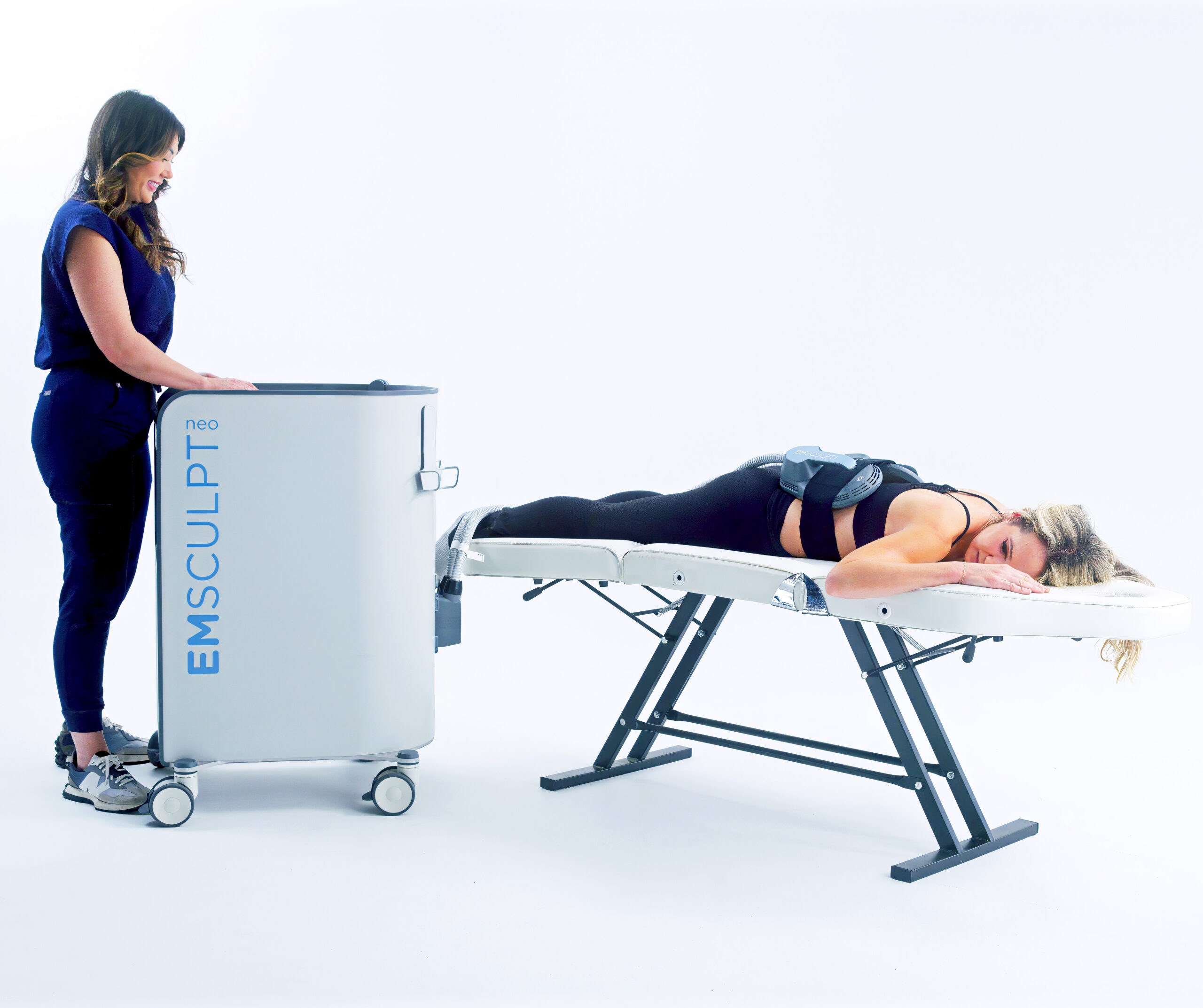
The reason this device is interesting for functional work rather than only aesthetic work comes down to the recruitment problem.
Voluntary contraction is limited by your nervous system’s own governor. Under conscious effort you cannot recruit all available motor units simultaneously — there’s a built-in regulatory ceiling.
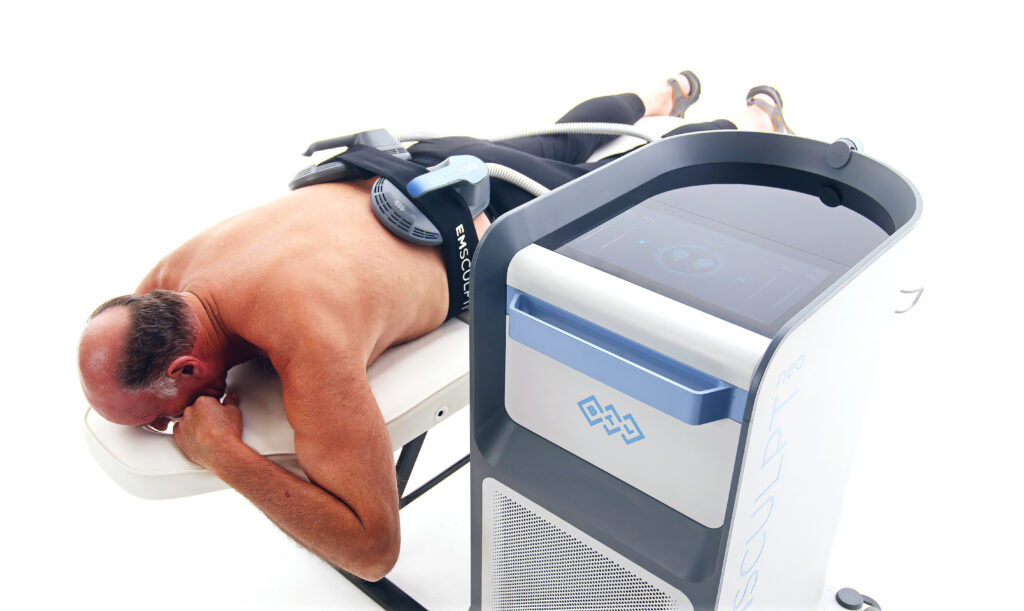
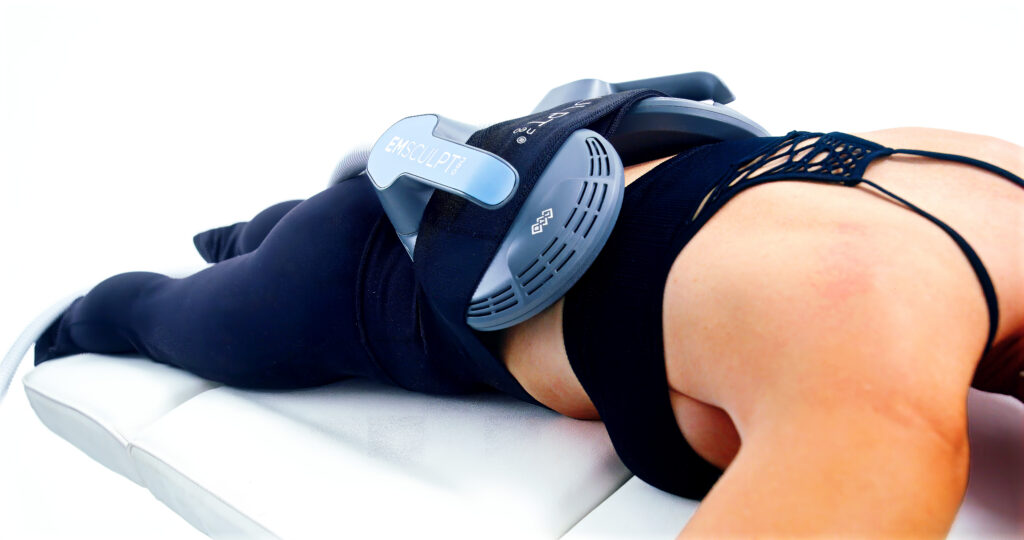
HIFEM energy induces contractions that bypass that voluntary pathway, producing what’s described as supramaximal contraction: more complete recruitment than voluntary effort achieves, sustained and repeated.
For someone whose problem is that they cannot voluntarily access a muscle, an externally induced contraction offers something conceptually useful — it produces the contraction the person can’t currently generate, which may support re-establishing the sensory experience of that muscle working.
Two honest caveats. First, an induced contraction is not the same as re-learning voluntary control. It doesn’t automatically teach your nervous system to recruit the muscle on its own during real movement. Second, this is precisely why we position it as adjunctive to rehabilitation rather than as a replacement for it.
What functional-focus sessions involve
The protocol differs from aesthetic treatment. Emphasis shifts toward contraction patterns supporting deep stabilizer engagement, generally with less emphasis on the fat-reduction component and different intensity progression.
Sessions run about 30 minutes. As with the aesthetic protocol, treatment is typically delivered as a series over several weeks.
Expect deep muscular soreness afterward, often in places you don’t usually feel.
How this fits alongside physical therapy
We want to be clear about this: this is adjunctive, not a replacement.
Physical therapy for core dysfunction and back pain involves assessment, diagnosis, motor control retraining, progressive loading, movement pattern correction, and education — delivered by a licensed clinician who can evaluate your specific presentation. None of that is replaced by a device.
Where a device may add value is as a supplementary stimulus alongside that work — potentially useful for someone struggling to access a muscle voluntarily, or as a complementary input during a rehabilitation program.
If you’re currently working with a physical therapist, please tell them you’re considering this, and tell us what they say. We’d rather coordinate than work at cross purposes. We’re actively building referral relationships with physical therapists in the Los Alamitos and Long Beach area for exactly this reason.
If you’re not working with anyone and you have persistent back pain, seeing a physician or physical therapist should be your first step, not your last.
Screening and contraindications
Absolute contraindications:
- Cardiac pacemaker, implanted defibrillator, or neurostimulator
- Metal or electronic implants in or near the treatment area
- Drug pumps or implanted delivery devices
- Pregnancy
- Hernia at or near the treatment site
- Malignancy, current or recent
- Pulmonary insufficiency
- Bleeding disorders or active anticoagulant therapy
- Fever or active infection
- Impaired sensation in the treatment area
- Recent abdominal or spinal surgery
Additional requirements for functional treatment:
- Postpartum: clearance from your OB or midwife, with timing dependent on delivery type and healing
- Recent abdominal surgery: surgical clearance required, with the incision fully healed
- Metal IUD: individual assessment
- Undiagnosed pain: if you have back pain that has not been evaluated by a physician, get it evaluated first. Pain is a symptom, and it needs a diagnosis before it needs a treatment.
When to see a physician instead
Some symptoms need medical evaluation, not a wellness service. See a physician promptly if you have:
- Pain radiating down one or both legs, particularly below the knee
- Numbness, tingling, or weakness in a leg or foot
- Changes in bowel or bladder function — this warrants urgent evaluation
- Numbness in the groin or inner thigh area — also urgent
- Pain following significant trauma
- Unexplained weight loss alongside back pain
- Fever with back pain
- Pain that is severe at night or wakes you from sleep
- Pain that is progressively worsening despite rest
- A history of cancer with new back pain
These can indicate conditions requiring prompt medical attention. Please don’t book a wellness appointment instead of a medical one.
Booking in Los Alamitos
Functional-focus sessions are available at Nawra Wellness Studio, 5122 Katella Ave., Suite 201, Los Alamitos. Dr. Rasiq Ahmed MD is our supervising physician, and every functional client completes a full screening and medical history review before treatment.
If we don’t think this is the right tool for your situation, we’ll tell you and point you toward what is.
Frequently asked questions
Can this fix my back pain?
It is not a treatment for diagnosed back conditions. Back pain has many possible causes and requires medical evaluation. Where weak or poorly activating core musculature is a contributing factor, functional strengthening may be part of an overall approach — alongside, not instead of, appropriate medical or physical therapy care.
What’s the difference between weak core muscles and poor activation?
Strength is capacity to produce force; activation is your nervous system’s ability to recruit the muscle when needed. A muscle can be strong and still fail to engage at the right time. This distinction is why generic core exercises sometimes don’t help.
Will this close my diastasis recti?
Connective tissue does not necessarily return to its pre-pregnancy width. What often improves is the ability to generate tension and transfer load through the midline, which is what affects function and symptoms. Please work with a pelvic floor physical therapist for diastasis specifically.
How soon after having a baby can I do this?
Not during pregnancy, and postpartum timing depends on your delivery, healing, and whether you’re breastfeeding. Get clearance from your OB or midwife first.
Is this a substitute for physical therapy?
No. Physical therapy involves assessment, diagnosis, and individualized progressive rehabilitation from a licensed clinician. This is a supplementary stimulus that may complement that work.
How is this different from the aesthetic treatment?
Different protocol and emphasis — contraction patterns are oriented toward deep stabilizer engagement rather than toward visible contouring.
Does it hurt?
The contractions are intense but not typically described as painful. Expect deep soreness afterward. If you have current back pain, tell us — we adjust and, in some cases, will decline to treat until you’ve been evaluated.
Can I do this if I have a herniated disc?
Not without evaluation and clearance from your physician. Spinal pathology requires medical assessment before any intervention.
How many sessions?
Typically a series over several weeks, with the specific plan set at consultation.
This article is educational and not medical advice. It does not diagnose or treat any medical condition. Persistent back pain requires evaluation by a qualified healthcare provider. Symptoms including radiating leg pain, numbness, weakness, or changes in bowel or bladder function require prompt medical attention. This device has specific contraindications including implanted electronic devices and pregnancy; a screening consultation is required.