Measurement: DEXA scan body composition · Reviewed by the DexaFit Los Alamitos clinical team · Updated August 2026
The short answer: The scale measures total weight, not what that weight is made of. It is entirely possible to lose four pounds of fat and gain four pounds of muscle in the same eight weeks and see the number stay exactly where it started. A DEXA scan separates your weight into fat, lean muscle, and bone — and shows where each of those sits on your body.
That distinction is the difference between “nothing is working” and “everything is working and I couldn’t see it.”
What the scale can’t tell you
A bathroom scale reports one number: the sum of everything in your body. Bone, muscle, organs, fat, and the several pounds of water your body holds and releases on its own schedule.
That single number moves for reasons that have nothing to do with fat. Sodium intake shifts water retention. Carbohydrate intake changes stored glycogen, and each gram of glycogen holds roughly three grams of water with it. A hard training session causes temporary inflammation and fluid retention in the muscles you worked. Menstrual cycles move the number by several pounds in either direction.
Underneath all that noise, the change you actually care about — body fat going down, lean mass holding or going up — can be happening quietly and invisibly.
What “skinny fat” actually means
Normal-weight obesity, sometimes called being “skinny fat,” describes a body that reads as healthy by weight and BMI while carrying a high proportion of fat and relatively little muscle.
It matters because of where that fat tends to sit. Visceral fat — the fat packed around the organs in the abdominal cavity — behaves differently from the subcutaneous fat under your skin. It is metabolically active tissue, and higher visceral fat is associated with insulin resistance, unfavorable lipid profiles, and elevated cardiometabolic risk.
You cannot see it, pinch it, or infer it from your weight. A DEXA scan quantifies it directly.
What a DEXA scan measures
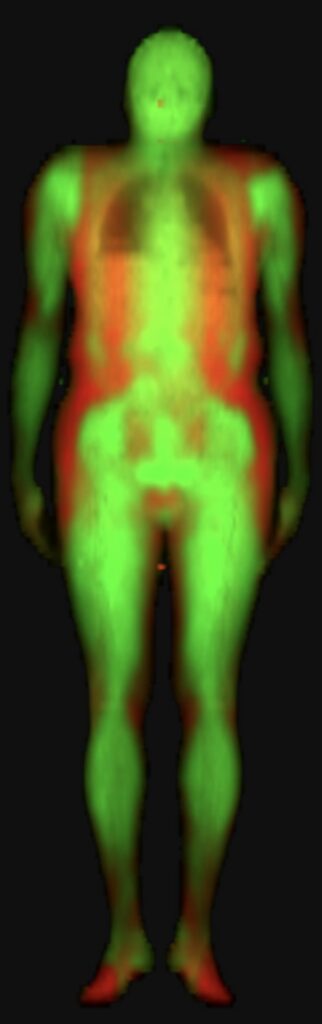
DEXA stands for dual-energy X-ray absorptiometry. Two low-dose X-ray beams at different energy levels pass through the body, and because fat, lean tissue, and bone each absorb those energies differently, the scanner can calculate how much of each is present — and where.
A full body composition scan returns:
- Total body fat percentage and total fat mass in pounds
- Lean mass by region — each arm, each leg, trunk, measured separately
- Visceral adipose tissue (VAT), reported as an estimated area or volume
- Bone mineral density, including T-score and Z-score
- Left-right symmetry, which often surprises people
The regional breakdown is the part most people find genuinely useful. Knowing you’re at 28% body fat is interesting. Knowing that your right leg carries noticeably more lean mass than your left after an old injury is something you can act on.
DEXA compared to other body composition methods
| Method | Typical error range | Measures visceral fat | Measures bone | Affected by hydration | Regional breakdown |
|---|---|---|---|---|---|
| DEXA | ~1–2% | Yes | Yes | Minimally | Yes, by limb and trunk |
| BIA / InBody | ~3–5%+ | Estimated only | No | Significantly | Limited |
| Skinfold calipers | ~3–5% | No | No | No | Site-specific only |
| Bod Pod | ~2–3% | No | No | Moderately | No |
| Bathroom smart scale | Highly variable | No | No | Significantly | No |
Bioelectrical impedance — the technology in InBody machines and smart scales — passes a small current through the body and estimates composition from the resistance it meets. Because water conducts that current, hydration status moves the result. Drinking a large glass of water, exercising beforehand, or testing at a different time of day can change your reading without anything about your body changing.
DEXA is widely used as the reference standard in body composition research for exactly this reason: it is far less sensitive to what you did that morning.
The GLP-1 question: are you losing fat or muscle?
If you are taking semaglutide, tirzepatide, or a similar GLP-1 medication, this section matters more than any other on this page.
These medications are highly effective at reducing total body weight. But research on rapid weight loss consistently finds that a meaningful share of the weight lost is lean mass rather than fat — with published estimates commonly falling in the range of roughly a quarter to 40% of total weight lost, depending on the study, the population, and whether resistance training and adequate protein intake were in place.
Losing muscle has consequences. Lean mass is the largest single contributor to your resting metabolic rate, so losing it makes long-term weight maintenance harder. It also affects strength, bone loading, insulin sensitivity, and functional independence as you age.
The scale cannot distinguish between the two. A DEXA scan can. Scanning before starting the medication and again at 90-day intervals tells you whether your protein intake and resistance training are doing their job — while there’s still time to adjust.
Talk to your prescribing physician about your results. This is information to bring into that conversation, not a substitute for it.
What actually happens during a scan
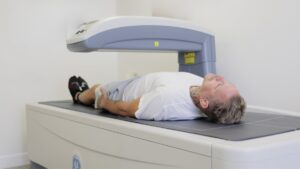
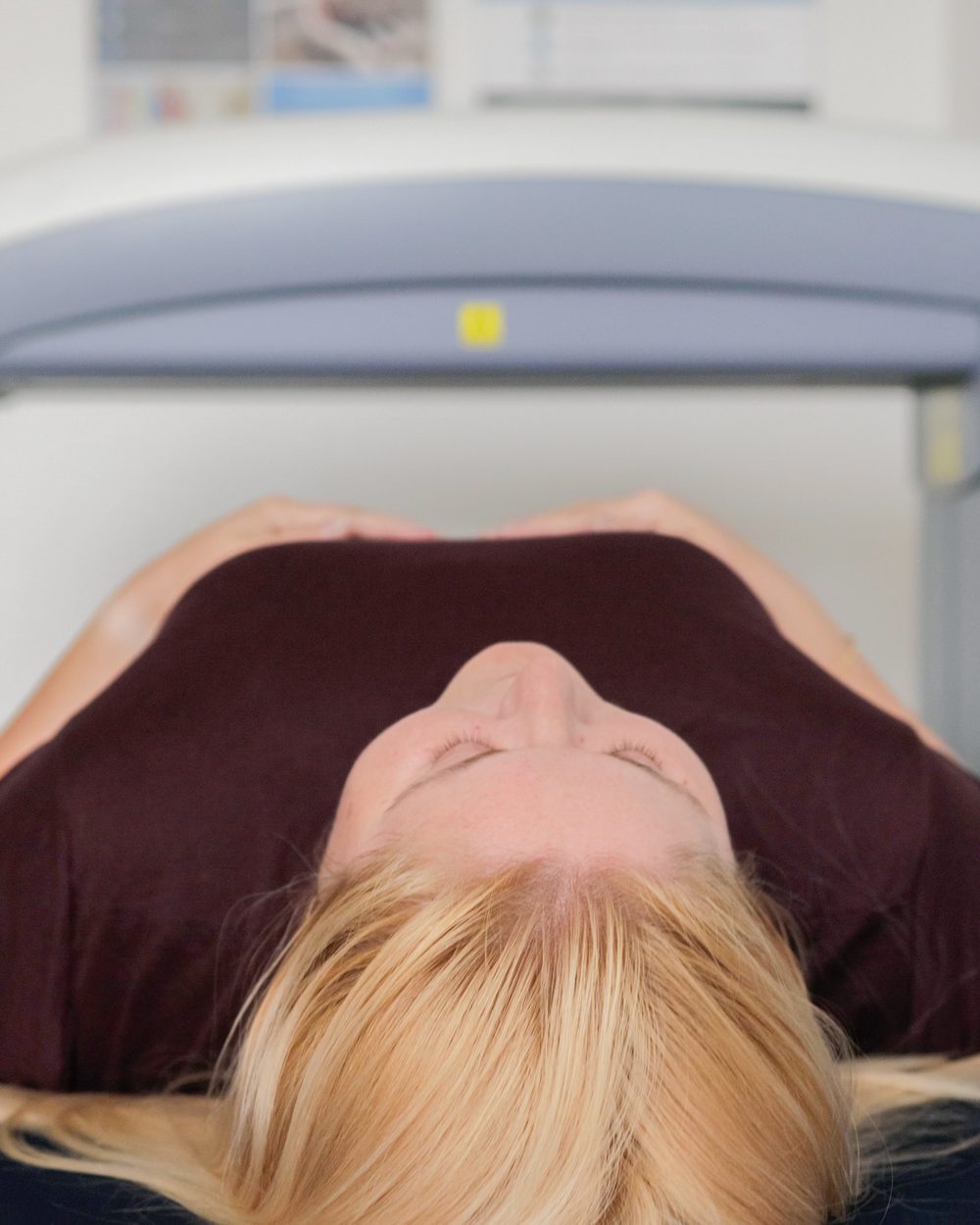
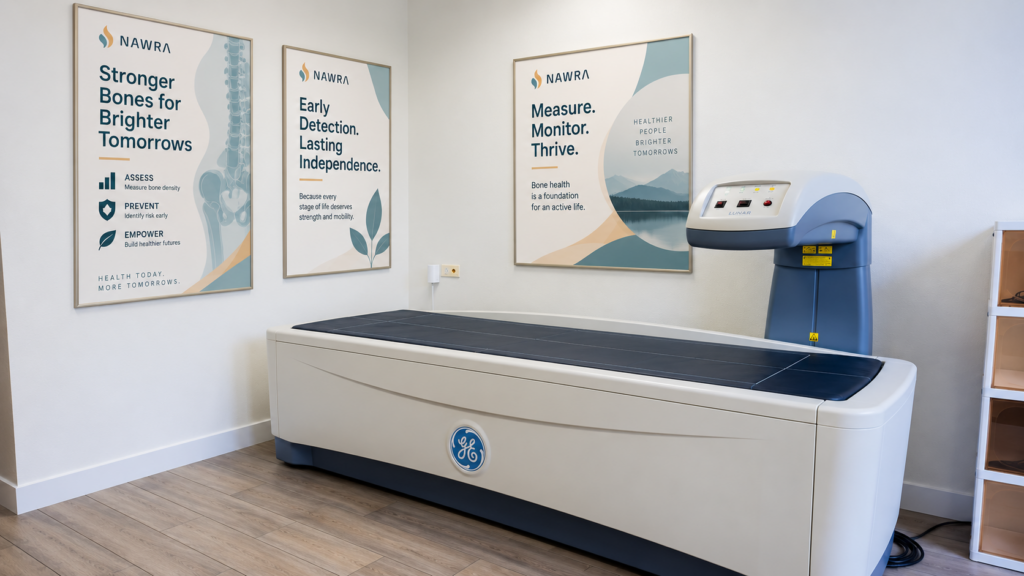
You lie still on a padded table, fully clothed, while a scanner arm passes above you. It does not touch you or enclose you. The scan takes roughly seven minutes.
The radiation dose for a body composition scan is very low — comparable to a fraction of what you’d receive from natural background radiation on an ordinary day, and far below a standard chest X-ray. Even so, DEXA is not performed during pregnancy. Let us know if there is any possibility you are pregnant.
To prepare: wear clothing without metal — no zippers, underwire, or metal buttons. Remove jewelry. Avoid exercise and large meals immediately beforehand, and keep your hydration normal rather than loading up or restricting. If you have had a scan with contrast dye or a nuclear medicine study in the past week, tell us; it can interfere with the reading.
Who benefits most from a scan
- Anyone whose weight has plateaued despite consistent effort
- GLP-1 users tracking whether their loss is fat or lean mass
- People training for strength or hypertrophy who want objective evidence of progress
- Adults over 50, or anyone with fracture history or family history of osteoporosis, tracking bone density
- Anyone with normal weight but metabolic concerns — the visceral fat number is often the missing piece
- People preparing for or recovering from surgery, where lean mass affects healing
How often to retest
Ninety days, not thirty.
Meaningful change in body composition takes time. Scanning too frequently means you’re mostly measuring noise — small day-to-day variation that feels like information but isn’t. A quarterly cadence gives each scan enough signal to be worth acting on, and it maps naturally onto a training block or a nutrition phase.
Try to keep conditions consistent between scans: similar time of day, similar hydration, similar time since your last meal and last workout.
Getting a scan in Los Alamitos
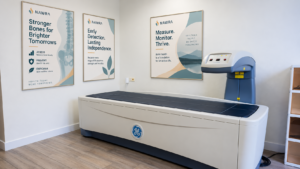
DexaFit Los Alamitos operates a clinical-grade DEXA scanner at 5122 Katella Ave., Suite 201, serving Orange County and the surrounding South Bay and Long Beach areas. Scans are read and reviewed with you in person — you leave with your numbers explained, not a PDF you have to decipher alone.
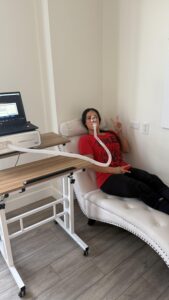
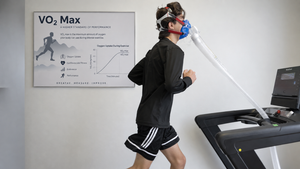
We also offer resting metabolic rate testing and VO₂ max testing, which pair naturally with body composition data. Together they answer three separate questions: what your body is made of, how much energy it uses at rest, and how efficiently it uses oxygen under load.
Frequently asked questions
How accurate is a DEXA scan?
DEXA is treated as a reference standard in body composition research, with a typical error range of roughly 1–2% for body fat percentage. Consistency matters as much as absolute accuracy — testing on the same machine under similar conditions gives the most reliable picture of change over time.
Is the radiation from a DEXA scan safe?
The dose from a body composition scan is very low, well below a standard chest X-ray and comparable to a small fraction of ordinary daily background radiation exposure. DEXA is not performed during pregnancy.
Do I need to fast before a DEXA scan?
Fasting is not required, but avoid a large meal or a hard workout immediately beforehand, and keep hydration normal rather than unusually high or low.
What should I wear?
Comfortable clothing with no metal — avoid zippers, underwire bras, metal buttons, and jewelry. Athletic wear is ideal.
What is a healthy body fat percentage?
Healthy ranges vary meaningfully by age and sex, and there is no single correct number. Your results are reviewed against reference ranges for your demographic, and the trend over time is generally more informative than any single reading.
Will insurance cover a body composition scan?
Body composition scans are typically not covered by insurance and are paid out of pocket. A diagnostic bone density scan ordered by a physician for osteoporosis screening is a different service and is often covered.
How is this different from the bone density scan my doctor ordered?
Both use DEXA technology, but a clinical bone density scan images specific sites — usually the hip and spine — to screen for osteoporosis. A body composition scan images the whole body and reports fat, lean mass, and visceral fat. A body composition scan is not a substitute for physician-ordered osteoporosis screening.
How long do results take?
Results are available immediately and reviewed with you during your appointment.
This article is for general educational purposes and is not medical advice. Body composition data should be interpreted alongside guidance from your physician, particularly if you have an existing medical condition or are taking medication that affects weight or metabolism.