
DEXA Body Composition Scan
Clinical-grade body composition in under ten minutes. The gold standard for understanding what your body is actually made of — and whether your protocol is working.
Free consultation
Tell us your goal — we’ll text you a baseline + re-scan plan and intro offer within one business day.
Why measure
A number on a bathroom scale tells you what you weigh. It cannot tell you whether the three pounds you lost were fat or the muscle you spent six months building.
DEXA is the clinically validated reference method for body composition. It separates bone, fat, and lean tissue, and it reports them region by region — left arm against right, trunk against limbs, and the visceral fat around your organs that you cannot see or pinch.
You can’t manage what you haven’t measured. This is the measurement.
What it measures
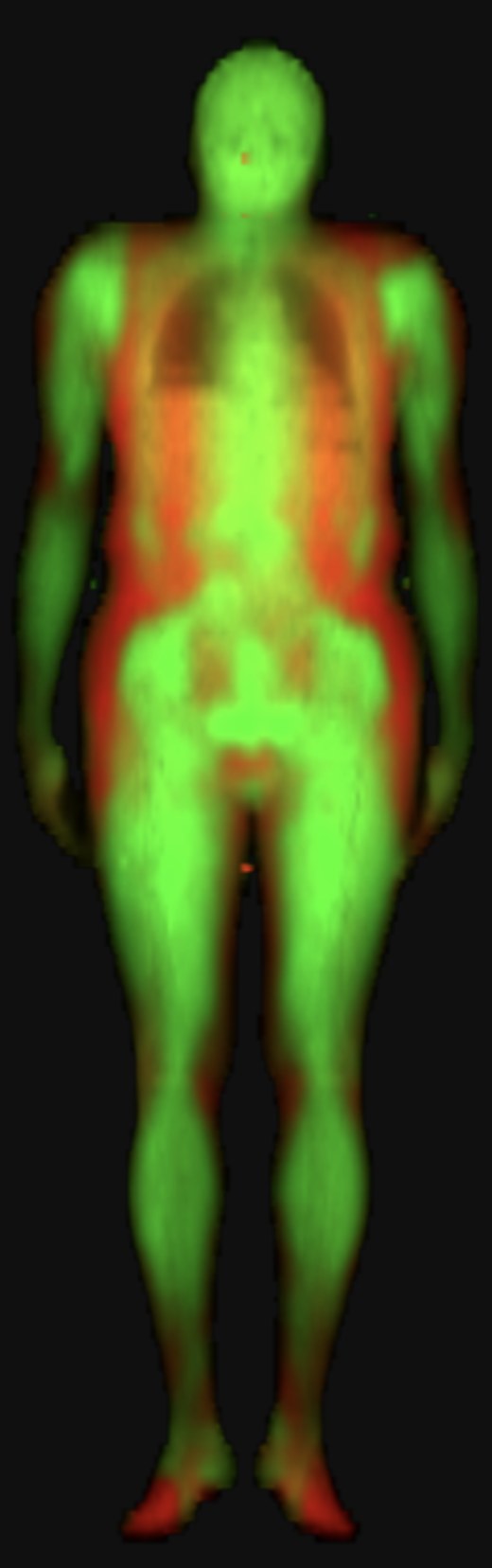
A real DEXA image: lean tissue reads green, fat mass reads red. Highlighted areas are indicative — your report gives exact figures for each region, in grams and as a percentage.
Bone - g/cm²
Bone strength across the spine, hips, and full body — the earliest measurable signal of osteopenia and osteoporosis risk, years before a fracture. Reported against age- and sex-matched reference ranges.
Fat - by region
Fat distribution mapped by region — android (trunk), gynoid (hips and thighs), arms, legs — rather than a single body-fat percentage. Two people at the same body fat can carry it in completely different places, and the difference matters.
Muscle - left / right
Lean tissue by region, including left-against-right symmetry. Asymmetry is what exposes the compensation patterns that quietly drive joint pain — and it’s invisible in any whole-body number.
Visceral - lb / g
The fat packed around your organs — metabolically the most consequential kind, and completely invisible from the outside. You can be lean by every other measure and still carry more of it than you’d want.
Your scan
Before you come
No fasting required. Wear comfortable clothes without zips, underwire, or metal fastenings, and leave jewellery at home — metal shows up on the scan and can affect the reading. Avoid a calcium supplement in the 24 hours beforehand.
On arrival
We’ll confirm height and weight and run through a brief screening form. It takes two minutes and it matters — see the section below on who shouldn’t be scanned.
The scan
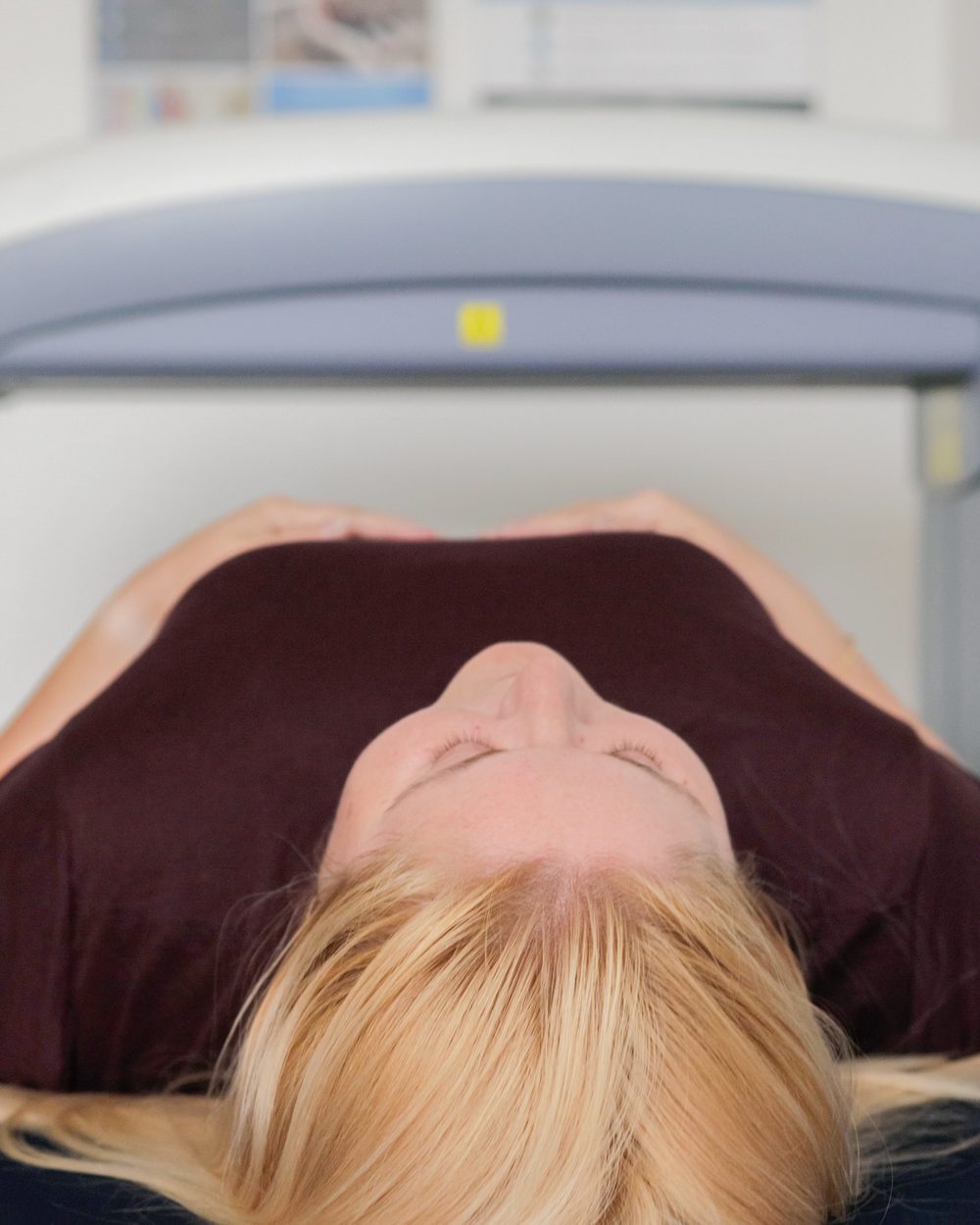
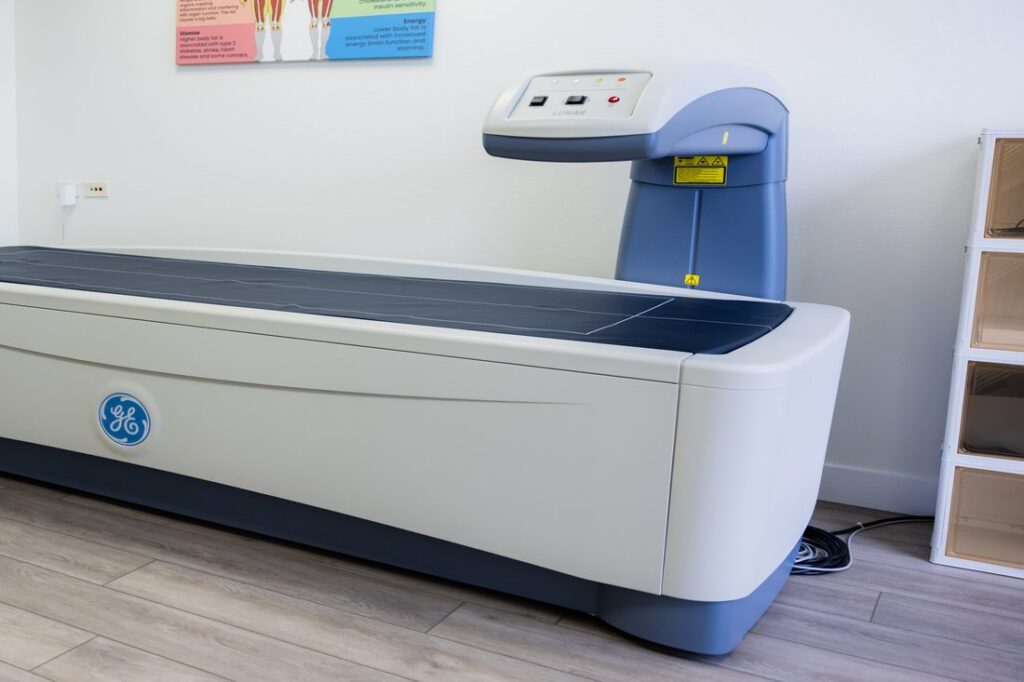
You lie on your back, fully clothed, while the scanning arm passes slowly over you. Nothing touches you, nothing is enclosed, and there’s no noise beyond a quiet motor. About ten minutes.
Your results
A consultant walks you through the report the same visit — what each number means, how it compares to reference ranges, and what would actually move it. You leave with the full report to keep or share with your physician.
Who it's for
Safety and screening
A DEXA scan uses a very low dose of X-ray, roughly comparable to a few hours of ordinary background radiation and far less than a chest X-ray. It is safe to repeat. Even so, it uses ionising radiation, and that means some people shouldn’t be scanned.
A note on claims
DEXA is the reference method for body composition, and it is genuinely precise. What it is not is a diagnosis, a health score, or a prediction about how long you’ll live. We won’t dress it up as any of those.
What it gives you is an accurate starting point and a way to check, twelve weeks later, whether what you changed actually changed anything. That’s a narrower promise than most of this industry makes. It also happens to be true.
Pricing & cadence
$120
One full-body scan, about 20 minutes including your results review. Report is yours to keep.
$220
Your first scan, plus a follow-up twelve weeks later on the same machine with the same operator — which is the only way a comparison actually means anything. A single scan is a photograph; two are a direction.
Pair your baseline with a 30-minute ExoPod recovery session. $269 separately — you save $40.
Common questions
The dose is very low — roughly equivalent to a few hours of ordinary background radiation, and far less than a chest X-ray. It’s safe to repeat several times a year. The one absolute exception is pregnancy: if you are or might be pregnant, we won’t scan you.
No fasting. Wear clothes without metal — no zips, underwire, or metal buttons — and leave jewellery off. Skip calcium supplements for 24 hours beforehand. If you’ve had contrast dye, barium, or a nuclear medicine scan in the past week, reschedule.
Twelve weeks is the usual interval — long enough for a real change in composition to show, short enough to correct course. For bone density, annually is typical unless your physician advises otherwise.
DEXA is the clinically validated reference standard for body composition, which is why research studies use it. Precision is best when conditions are consistent, so we scan at a similar time of day and in a similar hydration state each visit — that’s why the re-scan is booked on the same machine with the same operator.
Yes, and we’d encourage it. You get the full report to keep. A DEXA body composition scan is an assessment rather than a diagnosis, so anything it flags is a conversation to have with your physician.
Tell us when you book. Metal in the scan field changes the reading for that region — it doesn’t make the scan impossible, but we need to know so the report is interpreted properly.