“Fat reduction” doesn’t tell you whether a treatment focuses on fat, muscle, skin, or overall weight. That distinction matters when comparing radiofrequency fat reduction Orange County options, especially when treatment timelines and expected results are described differently. This guide explains how radiofrequency treatments vary, what they may be designed to address, and how to compare options against your goals without relying on broad claims.
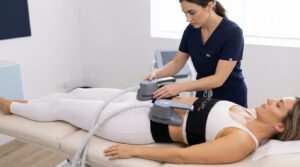
Radiofrequency energy creates heat in targeted tissue, but the intended effect depends on the device and treatment method. Some approaches focus on body contouring, while combination technologies may pair radiofrequency with muscle stimulation. Neither should be confused with general weight loss. At NAWRA in Los Alamitos, EMSCULPT NEO combines radiofrequency and HIFEM technology, while DEXA scans measure body composition. These services address different needs: one is for non-invasive sculpting and muscle stimulation, the other for measurement. Understanding the difference can help you set a clear goal and track relevant information.
Key Takeaways
- Radiofrequency fat reduction is intended for localized contouring, not overall weight loss. Define the change you want to address before comparing treatments.
- Different devices and protocols may have different goals and timelines. Compare the specific technology and intended use, not just the treatment label.
- When assessing radiofrequency fat reduction Orange County options, focus on the treatment’s target, realistic expectations, and how progress will be measured.
- Localized contouring, muscle stimulation, and recovery are distinct goals. Match the treatment category to your priority.
- NAWRA in Los Alamitos offers EMSCULPT NEO for non-invasive sculpting and muscle stimulation, alongside DEXA body-composition scans for measurement.
What Radiofrequency Fat Reduction in Orange County Is Designed to Address
Non-surgical radiofrequency fat reduction describes body-contouring approaches that use radiofrequency energy to heat targeted tissue, with the aim of changing the appearance of a selected area. It’s a treatment category, not one standardized procedure. Devices differ in how they deliver energy, which areas they’re intended to address, and the outcomes their protocols are designed to target. The term alone doesn’t tell you what a particular treatment does.
This distinction matters when researching radiofrequency fat reduction Orange County options. Localized contouring has a different purpose from overall weight change. It isn’t a substitute for weight management, and it shouldn’t be presented as a way to choose where the body loses fat. A specific area may remain a concern even when someone maintains healthy habits, but that doesn’t mean a device can guarantee a particular change.
What does localized fat reduction mean?
Localized body contouring describes an appearance-focused goal for a defined area, rather than a target number on the scale. For example, you might want to address the outline of one area while keeping broader health and fitness goals separate. Total body weight can stay similar even when appearance or body composition changes, and the reverse can also happen. Those measures answer different questions.
It’s also important to distinguish a treatment area from control over fat distribution. People can’t reliably direct where their bodies lose fat through a treatment choice. Individual responses vary, and a treatment intended for one area doesn’t promise a predictable change there or elsewhere. Before comparing options, clarify your priority: a local contour, overall weight, muscle definition, or another outcome. That goal helps determine which treatment information is relevant.
How is radiofrequency fat reduction described?
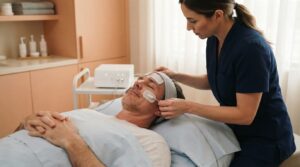
Radiofrequency is a form of energy used by some non-surgical body-contouring systems. Depending on the technology and intended use, a system may deliver energy to tissue to produce a controlled heating effect. The phrase “radiofrequency treatment” can therefore describe approaches with different designs and goals. An overview of Radio-frequency skin tightening provides broader context, but it doesn’t establish that every device reduces fat or produces the same result.
Evaluate claims at the device and protocol level. One system’s stated purpose or evidence doesn’t establish what the entire category can accomplish. Some treatments emphasize contouring, while others focus on skin appearance or combine radiofrequency with another modality. These claims aren’t interchangeable. Look for a clear explanation of what the specific approach is designed to address and how that goal will be assessed.
Set expectations accordingly. A treatment description can explain its intended use, but it can’t guarantee a universal outcome or timeline. Results depend on the technology, protocol, and individual factors. For a useful comparison, define your goal, distinguish appearance from weight change, and assess claims in relation to the specific treatment rather than the broad term “radiofrequency.”
How Radiofrequency Fat Reduction Works, and What Varies by Treatment
Radiofrequency body contouring uses radiofrequency energy delivered to a targeted area, with the device designed to create a controlled heating effect in tissue. That describes the broad technology, not a universal treatment method. Systems vary in how they deliver energy, which areas they’re intended to treat, and the outcomes their manufacturers describe.
What happens during a radiofrequency treatment?
The treatment method depends on the system. Some devices use an applicator placed against the skin; other designs and delivery methods may differ. The applicator, energy delivery, and area treated are specific to the device and shouldn’t be assumed across all radiofrequency approaches.
For the same reason, a general description can’t establish a particular sensation, appointment length, recovery experience, or number of sessions. Those details depend on the technology and its protocol. When comparing radiofrequency fat reduction Orange County options, identify the exact device and intended use, then assess the claims made for that system rather than treating them as universal.
Why do devices and treatment plans differ?
Radiofrequency systems vary in equipment design, energy delivery, and the body areas they’re intended to treat. A manufacturer’s instructions and protocol apply to that specific device; they don’t automatically establish how another system works or what results it may produce. Similar-sounding treatment descriptions can refer to different approaches.
Match each claim to the technology it describes. A statement about tissue heating, on its own, doesn’t prove a specific fat-reduction outcome. Nor does a claim about one device show that all radiofrequency systems affect fat, skin, or other tissue in the same way. Look for information that connects the stated outcome to the device and protocol being discussed.
When reading a treatment description, compare:
- The technology: how the system delivers radiofrequency energy.
- The intended use: the area and outcome the particular device is designed to address.
- The protocol: the treatment parameters and schedule specified for that system.
- The evidence: information supporting claims about outcomes, limitations, and safety.
This framework replaces broad labels with details you can evaluate. It also helps distinguish a device-specific protocol from a general explanation of radiofrequency. If a description moves from “uses radiofrequency” to promising a precise change, look for evidence supporting that claim for the named device and protocol. Energy delivery alone doesn’t guarantee a particular visible result.
For a locally grounded way to connect body-contouring goals with measurement, NAWRA offers EMSCULPT NEO and DEXA body-composition scans at its Los Alamitos clinic. Explore NAWRA’s body-contouring approach to learn about these distinct services.
Radiofrequency Fat Reduction vs. Other Goals: What Orange County Readers Should Compare
A treatment label can blur important differences. Localized contouring, muscle stimulation, and recovery are distinct goals, even when they appear in the same discussion. Before comparing radiofrequency fat reduction Orange County options, identify the outcome you want to assess. Understand each treatment according to its intended purpose, not a broad promise to “sculpt.”
| Goal | What it focuses on | What it doesn’t mean |
|---|---|---|
| Localized contouring | The appearance of a selected body area | Overall weight loss or control over where the body loses fat |
| Muscle stimulation | Muscle-focused stimulation or definition | The same mechanism or purpose as a radiofrequency-only system |
| Recovery | Support for recovery or physical comfort | Fat reduction or a body-contouring result |
Is fat reduction the same as muscle stimulation?
No. Targeted contouring and muscle stimulation describe different treatment goals. A system intended to address a localized contour shouldn’t automatically be described as strengthening or stimulating muscle. Likewise, muscle stimulation doesn’t mean a treatment is a weight-loss program.
NAWRA offers EMSCULPT NEO for non-invasive sculpting and muscle stimulation. It’s relevant for people whose goals include those areas, but it shouldn’t be treated as interchangeable with a radiofrequency-only system. Device-specific details and comparative outcome claims need to relate to the particular technology and protocol. Describe the service according to its stated goals rather than assuming that all systems use the same method or produce equivalent results.
Non-surgical contouring also isn’t a substitute for weight-loss care. If your priority is changing total body weight, consider that separately from an appearance-focused treatment for a defined area. A body-contouring service can relate to a specific goal, but it shouldn’t be framed as comprehensive weight management.
How should readers interpret treatment claims?
Timelines and outcome statements apply to the treatment they describe. A schedule or result promoted for one named device doesn’t establish what another device can do or what an individual will experience. Plans and outcomes can vary. When assessing a claim, ask: which technology is being discussed, what goal is it intended to address, and what evidence supports the stated outcome?
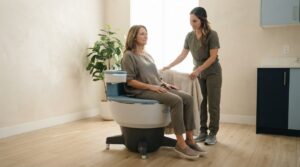
Recovery is a separate category, not another name for fat reduction or muscle stimulation. If your priority is recovery or physical comfort, explore recovery therapy options in Orange County as a distinct set of goals. Clear categories make comparisons more useful: define the outcome, match it to the modality, and keep expectations specific to the treatment. For a related explanation of how cold-based services differ from body-contouring methods, see ExoFreeze cryotherapy in Los Alamitos and the difference between cryotherapy and cryolipolysis.
How to Assess Radiofrequency Fat Reduction Options in Orange County
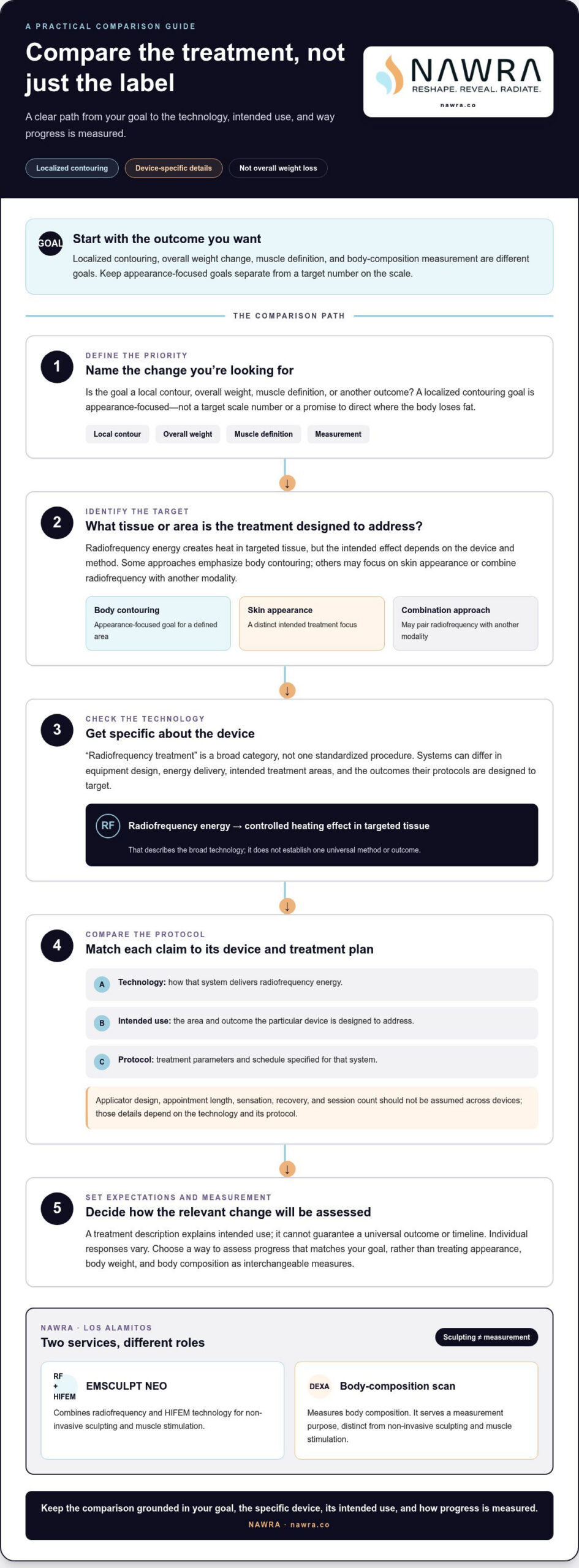
Use a goal-first process to compare treatment descriptions. For radiofrequency fat reduction Orange County options, separate what you want to change from how a device is promoted. Then decide how you’ll assess the goal. This keeps the decision grounded in your priorities rather than an impressive-sounding label or promised timeline.
- Define the goal. Decide whether you’re focused on the appearance of one area, muscle function, or broader body composition. Describe the change in practical terms, such as tracking a selected measurement or comparing photos taken consistently.
- Understand the modality. Identify the technology and its intended use. Similar treatment language doesn’t mean two approaches use the same method or address the same tissue.
- Review the claim. Look for a clear connection between the named treatment, the stated outcome, and the evidence supporting it. Treat timelines and expected results as specific to that device and protocol.
- Plan measurement. Decide what you’ll track and use the same method consistently. Scale readings, photographs, and body-composition information measure different things.
Which questions help clarify your goal?
Ask yourself: Is my priority a specific area, muscle function, or a broader understanding of body composition? What observable change would matter to me, and how can I describe it without relying on a vague promise to “sculpt”? Keep aesthetic goals separate from medical or weight-management concerns. If your main objective is total weight change, don’t treat localized contouring as a replacement for weight-management care.
Next, match the goal to the treatment description. A service presented for muscle stimulation isn’t automatically equivalent to a radiofrequency-focused approach. And a result claim for one device shouldn’t be assumed to apply to another. Clear definitions make comparisons more useful.
How can progress be measured more thoughtfully?
Choose a baseline and repeat the same measures under consistent conditions. Depending on your goal, you might use photographs taken from similar angles, a selected body measurement, or scale readings. Don’t treat one measure as a complete picture: the scale alone doesn’t explain body composition, while photographs show appearance rather than a clinical measurement.
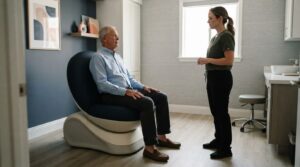
NAWRA offers DEXA body-composition scans in Los Alamitos. A DEXA scan provides body-composition information that can complement visual or scale-based tracking; it doesn’t predict or guarantee a treatment outcome. If you’re considering this measurement approach, learn about a DEXA scan in Los Alamitos.
For nearby Orange County communities, NAWRA’s Los Alamitos clinic brings precision wellness and body-contouring services together. Define what matters, choose measures that fit your goal, and interpret progress in context. Explore NAWRA’s data-oriented approach to body contouring to learn more.
Exploring Body Contouring at NAWRA in Los Alamitos
For Orange County readers comparing body-contouring approaches, connect the goal with a clear way to understand progress. NAWRA is a precision wellness and body-contouring clinic in Los Alamitos, serving nearby communities. Its services include EMSCULPT NEO, a non-invasive sculpting and muscle-stimulation service, and DEXA body-composition scans. They serve different roles: one is a body-contouring service, while the other provides measurement.
This distinction keeps the comparison practical. A scan is a measurement service, not a treatment prerequisite or a prediction of treatment results. It provides body-composition information that can complement visual or scale-based tracking. To use measurement meaningfully, understand what it describes and interpret it in relation to your goal.
How does NAWRA connect body contouring and measurement?
NAWRA brings body-contouring goals and measurement together in a data-oriented wellness setting without treating them as interchangeable. EMSCULPT NEO is the clinic’s non-invasive sculpting and muscle-stimulation service. DEXA is a separate measurement service that provides body-composition information. Each has a distinct purpose, and neither guarantees a particular outcome from the other.
For someone considering radiofrequency fat reduction Orange County treatments, this distinction helps clarify whether the priority is a contouring service, a measurement of body composition, or both as separate parts of a broader wellness plan. Measurement can add context, but it can’t replace a clearly defined goal or establish what results an individual will experience.
What is a practical next step for local readers?
Start by writing down what you want to understand or change. Are you exploring non-invasive sculpting and muscle stimulation, or looking for a clearer picture of body composition? Review the service information with that goal in mind. This makes it easier to distinguish a treatment description from a measurement tool and focus on the information that matters to you.
Keep expectations tied to each service’s stated purpose. A body-composition scan provides data, but it doesn’t prescribe a treatment or promise a result. A body-contouring service can relate to a defined goal, but it isn’t a general weight-loss plan. Clear goals and categories support more informed decisions.
- For a sculpting or muscle-stimulation goal: Review EMSCULPT NEO’s service information.
- For body-composition measurement: Learn what a DEXA scan measures and how that information may complement other tracking.
- For either goal: Keep the desired outcome realistic and specific to the service being considered.
NAWRA’s Los Alamitos location serves readers in nearby Orange County communities, including Los Alamitos, Cypress, Cerritos, Long Beach, Seal Beach, La Palma, Buena Park, Lakewood, Anaheim, Norwalk, Irvine, Laguna Niguel, Newport Beach, Huntington Beach, Bellflower, Tustin, Fullerton, and Yorba Linda. Explore NAWRA’s body-contouring services to see which goal you’d like to clarify first.
Make Your Next Step Specific
A useful decision starts with a clear personal goal, not a treatment label. Write down the change you’re considering, what would count as meaningful progress, and what information you want before deciding. This keeps research focused and makes it easier to separate promotional language from details relevant to your priorities.
If you’re exploring radiofrequency fat reduction Orange County options, tie your expectations to the specific technology and its stated purpose. You don’t need to commit to a treatment to take a next step. Review your goals alongside NAWRA’s body-contouring and measurement services, then decide what information will help you move forward.
Explore NAWRA’s body-contouring services and identify the goal you want to clarify first.
Frequently Asked Questions
Is radiofrequency fat reduction a weight-loss treatment?
No. It’s generally described as a body-contouring approach, not a treatment for overall weight loss. Someone focused on a specific clothing fit or body outline has a different goal from someone working toward a change in total body weight. Decide which outcome matters before comparing options. If weight management is the priority, consider it separately rather than expecting a contouring service to replace a broader plan.
Can radiofrequency fat reduction target a specific body area?
Some systems are designed to treat selected areas, but that doesn’t mean they can control where your body loses fat or guarantee a particular change. Identify the area and the observable difference you’re hoping for, such as a change in how a garment fits. Then compare that goal with the specific device’s stated intended use. A broad “targeted” claim alone doesn’t establish what result an individual can expect.
How long does it take to notice changes after radiofrequency fat reduction?
There isn’t one timeline that applies to every radiofrequency system or person. The device, protocol, and individual response can all matter, so a timeline promoted for one treatment shouldn’t be transferred to another. Before making plans around an expected date, identify which device the claim refers to and how progress is assessed. Track changes consistently rather than relying on a single early observation or a promised schedule.
Is radiofrequency fat reduction the same as muscle stimulation?
No. The terms describe different treatment goals, and one shouldn’t be assumed to deliver the purpose of the other. NAWRA offers EMSCULPT NEO for non-invasive sculpting and muscle stimulation. That service is distinct from a radiofrequency-only approach. If muscle stimulation is your priority, make that clear when reviewing treatment information. If your goal is a localized appearance change, evaluate claims tied to that purpose instead.
Can radiofrequency body contouring replace exercise or nutrition changes?
No. Body contouring shouldn’t be treated as a substitute for exercise, nutrition habits, or medical weight-management care. These address different needs. Someone may value a non-invasive sculpting service while continuing an established fitness routine, but that doesn’t make the service a replacement for the routine. Keep health goals and appearance-focused goals distinct, and use measures that reflect each one rather than expecting one intervention to address everything.
What should I consider before exploring non-surgical fat reduction in Orange County?
Define your goal, identify the treatment being described, and look for information tied to that device rather than relying on a general category label. Consider how you’ll assess progress and whether the stated purpose matches your priorities. NAWRA is located in Los Alamitos and serves nearby communities, including Cypress, Cerritos, Long Beach, Seal Beach, La Palma, Buena Park, Lakewood, Anaheim, Norwalk, Irvine, Laguna Niguel, Newport Beach, Huntington Beach, Bellflower, Tustin, Fullerton, and Yorba Linda.
Can body-composition testing track changes beyond body weight?
Yes. Body-composition testing can provide information that a scale’s total-weight reading doesn’t show on its own. NAWRA offers DEXA body-composition scans at its Los Alamitos clinic. The scan provides measurement information, not a guarantee that a treatment will produce a particular result. If you’re tracking progress, decide what question you want the measurement to answer and consider it alongside consistent photos or other relevant measures.